
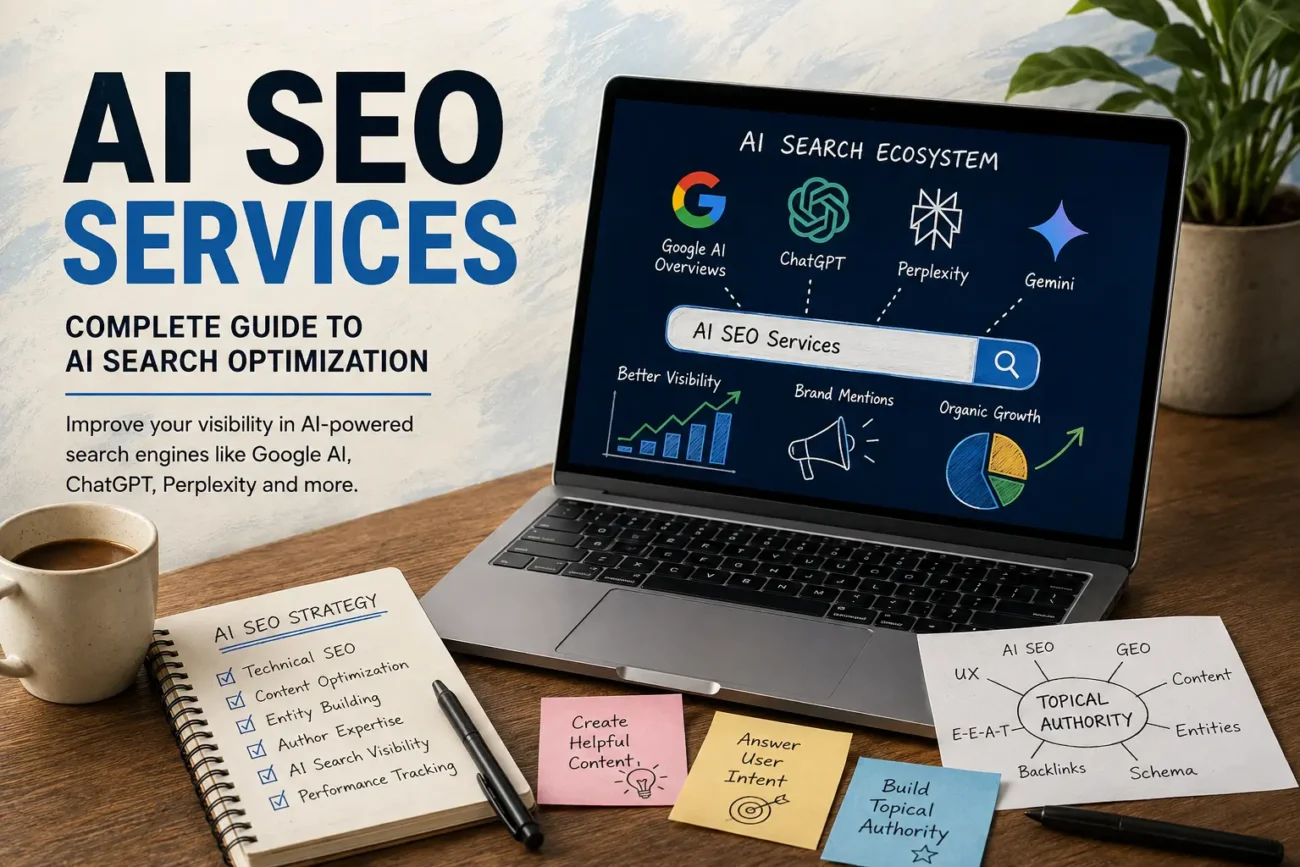
AI SEO services help businesses improve how their websites, brands, products, and expertise are discovered across traditional search engines and AI-powered search experiences.
Search is changing.
People still use traditional Google searches, but they are also increasingly using conversational interfaces and generative search experiences to research products, compare businesses, understand complex topics, and find recommendations.
Google now offers AI Overviews and AI Mode, while platforms such as ChatGPT and Perplexity can provide answers that include links to web sources.
This creates a new question for businesses:
How do you make your website useful and discoverable in a search environment where users may receive an AI-generated answer instead of a traditional list of links?
The answer is not a secret “AI ranking hack.”
A sustainable AI SEO strategy starts with strong technical SEO, useful content, clear entities, relevant expertise, authoritative information, and a website that search systems can discover and understand.
Google’s current guidance confirms that the fundamentals of SEO continue to apply to its AI search experiences. Pages still need to meet the normal technical requirements for Google Search to be eligible as supporting links in AI Overviews and AI Mode.
This guide explains what AI SEO services are, how AI search optimization works, what a professional AI SEO strategy should include, how to optimize a website for AI-powered search, and how to evaluate an AI SEO provider.
What Are AI SEO Services?
AI SEO services are search optimization services designed to improve a website’s visibility, discoverability, relevance, and representation across traditional search and AI-powered search experiences.
AI SEO combines established SEO principles with strategies that help search systems better understand:
- What a business does
- Which topics a website covers
- Who the experts are
- Which products or services are offered
- How different entities relate to one another
- Which pages answer specific questions
- What information is supported by evidence
- Why a source is relevant to a particular search
Depending on the business, an AI SEO engagement may include:
- Technical SEO
- Search-intent research
- Keyword research
- Topic clustering
- Semantic SEO
- Entity optimization
- Content optimization
- Internal linking
- Structured data
- Author and organization information
- Topical authority development
- Digital PR
- Original research
- AI-search visibility monitoring
- Conversion optimization
The important distinction is:
AI SEO does not replace traditional SEO. It builds on it.
Google says the same foundational SEO best practices that apply to normal Search remain relevant to AI Overviews and AI Mode. There are no additional technical requirements or special AI-specific schema types required for inclusion.
Why AI SEO Matters
Traditional search often begins with a short query.
For example:
best CRM for small business
An AI-powered search experience may receive a much more detailed question:
What is the best CRM for a five-person consulting company, and what are the advantages, disadvantages, pricing differences, and implementation challenges?
That single question contains multiple information needs.
The system may need to understand:
- The user’s business size
- Their industry
- The product category
- Their requirements
- Different alternatives
- Advantages and disadvantages
- Pricing
- Recommendations
Google explains that AI Mode and AI Overviews can use multiple related searches and sources to develop answers, a process Google describes as “query fan-out.”
This creates opportunities for websites that provide specific, useful information across related subtopics.
Instead of optimizing only for:
“CRM software”
a strong website may also answer:
- Best CRM for consultants
- CRM for five-person teams
- CRM implementation guide
- CRM comparison
- CRM pricing
- CRM integrations
- CRM alternatives
- CRM onboarding
The same principle applies to AI SEO.
Is AI SEO Different From Traditional SEO?
Yes, but not in the way many agencies suggest.
AI SEO and traditional SEO share the same foundation.
Technical accessibility, search intent, useful content, internal linking, relevance, authority, and a good user experience remain important.
The difference is that AI-powered search can present information differently from a traditional results page.
| Traditional SEO | AI Search Optimization |
|---|---|
| Focuses heavily on organic rankings | Considers visibility within AI-generated search experiences |
| Targets keywords and search intent | Targets search intent, questions, topics, and entities |
| Measures rankings, impressions and clicks | Can also monitor mentions, citations and AI visibility where measurable |
| Optimizes pages for search results | Optimizes information for discovery and interpretation |
| Builds topical authority | Builds topical and entity authority |
| Uses internal and external links | Uses internal structure and relevant external authority |
| Focuses on SERPs | Considers SERPs and AI-powered search interfaces |
The two strategies should therefore work together.
Strong SEO is the foundation of strong AI-search visibility.
What Do AI SEO Services Include?
There is no universal AI SEO package.
A useful strategy depends on:
- Website size
- Industry
- Competition
- Search demand
- Existing authority
- Technical condition
- Content quality
- Target market
- Business model
- Conversion goals
However, a serious AI SEO program can be organized into the following areas.
1. Technical SEO
Technical SEO comes first.
If search engines cannot reliably crawl, understand, or index your website, content optimization will have limited impact.
A technical AI SEO audit should review:
- Crawlability
- Indexability
- Robots.txt
- XML sitemaps
- Canonical URLs
- Redirects
- HTTP status codes
- Internal links
- JavaScript rendering
- Duplicate content
- Mobile usability
- Page experience
- Site architecture
- Structured data
Google’s guidance for AI features specifically recommends maintaining normal SEO fundamentals, including allowing crawling, making content discoverable through internal links, providing important content in textual form, and ensuring structured data matches visible page content.
Practical implementation
Start with:
Google Search Console → Indexing → Pages
Look for:
- Not indexed URLs
- Crawled but currently not indexed pages
- Duplicate URLs
- Redirect problems
- Server errors
Then review:
robots.txt
XML sitemap
canonical tags
internal linking
mobile usability
page experience
Technical SEO is not an “AI trick.”
It is the foundation that allows search systems to access the information you publish.
2. Search Intent Research
Keyword research tells you what people search for.
Search-intent research asks:
Why are they searching?
For example, someone searching:
AI SEO services
could be looking for:
Information
- What is AI SEO?
- How does AI SEO work?
- What is GEO?
- What is AI search optimization?
Commercial investigation
- What do AI SEO services include?
- How much does AI SEO cost?
- What does an AI SEO agency do?
- Should I hire an AI SEO consultant?
Practical information
- How do I optimize my website for AI search?
- How can my website appear in AI search?
- How do I improve AI search visibility?
A strong AI SEO strategy maps these intents and creates content that genuinely satisfies them.
3. Topic Clustering
Instead of creating dozens of disconnected articles, build logical topic clusters.
For example:
AI SEO
AI SEO Services
↓
What Is AI SEO?
↓
AI Search Optimization
↓
AI SEO Strategy
↓
AI SEO Tools
↓
AI SEO Case Studies
↓
AI Search Visibility
Then create another cluster around GEO:
GEO
What Is GEO?
↓
GEO Strategy
↓
GEO vs SEO
↓
Generative Engine Optimization Services
↓
AI Citation Optimization
↓
GEO Case Studies
Connect related pages using contextual internal links.
This creates a more useful resource for readers and a clearer topical structure for search engines.
4. Semantic SEO
Semantic SEO focuses on relationships between concepts instead of repeating an exact keyword.
For an AI SEO website, relevant concepts may include:
- AI SEO
- Search engine optimization
- AI search
- Generative Engine Optimization
- Answer Engine Optimization
- Search intent
- Semantic search
- Entities
- Topical authority
- Structured data
- Internal linking
- Digital PR
- Brand mentions
- Google AI Overviews
- AI Mode
- ChatGPT Search
- Perplexity
- Content quality
But there is an important rule:
Do not add related terms simply because an SEO tool tells you to.
Add a concept when it improves the reader’s understanding.
That produces a better page than artificial keyword expansion.
5. Entity SEO
Keywords describe what people search for.
Entities help search systems understand what or who something is.
For a company, an entity-based approach can connect:
Organization → Brand → People → Services → Products → Industry → Location → Expertise → Publications
For example, an AI SEO company should make it clear:
- Who operates the business
- What the company does
- Which services it offers
- Which industries it serves
- Who writes its content
- What experience the authors have
- Which claims can be independently verified
Useful entity signals can include:
- About page
- Author pages
- Organization information
- Consistent business information
- Professional profiles
- Case studies
- Original research
- Relevant third-party mentions
- Accurate structured data
The goal isn’t to manipulate an AI model.
The goal is to make the business understandable and verifiable.
6. Content Optimization for AI Search
One of the biggest mistakes in AI SEO is writing for machines instead of people.
Don’t do that.
A strong AI-search-friendly page should also be a genuinely good human resource.
Answer important questions early
Don’t force readers to scroll through 1,500 words before finding the answer.
Use descriptive headings
A reader should understand the page simply by scanning its headings.
Define specialist terminology
For example:
Generative Engine Optimization (GEO) generally refers to strategies designed to improve the visibility or representation of information within generative AI search experiences.
Use examples
Examples turn abstract concepts into practical information.
Make claims precise
Avoid:
“AI SEO will completely transform your business.”
Prefer:
“AI SEO focuses on improving how search systems discover, interpret, and represent a website’s information.”
Cite important claims
When information comes from official documentation, research, or other authoritative sources, identify the source.
Update information when it changes
AI search products and their capabilities evolve quickly.
7. Structured Data
Structured data can help communicate information about pages and entities in a machine-readable format.
Depending on the page, relevant schema types can include:
- Organization
- Person
- Article
- WebPage
- WebSite
- BreadcrumbList
- Product
- LocalBusiness
However, structured data is frequently misunderstood in AI SEO.
Schema does not guarantee AI visibility.
Google explicitly says there is no special AI-specific structured-data markup required for AI Overviews or AI Mode. Structured data should accurately describe visible page content and follow Google’s normal guidelines.
So avoid claims such as:
“Add our secret AI schema and Google will show you in AI Overviews.”
There is no reliable shortcut like that.
8. Author and Expertise Signals
A strong website should make it obvious:
Who created this content?
What experience do they have?
Why should the reader trust them?
Google’s people-first content guidance recommends clear authorship and background information about content creators. It also encourages creators to demonstrate first-hand expertise and depth of knowledge where relevant.
An author page can include:
- Full name
- Professional background
- Areas of expertise
- Relevant experience
- Published work
- Case studies
- Professional profiles
- Original research
- Contact information
For AISEOServices.company, every important article should have a clear author identity rather than appearing to come from an anonymous content team.
9. First-Hand Experience
This is one area where AI SEO websites can differentiate themselves.
Don’t only explain what other websites already explain.
Document what you actually observe.
For example:
AI Search Experiments
Test a defined set of queries and document the results.
Website Audits
Publish anonymized findings from real SEO audits.
Search Visibility Studies
Compare how brands appear across different search experiences.
Content Experiments
Document how different content structures perform.
Case Studies
Show:
Problem → Strategy → Implementation → Measurement → Outcome
Do not manufacture results.
If you have not run the experiment, don’t write:
“Our study found…”
Instead write:
“We plan to study…”
or conduct the study first.
This distinction is critical for credibility.
Google specifically encourages original research, analysis, and first-hand expertise rather than simply rewriting what already exists.
10. Original Research: The Long-Term Advantage
One of the strongest ways for AISEOServices.company to become an authority is to publish original datasets.
For example:
AI Search Visibility Study 2026
Create a defined methodology.
Step 1
Choose a set of commercial and informational queries.
Step 2
Run those queries across selected search experiences.
Step 3
Record:
- Brands mentioned
- Sources cited
- Pages referenced
- Query type
- Industry
- Search experience
- Date tested
Step 4
Publish the methodology.
Step 5
Publish the results.
Step 6
Update the dataset periodically.
This creates something other websites can reference.
And that is much more valuable than publishing another generic article titled:
“What is AI SEO?”
Important:
Do not invent the data.
Your first-party research should be based on actual observations, clearly documented methodology, and transparent limitations.
11. Digital PR and Relevant Authority
AI SEO should not become a synonym for “build more backlinks.”
Relevant third-party recognition can be useful, but the objective should be genuine authority.
Potential sources include:
- Industry publications
- Expert interviews
- Podcasts
- Research citations
- Professional communities
- Industry associations
- Relevant contributor articles
- Original studies
- Data-driven reports
The ideal situation is:
You publish something genuinely useful → people discover it → they reference it → relevant sites link to it → your reputation grows.
Not:
Publish hundreds of low-quality guest posts → acquire artificial links → hope rankings increase.
Google’s current guidance emphasizes original, valuable content and warns against content created primarily to manipulate rankings.
12. AI Search Crawler Accessibility
AI platforms have their own crawling and search systems.
That means website accessibility matters.
For example, Perplexity states that its PerplexityBot follows robots.txt. If a website blocks the crawler, Perplexity says it won’t index the full or partial text content of the site, although it may still index the domain, headline, and a brief factual summary.
The practical lesson is simple:
Review your robots.txt before trying to build AI-search visibility.
Don’t accidentally block the systems you want to discover your content.
But remember:
Crawler access ≠ citation guarantee.
Allowing a crawler to access your page does not mean an AI platform must mention your business.
13. AI Search Visibility Monitoring
Traditional SEO provides familiar metrics:
- Impressions
- Clicks
- CTR
- Rankings
- Organic traffic
- Conversions
AI search introduces additional questions:
- Is the brand mentioned?
- Which queries produce mentions?
- Which pages are referenced?
- Which competitors appear?
- Is the brand information accurate?
- Which external sources are repeatedly used?
- Is visibility increasing or decreasing?
These measurements need to be treated carefully.
AI responses can vary according to:
- Query wording
- Search engine
- User context
- Location
- Model
- Available sources
- Freshness
- Retrieval results
There is therefore no universal “AI ranking position.”
Google has also introduced dedicated Search Console reporting for visibility from generative AI features, including AI Overviews and AI Mode, with the new reporting being rolled out to a subset of sites.
How to Optimize a Website for AI Search
Use this practical framework.
Content
☐ Answer the main question clearly
☐ Match search intent
☐ Use descriptive headings
☐ Define important concepts
☐ Include useful examples
☐ Add original analysis
☐ Support important claims
☐ Identify the author
☐ Link to relevant sources
☐ Keep information current
Technical SEO
☐ Website is crawlable
☐ Important pages are indexable
☐ XML sitemap is configured
☐ Robots.txt is reviewed
☐ Canonical URLs are correct
☐ Internal linking is logical
☐ Important information exists as text
☐ Mobile experience works
☐ Major technical errors are fixed
☐ Structured data is accurate
Google recommends these same foundational SEO practices for its AI search experiences.
How to Improve Visibility in Google AI Overviews and AI Mode
There is no separate “AI Overview SEO” system that replaces Google SEO.
Google says that pages must be indexed and eligible to appear in normal Google Search to be eligible as supporting links in AI Overviews and AI Mode. It also states that meeting the requirements does not guarantee crawling, indexing, or serving.
The practical strategy is therefore:
- Build a technically accessible website.
- Create useful content.
- Satisfy search intent.
- Build topical depth.
- Make information easy to understand.
- Demonstrate expertise.
- Build relevant authority.
- Create original information.
- Monitor performance.
- Improve continuously.
Google also says AI features can surface a wider and more diverse set of supporting links, creating opportunities for different types of websites to appear.
How to Improve Discoverability in ChatGPT Search
ChatGPT Search can provide answers that include links to web sources.
There is no guaranteed method for obtaining a particular position or citation.
The practical approach is to make your website:
- Publicly accessible
- Crawlable
- Useful
- Topically relevant
- Clearly authored
- Technically sound
- Supported by credible information
For websites that want to appear in ChatGPT Search, review your crawler settings and ensure you have not unintentionally prevented relevant search crawling.
Again:
Being crawlable does not guarantee being cited.
How to Improve Visibility in Perplexity
Perplexity describes its system as a search experience that retrieves web information and provides answers with citations.
Its current documentation states that PerplexityBot respects robots.txt.
Therefore:
- Review robots.txt.
- Ensure important pages aren’t unnecessarily blocked.
- Keep content accessible.
- Publish useful information.
- Build topical authority.
- Earn relevant external recognition.
- Monitor citations and referrals where possible.
The goal is not to “optimize for Perplexity” with a secret keyword formula.
The goal is to create information worth retrieving.
AI SEO for ChatGPT, Google and Other AI Search Platforms
Trying to create a completely different SEO strategy for every AI platform is inefficient.
Instead, build the common foundation:
Relevance
The content answers the user’s question.
Clarity
The information is easy to understand.
Depth
The topic is covered sufficiently.
Experience
The author has relevant first-hand knowledge where appropriate.
Evidence
Claims can be verified.
Originality
The page contributes something new or useful.
Accessibility
Search systems can access the information.
Authority
Relevant sources recognize the website and its expertise.
This approach is more durable than chasing platform-specific tricks.
A Practical AI SEO Framework
A complete AI SEO strategy can be organized into nine stages.
Stage 1: Technical Foundation
Make the website accessible, indexable, and easy to navigate.
↓
Stage 2: Search Intent
Understand what users actually want to accomplish.
↓
Stage 3: Topic Architecture
Build connected topic clusters rather than isolated articles.
↓
Stage 4: Content
Create useful, original, comprehensive information.
↓
Stage 5: Entities
Clearly define brands, organizations, authors, products, services, and relationships.
↓
Stage 6: Authority
Earn relevant recognition through useful content, research, PR, and legitimate relationships.
↓
Stage 7: AI Visibility
Monitor relevant queries, mentions, citations, and referral traffic where measurable.
↓
Stage 8: Conversion
Turn qualified visibility into enquiries, leads, subscribers, or customers.
↓
Stage 9: Continuous Improvement
Use real performance data to improve the strategy.
What AI SEO Services Should NOT Promise
Be careful with agencies that make guarantees such as:
“We guarantee ChatGPT will recommend your company.”
“We guarantee Google AI Overview placement.”
“We can force AI models to cite your website.”
“Our secret schema guarantees AI visibility.”
“You will rank across every AI platform in 30 days.”
These promises should be treated skeptically.
Search and AI systems are dynamic.
Google explicitly states that satisfying requirements and following best practices does not guarantee that a page will be crawled, indexed, or served in AI features.
The right provider should therefore guarantee deliverables and methodology, not uncontrollable search outcomes.
AI SEO vs GEO vs AEO
These terms are often used interchangeably, but they can describe slightly different areas.
AI SEO
A broad term for SEO strategies designed for a search environment increasingly influenced by AI.
GEO
Generative Engine Optimization generally refers to strategies intended to improve visibility or representation within generative AI experiences.
AEO
Answer Engine Optimization is commonly used for strategies focused on direct-answer and answer-oriented search experiences.
There is significant overlap between all three.
The terminology matters less than the underlying objective:
Make valuable information discoverable, understandable, trustworthy, and useful.
How Much Do AI SEO Services Cost?
There is no universal price for AI SEO services.
Pricing can depend on:
- Website size
- Industry
- Competition
- Target countries
- Technical complexity
- Existing authority
- Content requirements
- Research requirements
- Digital PR
- Reporting requirements
- Ongoing optimization
A small local business and an international SaaS company may require completely different strategies.
When comparing providers, don’t ask only:
How much does AI SEO cost?
Also ask:
What exactly will you do, what will you measure, and how will you demonstrate progress?
How to Choose an AI SEO Services Provider
Before hiring an AI SEO consultant or agency, ask these questions.
1. What exactly is included?
Ask for a specific scope of work.
2. Do you handle technical SEO?
AI search optimization shouldn’t be separated from technical SEO.
3. How do you measure AI visibility?
Ask which queries, platforms, sources, and metrics are being monitored.
4. Can you show case studies?
Look for methodology and context rather than unexplained screenshots.
5. How is content produced?
Ask who researches, writes, edits, and verifies the content.
6. How do you build authority?
Be cautious about providers promising huge volumes of automated links or artificial mentions.
7. What happens after implementation?
A strong program should have an ongoing testing and improvement process.
AI SEO Services Checklist
Use this checklist when auditing your website or evaluating an AI SEO provider.
Strategy
☐ Business goals defined
☐ Target audience defined
☐ Search intent mapped
☐ Competitors analyzed
☐ Topic clusters identified
Technical SEO
☐ Website crawlable
☐ Important pages indexable
☐ XML sitemap configured
☐ Robots.txt reviewed
☐ Canonicals checked
☐ Internal links improved
☐ Mobile experience checked
Content
☐ Original content
☐ Clear answers
☐ Search intent satisfied
☐ Strong headings
☐ Helpful examples
☐ Author identified
☐ Relevant sources cited
☐ Content reviewed and updated
Entity & Authority
☐ Author page
☐ About page
☐ Organization information
☐ Consistent brand information
☐ Relevant external mentions
☐ Case studies
☐ Original research
AI Search
☐ Relevant AI-search queries identified
☐ Brand mentions monitored
☐ Citations monitored where measurable
☐ Competitor visibility monitored
☐ AI crawler access reviewed
☐ Referral traffic monitored
Frequently Asked Questions About AI SEO Services
What are AI SEO services?
AI SEO services are search optimization services designed to improve a website’s visibility, discoverability, relevance, and representation across traditional search engines and AI-powered search experiences.
Is AI SEO the same as GEO?
No. GEO generally focuses on generative AI search experiences, while AI SEO is a broader term that can include traditional SEO plus optimization for an AI-influenced search environment.
Does traditional SEO still matter for AI search?
Yes. Google states that its established SEO best practices continue to apply to AI Overviews and AI Mode.
Can AI SEO guarantee ChatGPT citations?
No. There is no reliable way to guarantee that an AI system will cite a particular website for a particular query.
Can AI SEO guarantee Google AI Overview placement?
No. Google states that following its requirements and best practices does not guarantee that a page will be shown in AI features.
Does structured data guarantee AI visibility?
No. Google states that there is no special AI-specific structured-data requirement for AI Overviews or AI Mode.
Does AI-generated content rank?
The use of AI is not itself the deciding factor. Google’s guidance focuses on whether content is useful, original, reliable, and created primarily for people. Google also warns against using automation to produce content primarily to manipulate rankings.
How long does AI SEO take?
There is no universal timeline. Results depend on technical health, authority, competition, content quality, search demand, implementation, and many other factors.
Do backlinks matter for AI SEO?
Relevant links and third-party recognition can contribute to overall authority, but AI SEO should not be reduced to link acquisition. The priority should be useful content and legitimate recognition.
How do I start AI SEO?
Start with technical SEO, search-intent research, topic architecture, content quality, internal linking, entity clarity, author information, and authority building. Then develop original research and monitor both traditional and AI-search visibility.
The Future of AI SEO
AI search is still evolving.
Search interfaces, retrieval systems, ranking systems, and user behavior will continue to change.
That makes short-term tactics fragile.
A more durable strategy is to build assets that remain useful regardless of which interface a user chooses.
Those assets include:
- Original research
- Expert analysis
- First-hand experience
- Strong technical foundations
- Comprehensive topic coverage
- Clear entities
- Author transparency
- Useful data
- Case studies
- Trustworthy external references
The future of AI SEO is therefore less about finding a secret ranking factor and more about becoming a trusted source of information.
Final Takeaway
AI SEO is not a replacement for traditional SEO.
It is a broader search strategy for an environment where people can discover information through traditional results, AI-generated answers, conversational search, recommendations, and multiple connected sources.
The strongest approach is simple:
Make your website technically accessible.
Answer real questions.
Demonstrate genuine expertise.
Make entities and relationships clear.
Create original information.
Earn relevant authority.
Monitor what happens.
Improve based on evidence.
Don’t build a website that tries to convince AI systems that it is authoritative.
Build a website that actually becomes authoritative.
That is the foundation of sustainable AI SEO.
