
Quick Answer
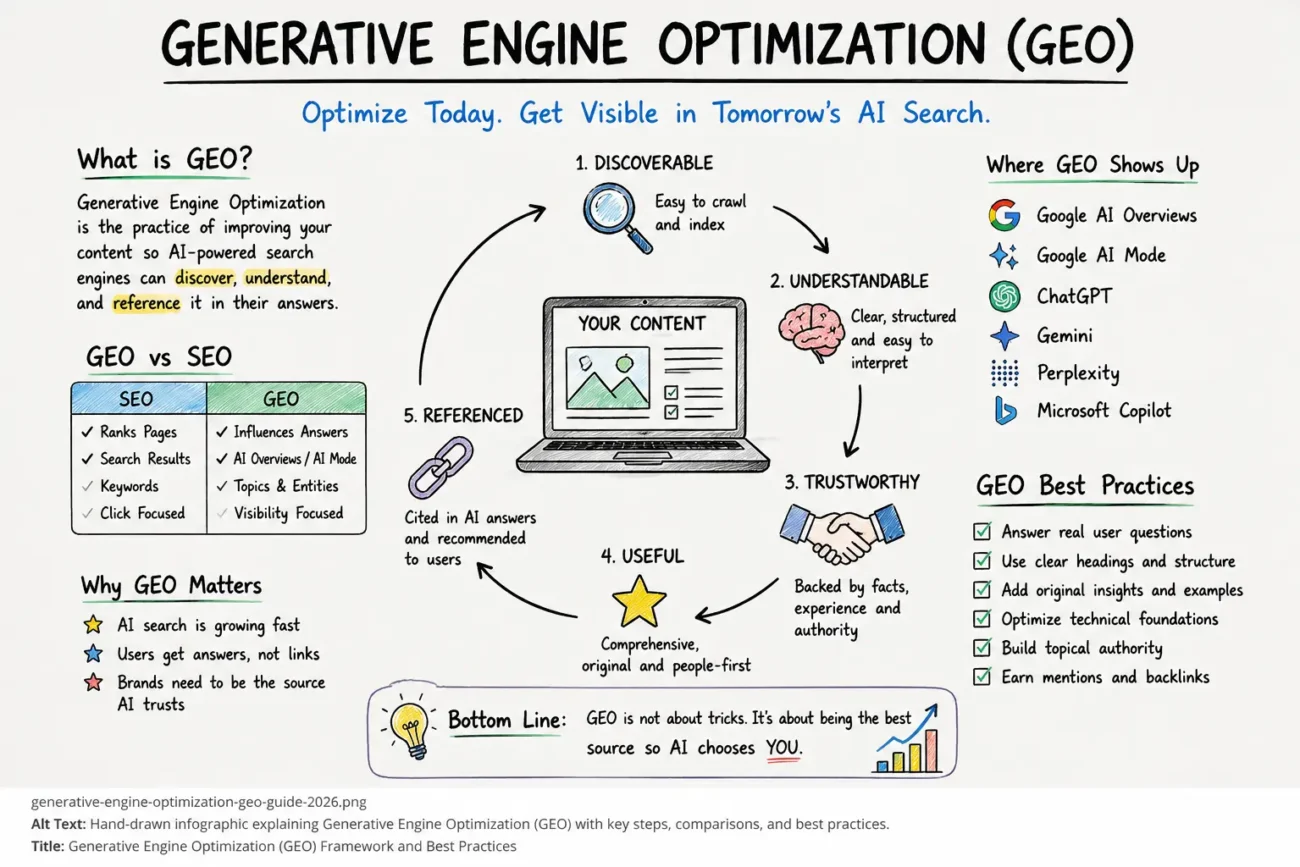
Generative Engine Optimization (GEO) is the practice of improving a website’s content, technical accessibility, authority, and clarity so it can be discovered, understood, and potentially referenced in AI-powered search experiences. These include Google AI Overviews, Google AI Mode, ChatGPT, Gemini, Perplexity, and other generative search systems. GEO does not replace traditional SEO. Google’s own guidance states that its generative search features rely on core Search ranking and quality systems, so strong SEO remains the foundation.
Key Takeaways
- GEO means Generative Engine Optimization, a term used for optimizing visibility in generative AI search experiences.
- GEO and SEO overlap heavily. GEO should complement SEO rather than replace it.
- Google says there are no special technical requirements or special schema markup required to appear in AI Overviews or AI Mode.
- Google’s current guidance emphasizes unique, valuable, non-commodity content, technical accessibility, clear structure, and people-first content.
- AI search systems can use multiple related searches to develop an answer, making comprehensive topical coverage increasingly important. Google calls this process query fan-out.
- The strongest GEO strategy combines SEO + original expertise + useful content + technical accessibility + authority + measurement.
- There is no legitimate “GEO hack” that guarantees an AI Overview citation or ChatGPT recommendation.
What Is Generative Engine Optimization (GEO)?
Generative Engine Optimization, or GEO, is the process of making information easier for generative AI search systems to discover, understand, evaluate, and potentially reference when producing an answer.
Traditional search typically presents users with a list of results.
Generative search can instead synthesize information from multiple sources and provide a direct answer, sometimes with links or citations to supporting pages.
That creates a different visibility question.
Traditional SEO asks:
Can my page rank for this search?
GEO asks:
Can my information become a useful source when an AI system constructs an answer?
The two questions are connected.
Google’s current documentation makes this particularly clear. Google says its AI Overviews and AI Mode are rooted in its core Search ranking and quality systems, and that existing SEO best practices remain relevant.
The term GEO is also not simply a recent marketing invention. Academic research titled GEO: Generative Engine Optimization was presented at KDD 2024 by researchers including Pranjal Aggarwal, Vishvak Murahari, Karthik Narasimhan, and others.
How Does GEO Work?
GEO works by improving the overall quality and accessibility of information that AI-powered search systems can retrieve and use.
A simplified model looks like this:
User Query
↓
Search / AI System
↓
Related Searches and Retrieval
↓
Relevant Sources
↓
Evaluation
↓
Generated Answer
↓
Citations / Links / Brand Mentions
Google explains that AI Overviews and AI Mode can use query fan-out, where the system generates related searches across different subtopics and data sources to develop a response. If you’re specifically focused on Google Search, our guide on how to show up in AI Overviews goes deeper into the practical considerations for improving your search visibility.
For example, someone might search:
“What is the best AI SEO strategy for a small business?”
A generative search system may need information about:
- AI SEO
- Traditional SEO
- GEO
- Content strategy
- Technical SEO
- AI search visibility
- Small-business SEO
- Measurement
This means a page that addresses the subject clearly and comprehensively can be more useful than a page that only repeats one keyword.
GEO vs SEO: What’s the Difference?
The biggest misconception about GEO is that it is a completely separate replacement for SEO.
It is not.
Google’s own documentation states that, from Google’s perspective, optimizing for generative AI search is still SEO because its generative search features are built on core Search systems.
| Factor | Traditional SEO | GEO |
|---|---|---|
| Primary objective | Improve visibility in search results | Improve visibility within generative answers |
| Main environment | Search engines | AI-powered search experiences |
| Typical output | Ranked URLs | Synthesized answers with supporting sources |
| Important foundation | Technical SEO, content, relevance, authority | The same foundations plus clear, useful, extractable information |
| User journey | Search → Result → Website | Question → AI answer → Source exploration |
| Core metrics | Rankings, clicks, traffic, conversions | Citations, mentions, visibility, referrals, conversions |
| Relationship | Core discipline | Additional optimization perspective |
The practical conclusion
Don’t choose between SEO and GEO.
Google’s AI search features do not make traditional SEO irrelevant. For a deeper look at this relationship, see our guide on traditional SEO after AI Mode.
Build one strong search strategy that works across both environments.
Why GEO Matters in 2026
Search is no longer limited to a page of ten blue links.
People can now ask more complex questions and receive AI-generated responses in search and standalone AI products.
Google describes AI Overviews as a way to help users understand complex topics more quickly, while AI Mode is designed for deeper exploration, reasoning, and comparisons.
This creates another layer of search visibility.
A business can potentially appear through:
- Traditional organic results
- Featured snippets
- People Also Ask
- Google AI Overviews
- Google AI Mode
- ChatGPT
- Gemini
- Perplexity
- Microsoft Copilot
- Other AI-powered search experiences
The important point is that visibility is becoming broader than a single ranking position.
What Actually Helps With GEO?
There is a lot of conflicting advice about GEO.
Some websites recommend special AI files.
Others recommend keyword “chunking.”
Others claim that adding a particular schema will make a page appear in AI answers.
Google’s current guidance is much more straightforward.
Google emphasizes:
- Unique and valuable content
- First-hand experience
- People-first information
- Strong technical foundations
- Crawlability
- Internal linking
- Good page experience
- Textual accessibility
- Relevant images and videos
- Accurate structured data
- Avoiding scaled content abuse
That is where your GEO strategy should start.
Our AI Search Visibility Experiment
Most GEO guides explain how AI search works. We wanted to take a more practical approach: measure how a website actually appears across AI-powered search experiences.
Instead of assuming that a particular GEO tactic guarantees visibility, we are testing real search queries and recording when our website is mentioned, cited, or recommended.
This experiment is designed to track AI search visibility over time.
What We Tested
We selected commercially and informationally relevant queries around:
- AI SEO
- Generative Engine Optimization
- AI SEO services
- AI SEO agents
- AI search optimization
- Google AI Overviews
- GEO vs SEO
- AI search visibility
We then tested these queries across multiple AI-powered search experiences.
Platforms Tested
| Platform | What We Track |
|---|---|
| Google AI Overviews | Brand appearance, cited pages and competitors |
| Google AI Mode | Brand appearance, cited pages and competitors |
| ChatGPT | Brand mentions, recommendations and cited sources |
| Gemini | Brand mentions, recommendations and cited sources |
| Perplexity | Brand mentions, citations and cited URLs |
What We Measure
For each query, we record five things:
- Was AI SEO Services mentioned?
- Was our website cited?
- Which URL was cited?
- Which competitors were mentioned?
- What type of information appeared to influence the answer?
We also record the date of each test because AI-generated results can change over time.
AI Search Visibility Tracking Table
| Query | Platform | Brand Mentioned | Website Cited | URL Cited | Competitors | Date |
|---|---|---|---|---|---|---|
| What is GEO? | Google AI | TBD | TBD | TBD | TBD | [Date] |
| What is GEO? | ChatGPT | TBD | TBD | TBD | TBD | [Date] |
| What is GEO? | Gemini | TBD | TBD | TBD | TBD | [Date] |
| What is GEO? | Perplexity | TBD | TBD | TBD | TBD | [Date] |
| Best AI SEO services | Google AI | TBD | TBD | TBD | TBD | [Date] |
| Best AI SEO services | ChatGPT | TBD | TBD | TBD | TBD | [Date] |
| AI SEO agent | Gemini | TBD | TBD | TBD | TBD | [Date] |
| GEO vs SEO | Perplexity | TBD | TBD | TBD | TBD | [Date] |
Why We Are Tracking This
AI search visibility is not the same as a traditional Google ranking.
A website can rank organically without being cited in a particular AI-generated answer. Likewise, an AI system may mention a company or source even when the traditional search relationship is not immediately obvious.
That makes measurement important.
Rather than claiming that a particular GEO technique “guarantees” AI visibility, we want to observe what actually happens.
What We Expect to Learn
The experiment will help us identify patterns such as:
- Which types of pages are cited most frequently
- Whether informational or commercial pages receive more citations
- Which content formats appear most often
- Whether original research improves visibility
- Which topics generate brand mentions
- How frequently cited URLs change
- How competitors appear across different AI platforms
- Whether content updates change AI search visibility
The results will be updated as the experiment develops.
This is an ongoing experiment, not a claim that any specific optimization technique guarantees AI search visibility.
The 7-Layer GEO Framework
Here is a practical framework for evaluating whether a page is ready for AI search.
1. Discoverability
Can search systems access the page?
Check:
- Robots.txt
- Indexability
- Canonical URL
- XML sitemap
- Internal links
- Server accessibility
- JavaScript rendering
Google states that pages need to be indexed and eligible to appear with a snippet in Google Search to be eligible for supporting links in AI Overviews or AI Mode.
2. Search Intent
Does the page actually answer the reason someone searched?
For example:
“What is GEO?”
requires an informational explanation.
But:
“Best GEO agency”
has commercial investigation intent.
Creating the wrong type of page for the query can make even excellent content less competitive.
Expert Rule
Start with the user’s problem, not the keyword.
3. Answerability
Can an important question be answered quickly and accurately?
For example:
Weak
GEO is becoming increasingly important in today’s changing search environment.
Better
Generative Engine Optimization (GEO) is the practice of improving content so AI-powered search systems can discover, understand, and potentially reference it in generated answers.
The second answer is easier for both humans and information-retrieval systems to understand.
Use:
- Short definitions
- Clear headings
- Tables
- Lists
- Examples
- Direct answers
- Specific terminology
But do not turn every paragraph into an artificial “AI snippet.”
Write naturally.
4. Entity Clarity
AI search systems need to understand the entities and relationships discussed on a page.
For example, an article about GEO might clearly connect:
GEO
→ Generative Engine Optimization
→ AI search
→ Google AI Overviews
→ Google AI Mode
→ ChatGPT
→ Gemini
→ Perplexity
→ SEO
→ AI citations
→ Search visibility
This creates contextual clarity.
Entity optimization does not mean inserting as many related words as possible.
It means explaining concepts and relationships accurately.
5. Evidence and Original Information
This is where you can potentially outperform generic competitors.
Google’s current guidance explicitly emphasizes unique viewpoints and first-hand experience, rather than simply summarizing information already available elsewhere.
Instead of writing:
“AI search is changing SEO.”
show what you have actually observed.
For example:
- Search Console data
- Your own GEO experiments
- AI citation tests
- Before-and-after content updates
- Competitor observations
- Internal linking experiments
- Content-refresh results
Important
Never manufacture an experiment or result.
If you have not tested something, say so.
That makes the content more trustworthy.
6. Authority
A useful page should be supported by a broader website ecosystem.
Build topical authority through:
- Relevant supporting articles
- Strong internal links
- Credible external references
- Author information
- Original research
- Expert commentary
- Relevant third-party mentions
- Consistent brand information
GEO is not simply an on-page writing exercise.
Your entire website contributes to how clearly your expertise is understood.
7. Measurement
You cannot improve GEO if you never measure it.
Track:
Traditional SEO
- Impressions
- Clicks
- Rankings
- Organic traffic
- Conversions
AI Search
Where reliable measurement is available:
- AI citations
- Brand mentions
- Cited URLs
- AI referral traffic
- Query visibility
- Share of AI answers
- Conversion activity
Google says AI Overview and AI Mode traffic is included in Search Console’s overall Web performance reporting.
This is important because you should not automatically assume that every AI-generated appearance will be visible as a separate traditional ranking metric.
How to Optimize a Page for GEO
Use this practical process.
Step 1: Identify the Primary Question
Determine the main question the page should answer.
Step 2: Analyze Search Intent
Look at the current search results.
Ask:
- What content format dominates?
- What questions are answered?
- What is missing?
- Is the intent informational or commercial?
Step 3: Create a Direct Answer
Answer the main question near the beginning of the page.
Step 4: Expand Into Supporting Questions
Cover the important subtopics naturally.
Step 5: Add Original Information
Include:
- Examples
- Data
- Experience
- Frameworks
- Comparisons
- Case studies
- Expert observations
Step 6: Strengthen Internal Links
Connect the page to relevant supporting and commercial pages.
Step 7: Check Technical SEO
Make sure the page can be crawled and indexed.
Step 8: Add Useful Visual Content
Use original diagrams, screenshots, charts, videos, or illustrations when they genuinely improve understanding.
Google specifically recommends supporting textual content with high-quality relevant images and videos where appropriate.
Step 9: Verify Claims
Check important facts against reliable sources.
Step 10: Measure
Monitor performance and update the page based on actual evidence.
Does Schema Help With GEO?
Structured data can help search engines understand content, but there is no special “GEO schema” that guarantees AI visibility.
Google explicitly says there is no special schema.org structured data required to appear in AI Overviews or AI Mode. It also says structured data should match the visible content on the page.
Use appropriate structured data when it genuinely describes your page.
For example:
- Article
- BreadcrumbList
- Organization
- Person
- Product
- LocalBusiness
depending on what the page actually contains.
Do not add schema simply because someone claims it is an AI Overview hack.
Do You Need llms.txt for GEO?
No, not as a requirement for Google AI Overviews or AI Mode.
Google’s current generative AI guidance specifically says you can ignore tactics such as creating unnecessary AI text files like llms.txt when optimizing for Google’s generative AI search features.
That does not mean every emerging AI system will necessarily treat every technical convention identically.
It means you should not treat llms.txt as a magic Google ranking or AI Overview requirement.
Focus first on:
crawlability + useful content + technical SEO + authority + clear information.
Can You Guarantee an AI Overview or ChatGPT Citation?
No.
Anyone promising guaranteed AI Overview inclusion, guaranteed ChatGPT citations, or guaranteed AI recommendations should be treated carefully.
Generative systems can:
- Change their retrieval sources
- Produce different answers
- Use different queries
- Select different sources
- Update their systems
- Interpret the same query differently
Recent analysis has even documented significant changes in the sources cited by ChatGPT over short periods, illustrating how dynamic AI visibility can be.
The correct goal is therefore:
Increase the probability of being discovered, understood, trusted, and referenced.
Not:
Guarantee a citation.
GEO Content Structure That Works
For important GEO pages, use a structure like this:
H1: Main Topic

Quick Answer

Key Takeaways

What Is [Topic]?

How Does It Work?

Why Does It Matter?

[Topic] vs Alternatives

How to Implement It

Practical Example

Common Mistakes

Expert Recommendations

Measurement

FAQs

Conclusion
This structure works well because it serves both readers and information retrieval.
But structure alone will not make weak content competitive.
The information inside the structure is what matters.
AI can also support the implementation side of SEO. For example, AI SEO agents can help automate repetitive workflows such as keyword research, competitor analysis, content briefs, internal-link discovery, and technical monitoring, while keeping human review in the workflow.
GEO Content vs Generic AI Content
This distinction is becoming increasingly important.
| Generic AI Content | Strong GEO Content |
|---|---|
| Repeats common information | Adds original insight |
| Broad statements | Specific explanations |
| No evidence | Evidence and references |
| Generic examples | Relevant real-world examples |
| Keyword focused | Intent focused |
| No author expertise | Clear expertise |
| Similar to competitors | Distinct perspective |
| Large volume | Useful depth |
| No measurement | Measurable outcomes |
Google’s guidance specifically warns against producing commodity content that simply repeats information already available elsewhere.
The GEO Content Decision Framework
Before publishing a page, ask these seven questions.
1. Is this topic genuinely useful to my audience?
If no, don’t publish it.
2. Does the page answer a real search intent?
If no, rethink the topic.
3. Does it provide something competitors don’t?
If no, find an original angle.
4. Can I demonstrate expertise?
If yes, include that experience.
5. Are important claims supported?
If no, verify them.
6. Can users navigate the information easily?
If no, improve the structure.
7. Would I recommend this page to someone without caring about SEO?
If no, it probably needs more work.
GEO vs AEO vs LLMO vs AI SEO
The terminology around AI search can become confusing.
| Term | Common Meaning |
|---|---|
| SEO | Search Engine Optimization |
| AEO | Answer Engine Optimization |
| GEO | Generative Engine Optimization |
| LLMO | Large Language Model Optimization |
| AI SEO | Broad term for SEO work involving AI search |
| AI Search Optimization | Optimization for AI-powered search experiences |
These terms overlap considerably.
For Google’s own Search ecosystem, Google says that what the industry calls AEO and GEO is still part of SEO from Google’s perspective.
Therefore, do not build your entire strategy around terminology.
Build it around visibility and user value.
A Practical GEO Workflow for Businesses
Here is the workflow I recommend.
Phase 1: Audit
Analyze:
- Current rankings
- AI visibility
- Existing content
- Technical SEO
- Internal links
- Brand mentions
- Competitors
Phase 2: Identify Opportunities
Find queries where:
- You already rank
- You have relevant content
- Competitors are being cited
- Your information is incomplete
- Commercial value is high
Phase 3: Improve Existing Content
Prioritize pages that already have:
- Impressions
- Relevant rankings
- Business value
- Strong topical relevance
Phase 4: Build Supporting Content
Create genuinely different pages when there is a different search intent.
Phase 5: Strengthen Internal Linking
Connect related pages into logical topical clusters.
Phase 6: Add Original Information
Use:
- First-hand observations
- Research
- Data
- Examples
- Frameworks
- Case studies
Phase 7: Measure
Track traditional and AI search visibility.
Phase 8: Iterate
Update your strategy based on actual performance.
How to Create First-Hand GEO Content
This is one of the biggest opportunities for your website.
Instead of publishing another:
“10 ways to optimize for AI search”
create something such as:
We Tested 50 AI Search Queries: What Gets a Website Mentioned?
Then document:
- The queries tested
- Date tested
- Platform
- Whether your brand appeared
- Whether your URL was cited
- Which competitors appeared
- What content was cited
- What changed after optimization
This becomes something competitors cannot simply rewrite.
It is also aligned with Google’s current emphasis on first-hand experience and unique viewpoints.
This is the direction I would take with AISEOServices.company.
Your goal should not be to become another website explaining AI SEO.
Your goal should be to become a website that actually studies AI search and publishes what it learns.
A GEO Experiment You Can Run
Start with 20 commercially relevant prompts.
For example:
- What is AI SEO?
- What are the best AI SEO services?
- How does AI SEO work?
- What is GEO?
- What is the difference between SEO and GEO?
- How do I optimize for AI Overviews?
- What is an AI SEO agent?
- How can a business improve AI search visibility?
- What is the best AI SEO strategy?
- How do AI search citations work?
Run the same prompts periodically.
Record:
| Query | Platform | Brand Mention | URL Citation | Competitors | Date |
|---|---|---|---|---|---|
| What is GEO? | ChatGPT | Yes/No | Yes/No | Record | Date |
| What is GEO? | Gemini | Yes/No | Yes/No | Record | Date |
| What is GEO? | Perplexity | Yes/No | Yes/No | Record | Date |
| What is GEO? | Google AI | Yes/No | Yes/No | Record | Date |
This becomes your own AI Search Visibility Dataset.
Common GEO Mistakes
Mistake 1: Treating GEO as a Replacement for SEO
Don’t.
Google explicitly says core SEO remains relevant to its generative search features.
Mistake 2: Publishing Hundreds of AI Articles
More content does not automatically mean better visibility.
Google specifically warns against creating content for every possible query variation primarily to manipulate rankings or AI responses.
Mistake 3: Copying Competitors
If five competitors explain GEO the same way, publishing a sixth version adds little value.
Find your own angle.
Mistake 4: Believing GEO Hacks
There is no guaranteed:
- GEO keyword density
- AI Overview schema
- AI ranking formula
- Citation word count
- Magic paragraph length
Focus on fundamentals.
Mistake 5: Ignoring Technical SEO
An amazing article that cannot be properly crawled or indexed has limited search visibility.
Mistake 6: Measuring Only Rankings
A page can have traditional search visibility and also appear in AI-generated experiences.
Measure both where reliable data exists.
Mistake 7: Making Unsupported Claims
AI search optimization is still evolving.
When evidence is limited, say:
“There is evidence suggesting…”
rather than:
“This guarantees…”
That distinction matters.
GEO Measurement Framework
I recommend dividing your reporting into four layers.
Layer 1: Search Visibility
- Impressions
- Rankings
- Organic clicks
- CTR
Layer 2: AI Visibility
- AI mentions
- AI citations
- Cited URLs
- AI search share of voice
Layer 3: Website Impact
- Organic sessions
- Engaged sessions
- Landing-page engagement
- Referral traffic
Layer 4: Business Impact
- Leads
- Sales
- Revenue
- Qualified enquiries
The ultimate objective isn’t:
“Get cited by AI.”
It is:
Become visible to the right audience and turn that visibility into business value.
Is GEO Worth Investing In?
Yes, but not as a replacement for SEO.
GEO becomes particularly valuable when:
- Your customers research products through AI
- Your industry is heavily information-driven
- Competitors are already appearing in AI answers
- Your brand depends on expertise
- You have valuable original knowledge
- Your website already has a reasonable SEO foundation
For a brand-new website, I would prioritize:
Technical SEO → Search intent → Useful content → Authority → GEO measurement
rather than trying to skip directly to AI citations.
The Future of GEO
The biggest change may not be “AI replacing Google.”
It is the emergence of multiple ways for people to discover information.
A customer might:
Search Google
↓
Read an AI Overview
↓
Ask AI Mode a follow-up
↓
Compare brands
↓
Ask ChatGPT
↓
Visit a company website
↓
Convert
The journey can now cross multiple search interfaces.
That means businesses need to think beyond:
“What position do we rank at?”
and start asking:
“Where does our brand appear when customers research this problem?”
That is the larger opportunity behind GEO.
Our GEO Framework: Discover, Explain, Prove, Connect, Measure
For practical implementation, we use five core principles.
Discover
Make your information accessible and technically discoverable.
Explain
Answer important questions clearly and directly.
Prove
Support claims with evidence, expertise, data, and credible references.
Connect
Build relationships between related topics, entities, pages, and your broader website.
Measure
Track search visibility, AI visibility, traffic, and business outcomes.
The Complete Model
DISCOVER → EXPLAIN → PROVE → CONNECT → MEASURE
This is not a Google ranking formula.
It is a practical framework for building content that is useful to people and understandable to modern search systems.
Frequently Asked Questions
What is Generative Engine Optimization?
Generative Engine Optimization, or GEO, is the practice of improving a website’s content and technical foundations so generative AI search systems can discover, understand, evaluate, and potentially reference its information in generated answers. GEO overlaps heavily with SEO and should generally be treated as an extension of search optimization rather than a replacement for it.
Is GEO the same as SEO?
No, but the two are closely connected. SEO focuses broadly on search visibility, while GEO is commonly used to describe optimization for generative AI search experiences. Google states that its AI Overviews and AI Mode rely on core Search ranking and quality systems, meaning traditional SEO fundamentals remain important.
How do I optimize my website for GEO?
Start with technical SEO, search intent, useful content, clear structure, internal linking, original information, and credible evidence. Make important answers easy to understand and verify. Google recommends applying foundational SEO best practices to its generative AI search experiences rather than relying on special GEO hacks.
Can GEO guarantee Google AI Overview visibility?
No. Google does not provide a guaranteed method for appearing in AI Overviews. A page must meet Google’s normal technical requirements and be eligible for Search, but meeting those requirements does not guarantee that Google will crawl, index, rank, or display the page in an AI feature.
Do I need special schema for GEO?
No special GEO schema is required for Google AI Overviews or AI Mode. Google specifically says there is no special schema.org structured data required for these features. However, appropriate structured data can still help describe eligible content when it accurately matches the visible page.
Does llms.txt improve GEO?
There is currently no basis for treating llms.txt as a required Google optimization technique for AI Overviews or AI Mode. Google’s current guidance specifically advises that site owners can ignore tactics such as unnecessary AI text files when optimizing for its generative AI search features.
What is the difference between GEO and AEO?
AEO usually means Answer Engine Optimization and refers broadly to optimizing for direct-answer experiences. GEO usually refers more specifically to generative AI search experiences. The terminology overlaps, and Google itself groups these concepts within the broader practice of SEO for its generative search features.
Can AI-generated content rank in Google?
AI-assisted content can appear in Google Search, but using AI does not automatically make content useful or competitive. Google focuses on whether content is helpful, reliable, original, and created for people. Generating large amounts of low-value content primarily to manipulate search results can violate Google’s spam policies.
How do I measure GEO?
Measure GEO separately from traditional rankings where reliable data is available. Track brand mentions, AI citations, cited URLs, AI referral traffic, relevant prompts, and business outcomes. For Google’s AI features, Search Console reports traffic from AI Overviews and AI Mode within the overall Web search performance reporting.
Is GEO worth it for a small business?
It can be, especially when customers use AI systems to research services, products, or complex questions. Small businesses should not try to automate everything. A better approach is to build strong SEO foundations, publish genuinely useful expert content, establish topical authority, and then measure how the brand appears across relevant AI search experiences.
Final Verdict: GEO Is an Evolution of Search, Not a Replacement for SEO
Generative Engine Optimization is becoming an important way to think about search visibility.
But the strongest GEO strategy is surprisingly familiar.
Create useful information.
Make it accessible.
Understand search intent.
Explain complex topics clearly.
Support important claims.
Build genuine expertise.
Connect related content.
Measure what happens.
Google’s current guidance reinforces this approach. Its AI search features rely on core Search systems, and Google specifically recommends unique, non-commodity, people-first content rather than attempting to manipulate AI results with artificial optimization techniques.
The biggest opportunity is therefore not to find a secret GEO trick.
It is to create information that people want, search systems can access, and AI systems can confidently understand and reference.
How We Approach AI Search Optimization
At AI SEO Services, we believe AI search should be treated as part of a broader search strategy rather than a replacement for traditional SEO.
Our approach combines:
- Technical SEO
- Search intent analysis
- Content strategy
- AI search optimization
- Generative Engine Optimization
- Internal linking
- Competitor analysis
- AI visibility monitoring
- Content optimization
- Human-led quality control
If you want to understand how this can be applied to your own website, explore our AI SEO Services.
