
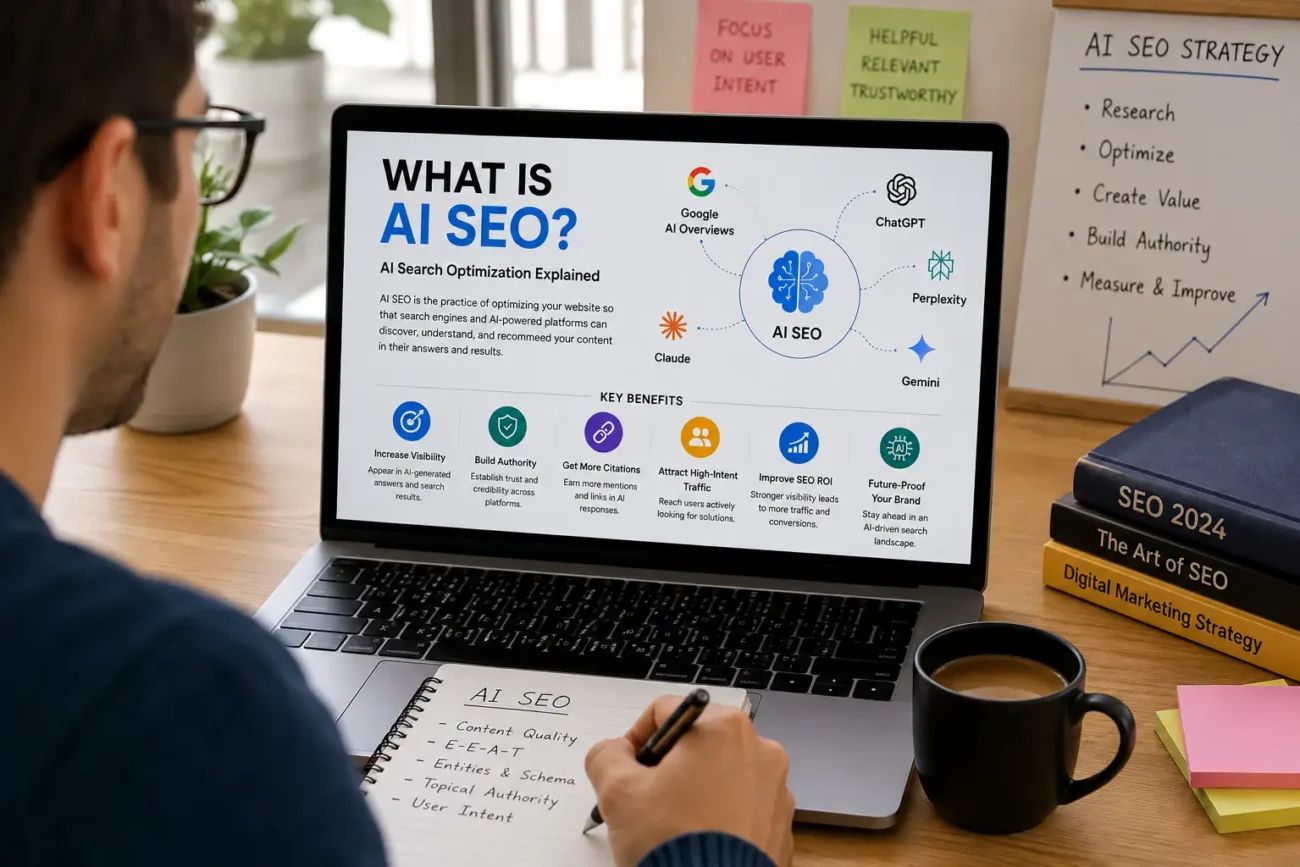
AI SEO is the practice of optimizing a website so that its content can be discovered, understood, evaluated, and surfaced across traditional search engines and AI-powered search experiences.
In simple terms:
AI SEO combines traditional search engine optimization with strategies designed for a search environment increasingly influenced by artificial intelligence.
Instead of focusing only on where a webpage ranks for a keyword, AI SEO considers a broader question:
Can search systems understand your website well enough to use it when answering a user’s question?
That question matters because search is no longer limited to a list of blue links.
Google now provides AI-powered experiences such as AI Overviews and AI Mode, while ChatGPT and Perplexity can search the web and provide answers with links to relevant sources.
However, AI SEO does not mean there is a secret technique for forcing your website into AI-generated answers.
Google’s current documentation says the foundational SEO practices used for Google Search also apply to its AI features, and there are no additional technical requirements specifically required for AI Overviews or AI Mode. A page still needs to be indexed and eligible to appear in Google Search. Google’s official guidance on AI features
The real opportunity is to create a website that is useful, technically accessible, understandable, authoritative, and genuinely valuable to people.
What Does AI SEO Mean?
AI SEO stands for Artificial Intelligence Search Engine Optimization.
It is commonly used to describe SEO strategies that account for how artificial intelligence influences modern search, content discovery, and search-generated answers.
Traditional SEO primarily focuses on improving a website’s visibility in search engine results.
AI SEO expands that thinking to include:
- Traditional organic search
- Google AI Overviews
- Google AI Mode
- AI-powered search experiences
- Conversational search
- Entity understanding
- Semantic search
- Generative search
- AI-assisted content discovery
- Brand mentions and citations
- Structured and machine-readable information
The underlying goal remains the same:
Help the right people discover the right information at the right time.
The difference is that modern search systems can understand relationships between concepts, questions, entities, sources, and pieces of information rather than relying only on exact keyword matches.
How Does AI SEO Work?
AI SEO works by improving the overall quality and discoverability of a website.
There isn’t one AI SEO ranking factor.
Instead, think of AI SEO as a system made up of several connected components.
1. Technical accessibility
Search systems need to be able to access and understand your website.
2. Search intent
Your content needs to answer what the user is actually trying to accomplish.
3. Content quality
Your pages need to provide useful, accurate, and sufficiently comprehensive information.
4. Semantic relevance
Your content should clearly explain the concepts and relationships surrounding a topic.
5. Entity clarity
Search systems should be able to understand organizations, people, products, services, locations, and other entities mentioned on your website.
6. Expertise and trust
Your website should demonstrate why its information is worth trusting.
7. Authority
Relevant third-party recognition, references, and links can help establish your website’s place within a topic.
8. Original information
Research, first-hand experience, data, examples, and unique analysis can make content more valuable than generic summaries.
Google’s current guidance for generative AI search specifically emphasizes valuable, unique, non-commodity content and says that unique viewpoints and first-hand perspectives can be particularly useful. Google’s guide to optimizing for generative AI features
AI SEO vs Traditional SEO
AI SEO and traditional SEO are not two completely separate disciplines.
In fact, traditional SEO provides much of the foundation for AI search visibility.
| Traditional SEO | AI SEO |
|---|---|
| Focuses on organic search visibility | Considers organic and AI-powered search experiences |
| Keywords and search intent | Topics, questions, entities and intent |
| Rankings and CTR | Rankings plus AI visibility and citations where measurable |
| Web pages | Web pages and information structures |
| Backlinks and authority | Authority, references, entities and relevant recognition |
| Search engine crawling | Search and AI crawler accessibility |
| SERP optimization | SERP + generative search optimization |
The biggest misconception is that businesses need to abandon traditional SEO to succeed in AI search.
They don’t.
Google explicitly states that its generative AI search features are rooted in its core Search ranking and quality systems, meaning established SEO best practices continue to matter. Google’s generative AI search guidance
Why Is AI SEO Important?
Search behavior is becoming more conversational.
A traditional search might look like:
best CRM software
A user interacting with an AI-powered search experience might ask:
What is the best CRM for a small consulting company with five employees, and which option is easiest to set up?
The second query contains multiple requirements.
The search system may need to understand:
- What a CRM is
- What the user means by “small”
- What features matter to a consulting company
- Which products satisfy those requirements
- Which sources are trustworthy
- Which information is current
This creates opportunities for websites that provide clear, useful, specific information.
Google says its AI search experiences can use multiple related searches and sources when developing responses. Google’s documentation on AI Overviews and AI Mode
That means a page doesn’t necessarily have to target one exact keyword to be useful.
It can become a valuable source for an entire group of related questions.
What Are the Main Components of AI SEO?
A strong AI SEO strategy usually includes several areas.
1. Technical SEO
Technical SEO makes your website accessible to search systems.
Important areas include:
- Crawlability
- Indexability
- XML sitemaps
- Robots.txt
- Canonical URLs
- Internal links
- Site architecture
- Mobile usability
- Page experience
- HTTP status codes
- JavaScript rendering
- Structured data
For Google AI features, the fundamentals remain important. Google says pages need to be indexed and eligible to appear in normal Google Search to be eligible as supporting links in AI Overviews or AI Mode.
2. Search Intent Optimization
AI SEO isn’t about putting a keyword into a page as many times as possible.
It is about understanding why the person is searching.
For example, someone searching:
what is AI SEO
probably wants an explanation.
They may want to know:
- What AI SEO means
- How it works
- Why it matters
- How it differs from SEO
- What AI SEO includes
- How to implement it
Therefore, an article targeting this keyword should answer those questions directly.
It shouldn’t immediately become a sales pitch for an AI SEO agency.
3. Topic and Semantic Optimization
A search system needs context.
If an article discusses AI SEO, it should naturally explain related concepts such as:
- Search engine optimization
- AI search
- Google AI Overviews
- AI Mode
- Generative Engine Optimization
- Answer Engine Optimization
- Semantic search
- Search intent
- Entities
- Structured data
- Topical authority
- Content quality
- Internal linking
- Digital PR
- AI search visibility
This does not mean stuffing every related keyword into the article.
The concepts should appear because they genuinely help explain the topic.
Google’s Search Essentials recommends using words that people use to look for your content in prominent locations such as titles, headings, and descriptive link text, while also emphasizing helpful, reliable, people-first content. Google Search Essentials
4. Entity SEO
One of the important ideas behind modern search is entities.
An entity can be a:
- Person
- Company
- Product
- Service
- Organization
- Location
- Brand
- Concept
For example, search systems should be able to understand that:
is associated with:
AI SEO → SEO → GEO → Search optimization → AI search
Likewise, a company website should clearly communicate:
- Who operates the company
- What services it provides
- Who its authors are
- Which industries it serves
- Where it operates
- What it has actually done
- What information it is known for
This is one reason an identifiable author, detailed About page, consistent company information, and original work can strengthen the overall credibility of a website.
Google’s people-first guidance specifically encourages clear authorship and asks creators to demonstrate expertise, provide sourcing, and make it clear who created the content. Google’s people-first content guidance
5. Content Optimization
Good AI SEO content should be written for people first.
That means:
Answer the main question quickly
Don’t make readers search through 2,000 words to find a definition.
Use clear headings
Make the article easy to scan.
Explain complex terminology
Don’t assume every reader understands SEO terminology.
Provide examples
Examples make abstract concepts easier to understand.
Support important claims
When making factual claims about a platform, link to the platform’s official documentation where possible.
Add something original
Don’t simply rewrite the first five articles ranking for the same keyword.
Google’s guidance says content should provide original information, research, analysis, or other substantial value rather than simply rewriting existing sources.
6. Original Research and First-Hand Experience
This is where AI SEO content can become much stronger.
Imagine two websites publish articles about:
AI search visibility
Website A summarizes information from 20 existing articles.
Website B publishes:
AI Search Visibility Study: 1,000 Commercial Queries Across Google AI Overviews, ChatGPT and Perplexity
Website B has created something other websites can potentially reference.
Examples of original AI SEO research include:
- AI search visibility studies
- Citation analysis
- Search-result experiments
- Industry-specific AI search research
- Content experiments
- SEO case studies
- Original datasets
- First-hand technical audits
This is exactly the type of content that can differentiate your website from thousands of generic AI-generated articles.
Google’s current generative-AI guidance says unique viewpoints and non-commodity content can be especially valuable because AI systems consider information from multiple sources.
Important: never manufacture research, statistics, experiments, or case studies.
If you haven’t conducted the research, don’t present it as original research.
7. Structured Data
Structured data helps communicate information about a webpage in a machine-readable format.
Depending on the page, websites may use structured data such as:
- Article
- Person
- Organization
- Product
- WebPage
- WebSite
- BreadcrumbList
- LocalBusiness
But there is an important distinction:
Structured data does not guarantee AI search visibility.
Google’s current documentation says there are no additional technical requirements specifically for AI Overviews or AI Mode. The same foundational SEO requirements apply.
So don’t believe claims such as:
“Add this secret AI schema and Google will automatically put your website in AI Overviews.”
There is no reliable shortcut like that.
8. AI Crawler Accessibility
AI search platforms can use web crawlers to discover and retrieve online information.
For example, OpenAI says websites that want to be included in ChatGPT Search should allow OAI-SearchBot to crawl their content. OpenAI also states that there is no way to guarantee top placement in ChatGPT Search. OpenAI’s ChatGPT Search documentation
OpenAI’s publisher guidance similarly recommends allowing OAI-SearchBot access if publishers want their content to be discoverable, surfaced, and cited in ChatGPT Search. OpenAI’s publisher and developer guidance
Perplexity also states that its PerplexityBot respects robots.txt and will not index the full or partial text of a site that disallows it through robots.txt. Perplexity’s official robots.txt guidance
This leads to an important principle:
Being crawlable is necessary for discoverability in some AI search systems, but being crawlable does not guarantee citation or visibility.
9. Authority and Trust
AI SEO isn’t just about technical optimization.
Search systems need reliable information.
A website can strengthen its credibility through:
- Original research
- Expert authors
- Transparent authorship
- Case studies
- First-hand experience
- Relevant backlinks
- Industry mentions
- Digital PR
- Accurate business information
- High-quality references
- Consistent topical coverage
Don’t confuse authority with simply having thousands of backlinks.
A single relevant reference from a respected industry publication can be more meaningful than hundreds of irrelevant links.
The objective should be:
Become a source that other people want to reference.
AI SEO, GEO and AEO: What’s the Difference?
These terms are often used together, but they aren’t necessarily identical.
AI SEO
AI SEO is the broader concept of adapting SEO strategy to an increasingly AI-influenced search environment.
GEO
Generative Engine Optimization generally refers to strategies intended to improve visibility or representation within generative AI experiences.
AEO
Answer Engine Optimization generally focuses on optimizing content for answer-oriented search experiences.
There is considerable overlap between these concepts.
A practical way to think about them is:
SEO
→ Traditional search visibility
AEO
→ Direct answers
GEO
→ Generative AI experiences
AI SEO
→ Broader optimization across an AI-influenced search ecosystem
The terminology is less important than the strategy behind it.
How to Do AI SEO: A Practical Process
If you’re starting from zero, use this process.
Step 1: Audit the Website
Check:
- Indexability
- Crawlability
- Technical errors
- Site architecture
- Internal links
- Existing rankings
- Existing content
- Organic traffic
- Search Console data
Step 2: Identify Search Intent
For every target keyword, ask:
What does the searcher actually want?
Don’t create a page until you understand the intent.
Step 3: Build Topic Clusters
Create one strong primary page and supporting content around it.
For example:
AI SEO Services
↓
What Is AI SEO?
↓
What Is AI Overview SEO?
↓
AI SEO Strategy
↓
AI SEO Tools
↓
AI SEO Audit
↓
AI SEO vs Traditional SEO
↓
GEO vs AEO vs AI SEO
This creates a connected information architecture.
Step 4: Create Helpful Content
Each page should:
- Answer its target question
- Cover important subtopics
- Provide examples
- Explain terminology
- Cite important sources
- Demonstrate expertise
- Add original insight
Don’t write 5,000 words simply because you think long articles rank better.
Google explicitly says there is no preferred word count.
Step 5: Add Internal Links
Every supporting article should connect to relevant pages.
For example, this article should link naturally to your commercial pillar:
This helps readers move from:
Learning → Understanding → Evaluating → Taking action
Step 6: Build Authority
Create assets worth referencing.
Examples:
- Research
- Statistics
- Studies
- Tools
- Templates
- Case studies
- Original datasets
- Expert interviews
Then promote those assets to relevant publications and communities.
Step 7: Monitor Results
Track traditional SEO metrics:
- Impressions
- Clicks
- CTR
- Rankings
- Organic traffic
- Conversions
Also monitor AI-search visibility where measurement is available:
- Brand mentions
- Citations
- Referenced pages
- AI-generated recommendations
- Referral traffic
Google’s generative AI search guidance confirms that SEO remains relevant because its AI search features rely on its core Search systems and retrieve information from its Search index.
Example: AI SEO for a SaaS Company
Imagine a SaaS company sells project-management software.
Traditional SEO might target:
project management software
AI SEO would go deeper.
The company could create content around:
- Project management software
- Project management for agencies
- Project management for startups
- Project management templates
- Project management workflows
- Project management automation
- Project management integrations
- Project management comparisons
- Project management implementation guides
Then create original resources:
Project Management Software Benchmark 2026
The website could collect data from real users, analyze features, document methodology, and publish the findings.
Now the company has more than a keyword page.
It has an information asset.
That’s the type of approach that can create long-term search authority.
Common AI SEO Mistakes
Mistake 1: Thinking AI SEO replaces SEO
It doesn’t.
Traditional SEO remains an important foundation.
Mistake 2: Publishing hundreds of AI-generated articles
More content isn’t automatically better.
Google’s people-first guidance specifically warns against producing lots of content primarily to attract search traffic and against extensive automation used for search-engine manipulation.
Mistake 3: Keyword stuffing
Repeating:
AI SEO, AI SEO services, AI SEO strategy, AI SEO agency
dozens of times doesn’t make an article authoritative.
Write naturally.
Mistake 4: Creating fake statistics
Never publish:
“73% of AI answers cite websites with…”
unless you have actually conducted a credible study supporting that number.
Mistake 5: Believing schema guarantees AI citations
It doesn’t.
Structured data can help search engines understand content, but it isn’t a guaranteed AI ranking mechanism.
Mistake 6: Blocking important crawlers
If you want your content to be discoverable through particular AI search systems, review your robots.txt and relevant crawler access.
OpenAI specifically identifies OAI-SearchBot for ChatGPT Search, while Perplexity documents how its PerplexityBot follows robots.txt.
Mistake 7: Making unrealistic promises
No legitimate SEO provider can guarantee:
“Your company will appear in every ChatGPT answer.”
or:
“You’ll rank #1 in Google AI Overviews.”
Search results and AI-generated responses depend on many factors.
Even Google says meeting its requirements does not guarantee crawling, indexing, or inclusion in AI features.
Does AI-Generated Content Work for SEO?
AI can be useful during the content creation process.
It can help with:
- Research organization
- Outlining
- Brainstorming
- Content analysis
- Editing
- Summarization
- Data organization
But AI-generated content should not become an excuse to publish large quantities of generic pages.
Google’s guidance focuses on the quality and purpose of the content, not simply whether AI was involved in producing it. Google says content should be original, high-quality, helpful, and created primarily for people.
A strong workflow is:
Human research
→ AI-assisted organization
→ Human expertise
→ Fact checking
→ Original analysis
→ Human editing
→ Publication
That is much stronger than:
AI prompt
→ Publish
How Long Does AI SEO Take?
There is no fixed timeline.
AI SEO results can depend on:
- Website age
- Domain authority
- Competition
- Industry
- Search demand
- Content quality
- Technical SEO
- Existing rankings
- Publishing consistency
- External authority
- Search platform
A new website should think in terms of building an information asset, not finding a quick ranking trick.
Early priorities should be:
- Technical foundation
- High-quality cornerstone content
- Supporting topic clusters
- Internal linking
- Original research
- Relevant authority
- Continuous measurement
How Do You Measure AI SEO?
AI SEO measurement is still developing.
For traditional Google Search, useful metrics include:
- Organic impressions
- Organic clicks
- CTR
- Average position
- Organic traffic
- Conversions
For AI search, additional measurements can include:
- Brand mentions
- Citation frequency
- Referenced URLs
- Competitor mentions
- Query-level visibility
- Referral traffic
But don’t reduce AI SEO to a single score.
A better measurement framework is:
Visibility
Are people discovering the brand?
Representation
Is the information about the brand accurate?
Citations
Are relevant pages being referenced?
Traffic
Are AI search experiences sending visitors?
Engagement
Do those visitors interact with the website?
Conversions
Does visibility create business value?
Is AI SEO the Future of SEO?
AI SEO is likely to become increasingly important as search experiences continue incorporating generative AI.
But the fundamentals aren’t disappearing.
Websites still need:
- Useful information
- Technical accessibility
- Good user experience
- Relevant content
- Clear structure
- Expertise
- Authority
- Trust
Google’s current guidance is particularly clear on this point: its generative AI search features are built on core Search systems, so established SEO best practices remain relevant.
The future isn’t:
SEO disappears → AI SEO replaces it.
It is closer to:
SEO evolves as search interfaces evolve.
AI SEO Checklist
Use this checklist when optimizing a website.
Technical
☐ Website can be crawled
☐ Important pages can be indexed
☐ XML sitemap works
☐ Robots.txt is reviewed
☐ Canonicals are correct
☐ Internal links are logical
☐ Important information is available as text
Content
☐ Search intent is understood
☐ Main question is answered clearly
☐ Content provides original value
☐ Important claims are supported
☐ Examples are included
☐ Content is easy to scan
☐ Author is identified
☐ Content is reviewed and updated
Authority
☐ About page exists
☐ Author pages exist
☐ Relevant credentials are clear
☐ Original research is published
☐ Case studies are available
☐ Relevant third-party references are earned
AI Search
☐ Google Search visibility monitored
☐ AI Overview/AI Mode visibility monitored where available
☐ ChatGPT Search discoverability considered
☐ OAI-SearchBot access reviewed
☐ PerplexityBot access reviewed
☐ AI mentions/citations monitored where measurable
Frequently Asked Questions
What is AI SEO in simple words?
AI SEO is the practice of optimizing a website so that search engines and AI-powered search systems can discover, understand, and potentially surface its information when people search for relevant topics.
Is AI SEO different from SEO?
AI SEO is broader than traditional SEO in some contexts, but it does not replace traditional SEO. Google says its AI search experiences rely on core Search systems and established SEO practices remain relevant.
How do I optimize my website for AI search?
Start with technical SEO, create useful people-first content, satisfy search intent, build topical depth, clearly identify authors and entities, publish original information, and build legitimate authority.
Can I guarantee my website will appear in ChatGPT?
No. OpenAI states that there is no way to guarantee top placement in ChatGPT Search.
Can I guarantee Google AI Overview rankings?
No. Google says that meeting its technical requirements and best practices does not guarantee that a page will be shown in AI features.
Does schema help with AI SEO?
Structured data can help communicate information about a webpage, but there is no special schema that guarantees placement in AI Overviews or other AI search experiences.
Does AI-generated content rank?
AI involvement itself isn’t the deciding factor. The important considerations include usefulness, quality, originality, accuracy, and whether the content is created primarily for people rather than to manipulate search rankings.
What is GEO?
GEO, or Generative Engine Optimization, is a term commonly used for strategies intended to improve visibility or representation within generative AI search experiences.
What is AI Overview SEO?
AI Overview SEO refers to applying SEO and content best practices with the goal of improving a webpage’s eligibility and usefulness within Google’s AI-generated search experiences, including AI Overviews.
Is AI SEO worth it?
For businesses that depend on organic discovery, AI SEO can be valuable because search behavior is expanding beyond traditional results. However, the best approach is to invest in sustainable SEO fundamentals, useful content, authority, and original information rather than short-term AI-search tricks.
Final Takeaway
AI SEO is not about tricking artificial intelligence into ranking your website.
It is about making your website a better source of information.
That means:
Build a technically accessible website.
Understand what users actually want.
Create useful content.
Explain topics clearly.
Build topical and entity relevance.
Show who created the content.
Use evidence and authoritative sources.
Publish original research and first-hand insights.
Build legitimate authority.
Monitor traditional and AI-powered search visibility.
And most importantly:
Don’t try to manufacture authority for AI systems. Build a website that deserves to be considered authoritative.
That is the foundation of sustainable AI SEO.
