
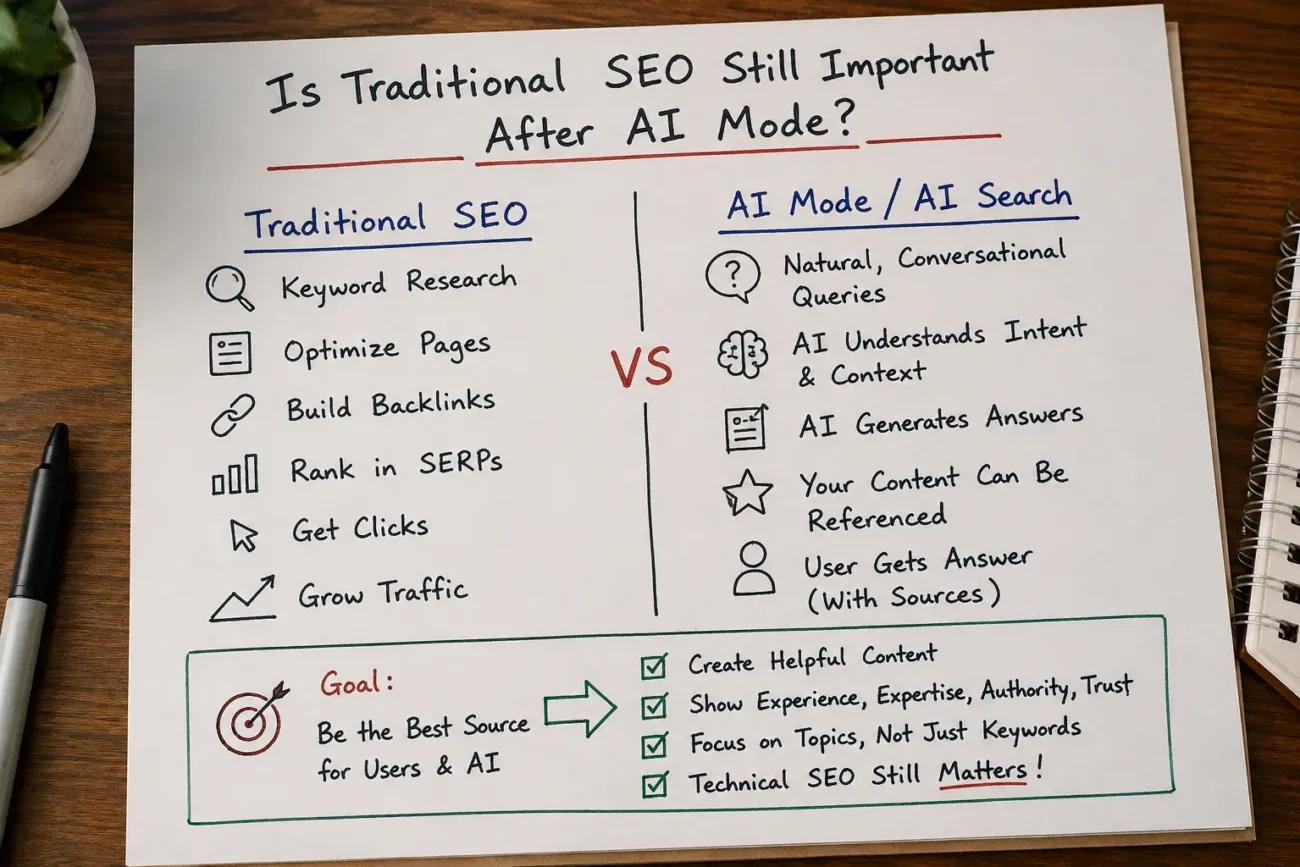
Quick Answer: Yes. Traditional SEO is still important after Google AI Mode. Google’s current guidance says its generative AI search experiences, including AI Overviews and AI Mode, are rooted in its core Search ranking and quality systems. That means crawlability, indexing, technical SEO, helpful content, search intent, site structure and overall page experience still matter. What is changing is the way people search and how Google presents information. The strongest strategy is not to replace SEO with “AI SEO,” but to strengthen traditional SEO while creating original, useful content that can perform across both traditional and AI-powered Search.
Key Takeaways
- Traditional SEO is not dead because of Google AI Mode.
- Google says its generative AI Search experiences are built on core Search ranking and quality systems.
- Technical SEO, crawling, indexing, useful content and search intent remain important.
- AI Mode makes searches more conversational, complex and exploratory, which makes comprehensive topic understanding more valuable.
- You do not need
llms.txt, special “AI schema,” artificial content chunking or a specific word count to appear in Google’s AI features. - Original, expert-led, non-commodity content is one of the strongest opportunities for visibility in AI-powered Search.
- Google introduced dedicated Generative AI performance reporting in Search Console in June 2026, although the reporting is being rolled out to a subset of websites.
Is Traditional SEO Still Important After AI Mode?
Yes. Traditional SEO remains important after Google AI Mode because Google says its generative AI Search experiences are rooted in the same core Search ranking and quality systems that power traditional Search.
Google’s official guidance is unusually direct on this question: SEO is still relevant for generative AI Search. Google explains that AI features such as AI Overviews and AI Mode use techniques including retrieval-augmented generation and query fan-out to retrieve relevant information from the web and generate responses.
That means the fundamentals still matter.
Google still needs to discover, crawl, process and understand webpages. Your content still needs to be relevant and useful. Your website still needs a sound technical foundation.
What has changed is the search experience.
Traditional Google Search often gives users a results page containing links, titles and snippets. AI Mode can provide a more conversational experience where users ask complex questions, explore follow-ups and receive synthesized responses with links to supporting webpages.
So the right question isn’t:
“Is traditional SEO dead?”
It’s:
“How should traditional SEO evolve as Google Search becomes more AI-powered?”
The answer is to keep the fundamentals and expand your strategy.
Traditional SEO vs. AI Search: What Actually Changed?
AI Mode changes how users interact with Search, but it does not remove the underlying need for websites to be discoverable, relevant and useful.
| Traditional Search | AI-Powered Search |
|---|---|
| Users often enter shorter queries | Users can ask longer, conversational questions |
| Search results primarily present links | AI can synthesize information and provide supporting links |
| Each query can be treated separately | Users can explore a topic through follow-up questions |
| Keyword research is important | Keyword research remains useful alongside broader intent |
| Pages compete for organic visibility | Pages can also be surfaced within generative AI experiences |
| Search Console tracks traditional performance | Google now also provides generative AI visibility reporting for eligible properties |
Google describes query fan-out as a process in which its AI systems generate multiple related searches to gather information relevant to the user’s original question. For example, a broad question can lead the system to investigate several related aspects before producing an answer.
This has an important implication for SEO:
You shouldn’t create a separate article for every possible variation of a search.
Instead, create genuinely useful resources that satisfy the underlying information need.
Google specifically warns against creating unnecessary pages for every possible query or fan-out variation simply to manipulate Search or generative AI visibility.
Does AI Mode Replace Traditional Google Search?
No. AI Mode changes the interface and search experience, but websites remain an important part of Google’s information ecosystem.
Google’s generative AI Search guidance explains that its systems can use retrieval-augmented generation to retrieve relevant, up-to-date webpages from the Search index and then use information from those pages to help generate responses. Google also displays prominent links to relevant webpages supporting the response.
That makes a technically sound, useful website more not less important.
A business should therefore avoid thinking about AI Mode as:
Google versus websites.
A better way to think about it is:
Google’s Search experience is evolving, while websites continue to provide the information Google can discover, evaluate and surface.
What Traditional SEO Still Does Well
1. Technical SEO Still Matters
Technical SEO remains foundational because Google needs to access and process your website before your content can become useful to Search.
Google’s current AI Search documentation recommends maintaining a clear technical structure and continuing established SEO practices. Pages need to be indexed and eligible to appear with a snippet in Google Search to be eligible for generative AI features. Google also notes that meeting technical requirements does not guarantee crawling, indexing or serving.
Important areas include:
- Crawlability
- Indexability
- Internal linking
- Canonical URLs
- XML sitemaps
- Robots.txt configuration
- Mobile accessibility
- JavaScript SEO
- Page rendering
- Duplicate URL management
- HTTP status codes
- Page experience
For example, if an important page is accidentally blocked from crawling or marked noindex, publishing another AI-focused article won’t fix that underlying problem.
AI search doesn’t eliminate technical SEO. It makes having accessible information a prerequisite for visibility.
2. Search Intent Still Matters
Understanding what a searcher actually wants remains one of the most important parts of SEO.
Consider these two searches:
SEO
and:
Is traditional SEO still important after AI Mode?
The first is broad and ambiguous.
The second has a clear information need.
The person is likely asking:
- Is SEO still worth investing in?
- What has AI Mode changed?
- Which SEO practices still matter?
- Should businesses change their SEO strategy?
- What should they prioritize now?
- Is AI SEO replacing traditional SEO?
A strong article answers those questions.
It doesn’t simply repeat the keyword throughout the page.
This is particularly important as searches become more conversational and complex.
3. Helpful Content Still Matters
AI Mode does not mean Google wants more generic AI-generated content.
Google’s guidance emphasizes unique, useful, reliable and people-first content. It specifically recommends creating non-commodity content that offers something beyond information that could easily be produced or repeated by anyone.
That distinction is becoming increasingly important.
Consider two articles.
Article A
AI is changing SEO. Businesses should adapt, create quality content and focus on users.
Article B
We compared Google’s current documentation for AI Search with established SEO principles and created a practical framework showing which SEO activities remain essential, which AI-search tactics are unnecessary and how businesses can measure their visibility.
The second article has a stronger reason to exist.
It provides:
- Evidence
- Interpretation
- Structure
- Original analysis
- Practical recommendations
That’s the type of value that is harder to replace with a generic summary.
What Makes Content More Competitive in AI Search?
Create Non-Commodity Content
The biggest opportunity is to publish information that provides something beyond a generic summary of existing pages.
Google’s current guidance specifically recommends unique viewpoints, first-hand experience and non-commodity content.
For an SEO website, that could include:
- Original research
- Campaign analysis
- First-hand SEO experiments
- Screenshots
- Case studies
- Original datasets
- Expert commentary
- Interviews
- Industry observations
- Before-and-after examples
- Practical frameworks
For example, rather than writing another generic article about “AI SEO,” an experienced SEO professional could document an actual content experiment:
What changed after updating 20 pages for search intent, internal linking and original information?
That creates evidence and experience that a generic article doesn’t have.
Don’t invent results to make content look original.
A small, transparent experiment is more valuable than an impressive statistic that cannot be verified.
Does Keyword Research Still Matter After AI Mode?
Yes. Keyword research remains useful, but modern SEO should go beyond exact-match keyword targeting.
Keywords help you understand:
- Search demand
- User language
- Search intent
- Topic variations
- Commercial opportunities
- Questions people ask
But keywords shouldn’t become the entire strategy.
Consider:
best CRM for small business
The underlying information need might be:
Which CRM is suitable for a small business based on price, features, ease of use, integrations and team size?
A page that only lists CRM products may target the keyword.
A better resource might explain:
- Who each option is suitable for
- Pricing considerations
- Key features
- Limitations
- Integrations
- Ease of implementation
- Business size
- Selection criteria
That is a more complete response to the user’s problem.
Google also says its systems can understand synonyms and general meanings, meaning publishers do not need to create content for every exact wording variation of a search.
Traditional SEO vs. AI SEO
The phrase “AI SEO” is increasingly common, but it’s important not to treat it as a completely separate discipline.
Google’s own guidance says that terms such as AEO and GEO are used to describe work focused on AI search experiences, but from Google’s perspective, optimizing for generative AI Search is still SEO.
| Traditional SEO | AI Search Optimization |
|---|---|
| Technical SEO | Technical SEO |
| Crawlability | Crawlability |
| Indexing | Indexing |
| Search intent | Search intent + complex information needs |
| Keyword research | Keyword research + topic understanding |
| Helpful content | Helpful, original, non-commodity content |
| Internal linking | Clear information architecture |
| Authority | Relevant and legitimate authority |
| Organic rankings | Organic + generative AI visibility |
| Search Console | Search Console + generative AI reporting |
The overlap is much larger than the difference.
AI search optimization is better understood as an extension of strong SEO rather than a replacement for it.
What SEO Tactics Should You Stop Overvaluing?
AI search has created a huge number of new SEO theories.
Some are useful.
Others aren’t supported by Google’s own documentation.
Myth 1: You Need llms.txt to Appear in Google AI Mode
You don’t.
Google explicitly says that Google Search does not use llms.txt or other special AI text files for Search visibility or rankings. Google also says these files neither help nor hurt Google Search visibility.
Other AI systems may choose to use different technologies, but don’t confuse those with a Google Search requirement.
Myth 2: You Need Special “AI Schema”
You don’t need special schema for AI Mode.
Google says structured data is not required for generative AI Search and that there is no special Schema.org markup you need to add for this purpose. Structured data can still be useful as part of your broader SEO strategy and for eligibility for applicable Search features.
So don’t invent schema such as:
AIOverviewSchema
or:
GenerativeAISEO
There is no official Schema.org type that guarantees AI Overview or AI Mode visibility.
Myth 3: You Need to Break Every Article Into Tiny “AI Chunks”
No.
Google says there is no requirement to break content into tiny pieces so that AI systems can understand it. Its systems can understand the relationships and nuances between topics on a page.
Use headings, tables, lists and short paragraphs because they help people read and navigate your content.
Don’t create artificial fragments solely because an SEO tool says AI prefers them.
Myth 4: Longer Content Automatically Performs Better
There is no magic word count for Google Search or AI Mode.
Google explicitly says there is no preferred word count.
A 1,200-word article that completely answers a question can be better than a 3,500-word article filled with repetition.
The correct question isn’t:
“How many words do I need?”
Ask:
“What does the reader need to know to make a useful decision?”
Then answer it completely.
Myth 5: Every AI Search Query Needs a New Article
Creating a separate article for every related search can make your website worse rather than better.
Google warns against creating large amounts of content primarily to manipulate rankings or generative AI responses. It specifically notes that creating separate content for every possible variation or fan-out query is not an effective long-term strategy.
Instead:
One genuine user need → one genuinely useful resource.
Create supporting content when it serves a distinct purpose not simply because a keyword tool generated another variation.
Does Backlink Building Still Matter?
Authority and relevant references remain part of broader SEO, but there is no published Google formula that says a specific number of backlinks will make a page appear in AI Mode.
That distinction matters.
Don’t build links because you believe:
“50 backlinks = AI Overview.”
Instead, build things worth referencing.
Examples include:
- Original research
- Industry studies
- Useful tools
- Unique datasets
- Expert resources
- In-depth guides
- Original analysis
- Digital PR
The goal is to earn legitimate recognition rather than manufacture mentions.
Google’s AI Search guidance also warns against pursuing inauthentic mentions simply because you think they might influence generative AI visibility.
Does E-E-A-T Matter After AI Mode?
The practical principles behind experience, expertise, authoritativeness and trust remain highly relevant to creating useful content, but you should not treat E-E-A-T as a simple ranking score.
For an expert-led website, demonstrate credibility rather than simply claiming it.
For example:
Weak
We are SEO experts and provide the best AI SEO advice.
Stronger
This analysis is based on Google’s published AI Search documentation, combined with our practical SEO experience and documented observations.
Even better:
- Identify the author
- Provide a useful author page
- Explain relevant experience
- Cite primary sources
- Show original work
- Correct mistakes
- Keep important information current
For your own website, your Sanjay author profile can support this strategy when it accurately describes your experience and role.
How Should Content Strategy Change After AI Mode?
The biggest strategic shift is from producing pages for keywords to building genuinely useful resources around user problems.
A stronger workflow looks like this:
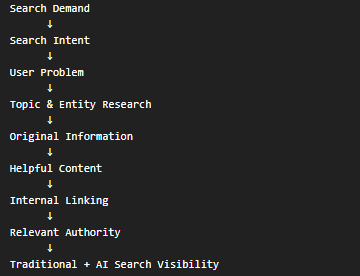
This doesn’t mean keywords are irrelevant.
It means keywords become inputs into a larger content strategy.
What Should Businesses Do After Google AI Mode?
Step 1: Fix Technical SEO First
Make sure Google can access the pages that matter.
Audit:
- Crawling
- Indexing
- Internal links
- Canonicals
- XML sitemap
- Robots.txt
- JavaScript rendering
- Mobile accessibility
- Page experience
Google recommends continuing these foundational practices for generative AI Search.
Step 2: Audit Existing Content
Don’t immediately publish 100 new AI-generated articles.
First examine what you already have.
Find pages that:
- Are outdated
- Don’t satisfy search intent
- Repeat competitors
- Contain little original information
- Have weak internal links
- Have impressions but poor engagement
- Compete with other pages on your own website
- No longer represent your expertise
Improving an existing useful page can be more valuable than adding another generic article.
Step 3: Add Original Information
Ask:
What does this page provide that competing pages don’t?
If the answer is:
“Nothing.”
you have identified the biggest content opportunity.
Add:
- Original examples
- First-hand experience
- Research
- Data
- Screenshots
- Case studies
- Expert analysis
- Comparisons
- Practical frameworks
Step 4: Build Logical Topic Coverage
Don’t create pages simply because a keyword tool suggests them.
Create supporting content when users genuinely need it.
For example, your AI SEO content cluster could look like:
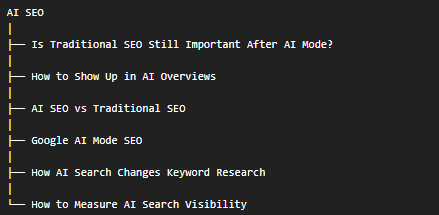
Each page should answer a different primary question.
That gives users a logical journey rather than a collection of near-duplicate articles.
Step 5: Strengthen Internal Linking
Internal links help users and search engines discover related resources.
This creates a logical relationship between the two resources rather than allowing them to compete with each other.
If you want to learn how to improve your chances of appearing in Google’s AI Overviews, read our guide to How to Show Up in AI Overviews.
This creates a logical relationship between the two resources rather than allowing them to compete with each other.
Step 6: Demonstrate First-Hand Expertise
This is where many AI-generated SEO articles fall short.
Don’t just explain what Google says.
Interpret it.
For example:
Google’s guidance makes an important distinction: there isn’t a separate technical checklist for “AI SEO” that replaces traditional SEO. The practical implication for businesses is that an AI-search strategy should start with the same crawlability, indexing, content and site-quality fundamentals used for conventional Search.
That is more valuable than simply copying Google’s documentation into a blog post.
Step 7: Measure AI Search Visibility
Don’t measure your SEO strategy exclusively through traditional keyword rankings anymore.
Google launched Generative AI performance reports in Search Console in June 2026. These reports provide dedicated views of impressions from generative AI features such as AI Overviews and AI Mode. Google says the reports are initially being rolled out to a subset of websites.
The reports can provide information such as:
- Impressions
- Pages appearing in AI features
- Countries
- Devices
- Dates
That gives SEO teams another way to understand how their content is being discovered.
A broader measurement framework can look like this:
| Metric | What It Measures |
|---|---|
| Organic impressions | Traditional Search visibility |
| Organic clicks | Visits from traditional Search |
| Average position | Traditional ranking visibility |
| Organic CTR | How effectively impressions generate clicks |
| AI-generated impressions | Visibility in generative AI features |
| AI-visible pages | Which URLs appear in AI features |
| Leads | Business outcomes |
| Revenue | Commercial impact |
Don’t optimize for AI visibility at the expense of business results.
A page appearing in an AI feature is useful, but the ultimate goal may be:
Visibility → Visit → Engagement → Lead → Customer
What Does This Mean for SEO Professionals?
The SEO professional’s role is becoming broader.
Instead of asking only:
“How do I rank this keyword?”
you should increasingly ask:
“How can this website become the most useful source for the underlying information need?”
That requires understanding:
- Search intent
- Technical SEO
- Content strategy
- Information architecture
- Entity relationships
- Original research
- User experience
- Internal linking
- Authority
- Conversion paths
- Traditional Search visibility
- Generative AI visibility
This doesn’t make SEO less important.
It makes good SEO more strategic.
Traditional SEO vs. AI SEO: Myth vs. Reality
| Myth | Reality |
|---|---|
| AI Mode has killed SEO | Google says SEO best practices remain relevant |
| Keywords are dead | Keywords still help understand search demand and language |
You need llms.txt | Google says it isn’t used for Search visibility |
| You need special AI schema | Google says no special schema is required |
| Longer content automatically wins | Google says there is no preferred word count |
| Every AI query needs a separate article | Google warns against unnecessary content created for query variations |
| AI content automatically ranks | Content still needs to satisfy Google’s quality and spam policies |
| More mentions automatically mean more AI visibility | Google warns against inauthentic mentions |
| Technical SEO is becoming irrelevant | Google explicitly says foundational technical SEO remains important |
| Traditional SEO and AI SEO are completely separate | Google describes generative AI optimization as part of SEO |
A Practical SEO Framework for the AI Mode Era
Use this framework when deciding what to prioritize.
1. Crawl
Can Google access the important content?
2. Index
Can the important pages be indexed and appear in Search?
3. Understand
Is the site’s structure and content clear?
4. Satisfy
Does the page actually answer the user’s question?
5. Differentiate
Does it provide something competitors don’t?
6. Demonstrate
Does it show genuine expertise or first-hand experience?
7. Connect
Are related pages logically connected through internal links?
8. Earn
Does the website have legitimate recognition and relevant references?
9. Measure
Are you tracking both traditional and generative AI visibility?
10. Improve
Are you using actual evidence to improve the site rather than chasing every new SEO theory?
Decision Tree: What Should You Prioritize?
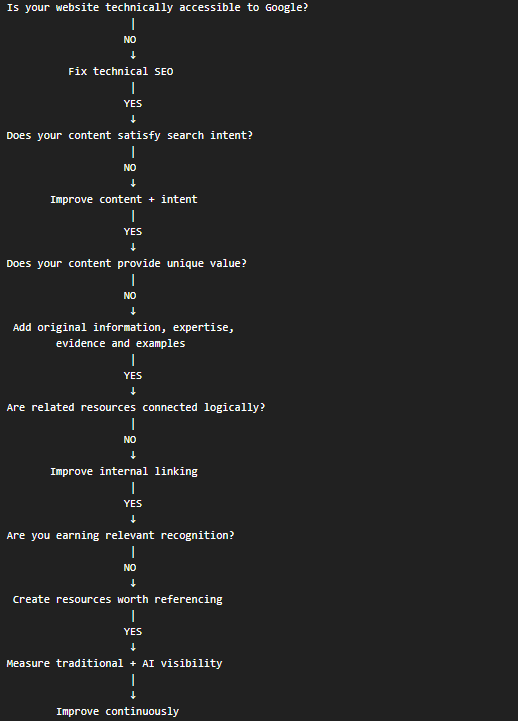
Conclusion: Traditional SEO Isn’t Dead, It’s Evolving
Traditional SEO is still important after Google AI Mode.
The biggest mistake a business can make is assuming that the arrival of AI-powered Search means everything about SEO has become obsolete.
Google’s own guidance says the opposite.
Its generative AI Search experiences are rooted in core Search ranking and quality systems, and Google recommends continuing foundational SEO practices. That includes maintaining a clear technical structure and creating unique, valuable content for people.
What has changed is the search experience.
People can ask more complex questions.
They can explore topics conversationally.
They can ask follow-up questions.
And Google’s AI systems can investigate related searches and synthesize information from multiple sources.
That means SEO should become more useful, more evidence-driven and more focused on the underlying information need not abandoned.
Keep your technical SEO strong.
Keep researching search intent.
Keep creating helpful content.
Keep building logical internal links.
Keep demonstrating genuine expertise.
But don’t stop there.
Add original research, first-hand experience, unique data and useful analysis wherever you can.
And instead of chasing every new “AI SEO hack,” use Google’s own guidance as your baseline.
There is no special llms.txt requirement.
There is no magic AI schema.
There is no perfect word count.
There is no requirement to artificially split every article into tiny chunks.
And there is no guarantee that any individual tactic will make your content appear in an AI response.
The more durable strategy is much simpler:
Create a technically accessible website with useful, original, trustworthy content that genuinely satisfies what people are searching for.
That’s good SEO today.
And according to Google’s current guidance, it’s also the foundation for visibility in its AI-powered Search experiences.
Need Help Adapting Your SEO Strategy for AI Search?
Google Search is evolving, but abandoning SEO isn’t the answer.
The better approach is to identify weaknesses in your technical SEO, content, search intent, internal linking and overall site structure and then build an SEO strategy that can perform across both traditional and AI-powered Search.
Explore AI SEO services to identify opportunities for stronger organic and AI-search visibility.
Frequently Asked Questions
Is traditional SEO dead because of AI Mode?
No. Google explicitly says that SEO best practices remain relevant because its generative AI Search experiences are rooted in Google’s core Search ranking and quality systems.
Does SEO still work with Google AI Mode?
Yes. Crawlability, indexing, technical SEO, helpful content, search intent and a clear site structure remain important parts of Google’s Search ecosystem.
Will AI Mode replace organic search?
AI Mode changes the Search experience, but it does not make websites irrelevant. Google’s AI Search systems can retrieve information from webpages and provide links to relevant sources.
Should I stop doing keyword research?
No. Keyword research remains useful for understanding search demand and the language people use. However, it should be combined with search intent, topic understanding and the underlying problem the user is trying to solve.
Is AI SEO different from traditional SEO?
There is significant overlap. Google describes optimization for generative AI Search as SEO and recommends continuing foundational SEO practices rather than replacing them with a separate set of AI hacks.
Do I need llms.txt to appear in Google AI Mode?
No. Google says its Search systems don’t use llms.txt or other special AI text files for Search visibility or rankings.
Do I need special schema for AI Mode?
No. Google says there is no special Schema.org markup required for generative AI Search. Appropriate structured data can still be useful for your broader SEO strategy and applicable Search features.
Is there a specific word count for AI Mode?
No. Google says there is no preferred word count. Content should be long enough to satisfy the user’s needs without unnecessary repetition.
Does technical SEO still matter after AI Mode?
Yes. Google recommends continuing technical SEO best practices and says pages need to meet Search technical requirements and be indexed and eligible to appear with a snippet to be eligible for generative AI features.
How can I measure AI Mode visibility?
Google introduced Generative AI performance reports in Search Console in June 2026. The reports provide dedicated visibility data for generative AI features such as AI Overviews and AI Mode and are being rolled out to a subset of websites.
Should businesses invest in traditional SEO or AI SEO?
Both but start with traditional SEO fundamentals. The strongest strategy is to maintain technical SEO, create helpful and original content, understand search intent, build a logical website structure and then measure how that content performs across traditional and AI-powered Search.
