
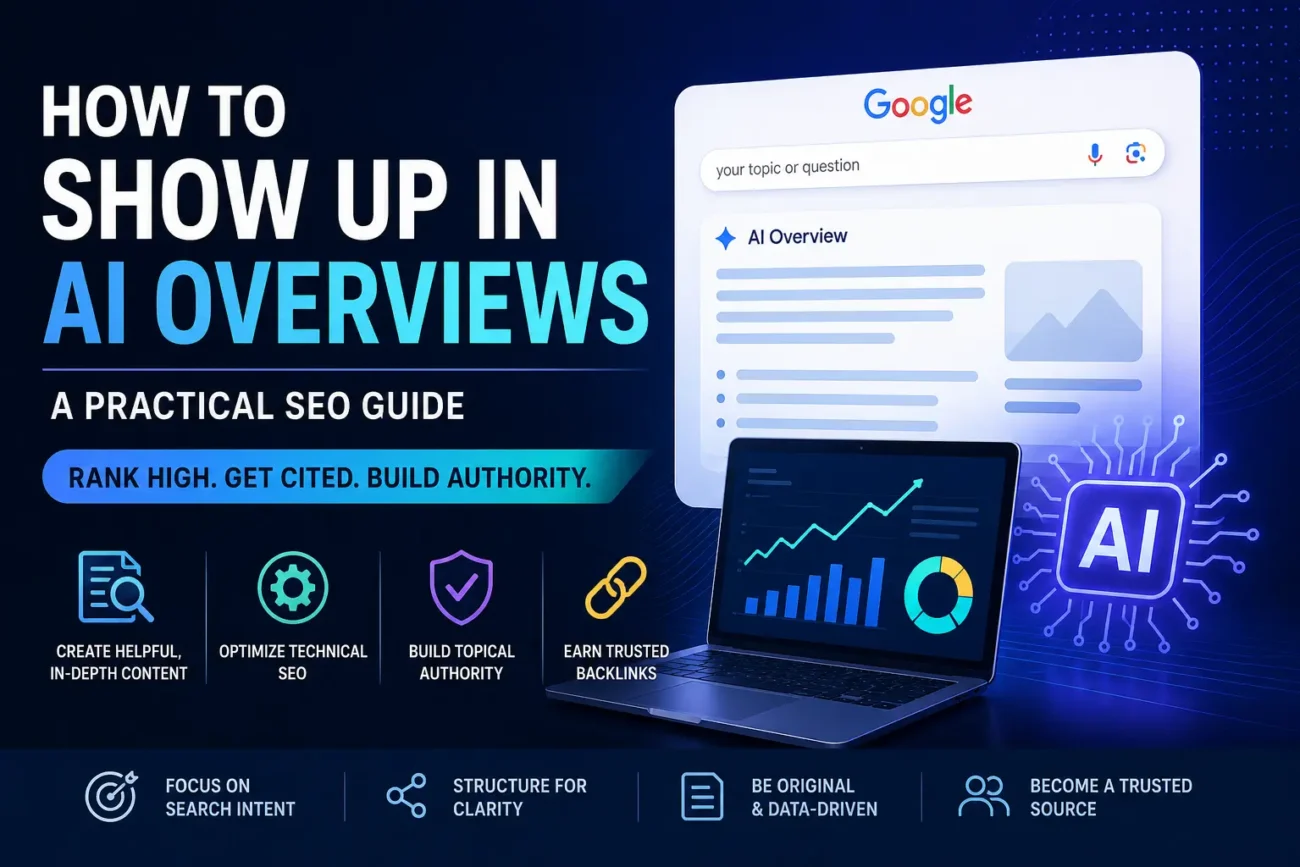
Quick Answer: There is no guaranteed method for getting a page cited in Google AI Overviews. The strongest approach is to build on Google’s established SEO fundamentals: make your content crawlable and indexable, satisfy search intent, publish helpful and original information, demonstrate relevant expertise, and build a technically sound website. Google says AI Overviews and AI Mode use its Search systems, including query fan-out, to find relevant information. There is also no special AI Overview schema, required word count, or llms.txt file that guarantees visibility.
Key Takeaways
- Traditional SEO still matters: Google says its generative AI search features are rooted in its core Search ranking and quality systems.
- There is no AI Overview hack: Google does not require special AI markup, a particular word count, content “chunking,” or
llms.txtto appear in its generative search experiences. - Query fan-out matters: Google may generate related searches to find additional information before constructing an AI response.
- Organic rankings are relevant, but not a guarantee: Independent research has found substantial overlap between traditional rankings and AI Overview citations, although newer research shows that AI citations can also come from pages outside the original top 10.
- Original information is an opportunity: Google recommends unique, valuable, people-first content rather than commodity content that simply repeats what is already available.
- Measure AI visibility: Google launched dedicated Search Console reporting for generative AI visibility, including AI Overviews and AI Mode, with availability rolling out to websites.
What Is AI Overview SEO?
AI Overview SEO is the practice of improving a website’s overall search visibility and content quality so its pages are eligible to be considered as sources in Google’s AI-powered search experiences.
Google does not describe AI Overview optimization as a completely separate form of SEO.
In its current guidance, Google says that AI Overviews and AI Mode are built on its core Search ranking and quality systems. Its generative AI systems can retrieve information from the Search index and use it to generate responses with links to relevant webpages.
That means the foundation remains familiar:
- Technical SEO
- Crawlability
- Indexability
- Search intent
- Helpful content
- Internal linking
- Relevant structured data
- Original information
- Good page experience
- Relevant authority
The difference is how your content can be presented.
Instead of appearing only as a traditional organic result, your page may be selected as a supporting source within an AI-generated response.
Can You Guarantee an AI Overview Citation?
No. There is currently no legitimate SEO technique that guarantees a website will appear in an AI Overview.
Google’s documentation makes an important distinction: meeting technical requirements and following best practices makes a page eligible, but Google does not guarantee that it will crawl, index or serve the page.
The same principle applies to AI Overview visibility.
You can improve your eligibility and the quality of your content, but you cannot force Google to cite a particular URL.
Be skeptical of anyone promising:
- Guaranteed AI Overview placement
- Guaranteed AI citations
- A secret AI ranking score
- A specific word count that guarantees citations
- A special schema that guarantees AI visibility
- A guaranteed
llms.txtstrategy
Those claims go beyond what Google has publicly documented.
How Google AI Overviews Find Information
Google’s AI search systems can retrieve information from the web and perform related searches to build a response.
Google describes two particularly important concepts in its current documentation:
Retrieval-Augmented Generation
Google says its generative AI features can use retrieval-augmented generation, or RAG, to retrieve relevant and up-to-date information from Google’s Search index before generating an answer.
Query Fan-Out
Google also explains that its systems can use query fan-out.
Instead of relying solely on the exact query entered by the user, the system can generate multiple related searches to explore different aspects of the topic.
For example, a user might search:
How can I show up in Google AI Overviews?
Related searches could explore questions such as:
- How do Google AI Overviews work?
- Does traditional SEO affect AI Overviews?
- Does a page need to be indexed?
- What content does Google consider helpful?
- Does structured data matter?
- How can AI Overview visibility be measured?
This has an important implication for content strategy:
Don’t optimize a page only for one exact keyword. Build content that comprehensively satisfies the underlying information need.
That does not mean creating dozens of thin pages targeting every keyword variation.
Google specifically advises against creating unnecessary content simply to capture different search variations.
Does Traditional SEO Still Matter for AI Overviews?
Yes. Traditional SEO remains an important foundation for Google’s generative AI search experiences.
Google explicitly says that its AI search features are rooted in its core Search ranking and quality systems.
That means you should not abandon:
- Keyword research
- Search intent analysis
- Technical SEO
- Internal linking
- Content optimization
- Site architecture
- Page experience
- Authority building
- Search Console monitoring
Instead, think of AI search as an additional layer of visibility.
Traditional SEO
Your goal is to earn visibility in Google’s organic results.
AI Overview SEO
Your goal is to create content that is eligible, relevant, useful and valuable enough to potentially be selected as supporting information within Google’s generative search experience.
The foundations overlap considerably.
Does Ranking in the Top 10 Help You Appear in AI Overviews?
It can help, but ranking in the top 10 does not guarantee an AI Overview citation.
This is an area where SEO research has evolved.
An Ahrefs study published in July 2025 analyzed approximately 1.9 million citations from 1 million AI Overviews and found that 76.1% of cited pages ranked in Google’s top 10.
However, Ahrefs published newer research in 2026 showing a substantially different distribution, with about 37.1% of cited URLs appearing in the traditional top 10 for the original query in its later test. The research suggests that query fan-out and related searches can influence which pages are discovered and cited.
This is an important distinction.
It would be inaccurate to say:
“Rank #1 and Google will cite you.”
A more defensible conclusion is:
Strong organic visibility is valuable, but AI Overview source selection can extend beyond the original query’s traditional search results.
This makes broader topical coverage particularly important.
Create Content That Provides Information Gain
One of the strongest ways to differentiate your content is to provide something competitors do not.
Google’s current guidance recommends creating unique, valuable, non-commodity content that provides genuine value to users.
Consider two articles.
Article A
AI SEO is important because AI search is becoming more popular. Businesses should create helpful content and optimize their websites.
Article B
We analyzed 100 commercial and informational queries, recorded which pages appeared in AI Overviews, compared cited URLs with organic rankings, and identified the content characteristics shared by the cited pages.
Article B provides something that readers cannot get simply by asking another AI tool to summarize existing SEO advice.
That is information gain.
For an AI SEO website, useful original assets could include:
- AI Overview SERP analysis
- Original datasets
- Case studies
- Search Console observations
- Content experiments
- Competitor comparisons
- Screenshots
- First-hand testing
- Expert interviews
- Industry surveys
- Before-and-after content audits
Do not manufacture research or statistics.
A small, transparent study that you actually conducted is more valuable than a fabricated “10,000-page analysis.”
Demonstrate First-Hand Expertise
Show readers what you actually know and what you have actually done.
For SEO content, first-hand experience could include:
- How you conducted a SERP audit
- What happened after improving a page
- What technical problems you discovered
- How you structured a content hub
- What changed after improving internal links
- How you monitored AI Overview visibility
- What experiments failed
- What you learned from testing
Google’s guidance emphasizes creating useful, reliable, people-first content and adding unique value rather than producing commodity information.
The key is authenticity.
Don’t claim:
“We tested this on 5,000 websites.”
unless you actually did.
Instead, say:
“We analyzed 50 pages across three industries…”
if that is what you really analyzed.
Optimize for Search Intent First
Your page should answer the user’s actual question before trying to optimize for AI systems.
For the query:
how to show up in AI Overviews SEO
the dominant intent is informational.
The reader wants to understand:
- Whether AI Overview visibility is possible
- How Google finds sources
- What SEO factors matter
- What Google officially recommends
- What tactics are myths
- How to improve a website
- How to measure results
A strong article should therefore explain the subject rather than immediately trying to sell an AI SEO service.
Commercial calls to action can come later, once the reader has received genuine value.
Make Important Answers Easy to Find
Answer important questions directly before expanding on them.
For example:
Does AI Overview SEO require special schema?
No. Google says there is no special Schema.org markup required for AI Overviews or AI Mode.
Structured data can still be useful for your broader SEO strategy and eligibility for certain Search features, but Google does not recommend a special “AI Overview schema.”
This format is useful because:
- Readers can find the answer quickly.
- Important concepts are clearly defined.
- The page has a logical information structure.
- Complex subjects become easier to navigate.
But avoid artificial formulas such as making every answer exactly 50 words.
Google does not require that.
Is There an Ideal Word Count for AI Overviews?
No. Google does not specify an ideal word count for AI Overview visibility.
Google’s current guidance explicitly says there is no ideal page length and that content should be created for the audience rather than for generative AI systems.
A 1,000-word article can be better than a 3,000-word article if it answers the question more effectively.
Likewise, a complex topic may genuinely require 3,000 or 5,000 words.
The objective should be:
Complete coverage without unnecessary filler.
Don’t add 1,000 words just because an SEO tool recommends a particular content length.
Do You Need to Create llms.txt?
No—not for Google Search or Google AI Overviews.
Google’s current documentation explicitly states that Google Search does not use llms.txt and that creating one will neither help nor hurt your visibility or rankings in Google Search.
You may encounter recommendations claiming that llms.txt is essential for AI SEO.
For Google specifically, that is not supported by Google’s documentation.
If another AI service eventually uses such a file for its own purposes, that is a separate consideration.
But it should not be treated as a Google AI Overview ranking requirement.
Do You Need Special AI Schema?
No.
Google says there is no special Schema.org markup required for AI Overviews or AI Mode.
That does not mean structured data is useless.
Appropriate structured data can still help Google understand your content and can support eligibility for relevant Search features.
For example, depending on the page, you may use appropriate structured data such as:
ArticleBreadcrumbListOrganizationPersonWebSite
The important rule is accuracy.
Your structured data should represent information that is actually present on the page and should follow Google’s structured-data guidelines.
Build a Strong Internal Linking Structure
Internal links help users and search engines discover related content across your website.
For an AI SEO website, you could build a topic cluster around:
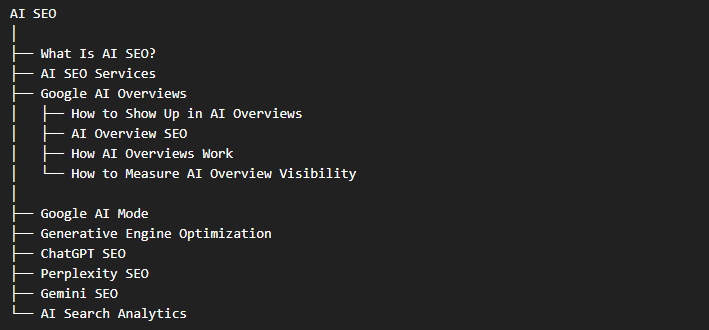
The pages should be genuinely useful individually.
Don’t create pages simply because a keyword tool shows another variation.
Link related articles naturally using descriptive anchor text.
For example:
Learn more about AI SEO services and generative search optimization.
This is more useful than:
Click here.
Strengthen Technical SEO Before Chasing AI Search
A page cannot benefit from Google Search visibility if Google cannot properly access or process it.
Google’s minimum technical requirements include:
- Googlebot is not blocked.
- The page returns a successful HTTP status.
- The page contains indexable content.
For AI search specifically, Google says pages must be indexed and eligible to appear in Google Search with a snippet to be eligible for supporting links in generative AI features.
Technical checklist
| Area | What to check |
|---|---|
| Crawling | Googlebot can access the page |
| Indexing | Page is eligible for indexing |
| HTTP status | Page returns 200 where appropriate |
| Robots.txt | No accidental blocking |
| Meta robots | No accidental noindex |
| Canonical | Correct canonical URL |
| Internal links | Page is discoverable |
| JavaScript | Important content is accessible |
| Mobile | Page works properly on mobile |
| Page experience | Content is easy to use |
| Main content | Important information is available as text |
Meeting these requirements does not guarantee indexing or rankings, but failing them can prevent visibility.
Use Text, Images and Video Together
AI search is not limited to plain text, and neither should your content strategy be.
Google recommends supporting textual content with high-quality images and videos for multimodal search experiences.
For an AI SEO article, you could include:
- SERP screenshots
- AI Overview screenshots
- Original charts
- Process diagrams
- Video explanations
- Before-and-after examples
However, make sure important information is also available as accessible text.
For example, if an image contains:
“37% of cited URLs ranked in the top 10”
the article should not rely solely on the image to communicate that information.
Build Authority the Right Way
Don’t try to manufacture authority through artificial mentions or links.
Google specifically warns against pursuing inauthentic mentions as a generative AI optimization tactic. Its systems continue to focus on quality and spam prevention.
Instead, build legitimate authority through:
- Original research
- Expert contributions
- Industry publications
- Digital PR
- Relevant editorial links
- Interviews
- Podcasts
- Case studies
- Useful resources
- Genuine partnerships
The objective isn’t to collect a predetermined number of backlinks.
The objective is to become a source that other relevant websites have a legitimate reason to reference.
AI Overview SEO vs Traditional SEO
| Factor | Traditional SEO | AI Overview Visibility |
|---|---|---|
| Crawlability | Essential | Essential |
| Indexing | Essential | Essential |
| Search intent | Essential | Essential |
| Helpful content | Essential | Essential |
| Technical SEO | Essential | Essential |
| Internal linking | Important | Important |
| Organic rankings | Core objective | Useful source of visibility |
| Original information | Valuable | Highly valuable |
| Query fan-out | Less visible to publishers | Important concept |
| Structured data | Useful where applicable | No special AI schema |
llms.txt | Not required | Not used by Google Search |
| Word count | No fixed requirement | No fixed requirement |
| AI citation | Not applicable | Additional visibility opportunity |
The most important takeaway is:
AI Overview optimization should complement traditional SEO, not replace it.
How to Measure AI Overview Visibility
Don’t measure AI SEO only by whether you received one citation. Measure visibility, traffic and business outcomes together.
Google launched new Search Generative AI performance reports in Search Console in June 2026. These reports provide dedicated views of visibility in generative AI features such as AI Overviews and AI Mode, with the rollout initially limited to a subset of websites.
Where the reporting is available, monitor:
- Generative AI impressions
- Search queries
- Pages receiving visibility
- Clicks
- CTR
- Conversions
- Leads
- Revenue
You can also use third-party tools to monitor AI citations.
However, don’t confuse a third-party visibility score with Google’s actual ranking algorithm.
Google specifically advises caution when evaluating third-party SEO tools and recommendations because those providers do not have access to Google’s internal ranking systems.
A Practical AI Overview SEO Strategy
Step 1: Choose a Valuable Topic
Start with a real user problem rather than a keyword alone.
Step 2: Identify Search Intent
Determine whether the query is:
- Informational
- Commercial investigation
- Transactional
- Navigational
Then build the page around that intent.
Step 3: Analyze the SERP
Study:
- Organic results
- AI Overview presence
- Featured snippets
- People Also Ask
- Related searches
- Content formats
- Competitor weaknesses
Step 4: Map Related Questions
Identify the important questions surrounding the main topic.
Step 5: Create the Best Useful Resource
Answer the main question early, then expand with evidence, examples and practical advice.
Step 6: Add Information Gain
Give readers something competitors don’t have.
That could be:
- Original research
- Data
- Testing
- Case studies
- Expert analysis
- First-hand experience
Step 7: Improve Technical SEO
Make sure Google can crawl, understand and index the page.
Step 8: Build Internal Connections
Link the article to relevant supporting resources and create a logical topic cluster.
Step 9: Build Genuine Authority
Earn relevant links and mentions through valuable work rather than artificial promotion.
Step 10: Measure Results
Use Search Console and other appropriate tools to monitor organic and generative AI visibility.
Step 11: Update With Evidence
Update the page when Google’s documentation, the underlying topic or your own research changes.
AI Overview SEO Checklist
Content
- Main question answered immediately
- Search intent clearly satisfied
- Content is original
- Important claims are accurate
- Reliable sources support factual claims
- Examples are included
- No unnecessary filler
- Content provides information beyond competitors
Technical SEO
- Googlebot can access the page
- Page is indexable
- No accidental
noindex - Correct canonical
- Important content is accessible
- Internal links point to the page
- Page works well on mobile
- Page experience is good
AI Search
- Important questions are answered directly
- Related concepts are covered naturally
- Content demonstrates genuine expertise
- Original information is included
- No unsupported AI SEO hacks are being used
- AI visibility is monitored where possible
Authority
- Author is identified
- Relevant expertise is demonstrated
- External sources are credible
- Links and mentions are earned naturally
- No fabricated statistics or case studies
Common AI Overview SEO Myths
Myth: You Must Rank #1
False.
There is no Google rule saying that only the #1 organic result can be cited.
Research indicates a relationship between organic visibility and AI Overview citations, but AI Overview source selection can also extend beyond the original top 10.
Myth: There Is a Perfect AI Overview Word Count
False.
Google says there is no ideal page length.
Myth: You Need AI Overview Schema
False.
Google says no special schema is required for AI Overviews or AI Mode.
Myth: You Need llms.txt
False for Google Search.
Google Search ignores llms.txt for ranking and visibility purposes.
Myth: Every Paragraph Should Be “AI Optimized”
Unsupported.
Google says you do not need to rewrite content in a special way specifically for generative AI search. Its systems can understand synonyms and related meanings.
Myth: You Need a Separate Article for Every Long-Tail Keyword
False.
Google recommends creating helpful content rather than generating unnecessary pages for every possible search variation.
Myth: AI-Generated Content Automatically Cannot Rank
False.
Google’s concern is not simply whether AI was used. The problem arises when automation is used to produce content at scale without providing value, including content that violates Google’s spam policies.
Final Thoughts
There is no secret formula for ranking in Google AI Overviews. The strongest strategy is to become a genuinely useful source that Google can discover, understand and retrieve.
Start with technical SEO.
Then build around search intent.
Create content that genuinely answers the user’s question.
Go beyond information that every competitor already publishes.
Add original research, first-hand experience, useful examples and credible evidence.
Build a strong internal linking structure.
Earn legitimate authority.
Then measure both traditional organic visibility and generative AI visibility.
Google’s own guidance is consistent on the central point: the fundamentals of SEO still apply to generative AI search. Google recommends unique, valuable, people-first content and explicitly says that publishers do not need special AI files, special AI markup, artificial content chunking or a particular page length to succeed in its AI search experiences.
And there is one important lesson to take from the latest research:
Don’t optimize only for the original keyword.
Because Google can use query fan-out, the page that eventually gets cited may be discovered through related searches rather than only the exact query the user typed.
So the real objective is bigger than:
“How do I rank for this keyword?”
Think instead:
“How can I become one of the most useful and trustworthy sources for the entire information need behind this search?”
That approach gives your website the strongest foundation for traditional Google rankings and visibility across Google’s evolving AI search experiences.
Frequently Asked Questions
How do I show up in Google AI Overviews?
Follow Google’s foundational SEO guidance: make your page accessible and indexable, satisfy search intent, publish useful and original content, and follow Google’s Search Essentials. There is no guaranteed AI Overview placement technique.
Can I guarantee an AI Overview citation?
No. You can optimize for eligibility, relevance and quality, but Google does not provide a method for guaranteeing that a particular page will be cited.
Does ranking #1 guarantee an AI Overview citation?
No. Independent research has found significant overlap between organic rankings and AI Overview citations, but newer research also shows that cited pages can come from outside the original top 10.
Does traditional SEO still matter for AI Overviews?
Yes. Google says its generative AI search features are rooted in its core Search ranking and quality systems.
Do I need special schema for AI Overviews?
No. Google says there is no special Schema.org markup required for AI Overviews or AI Mode.
Does llms.txt improve Google AI Overview visibility?
No. Google Search does not use llms.txt and says the file will neither improve nor hurt Search visibility or rankings.
What is query fan-out?
Query fan-out is Google’s term for generating multiple related searches to retrieve additional information that can help answer the user’s original query.
Is there a perfect word count for AI Overview SEO?
No. Google says there is no ideal page length. Content should be long enough to satisfy the user’s needs without unnecessary filler.
How can I measure AI Overview visibility?
Google introduced dedicated Search Console reporting for generative AI visibility, including AI Overviews and AI Mode, although the reporting is being rolled out to websites.
Does structured data help with AI Overviews?
Structured data can support your overall SEO and eligibility for certain Search features, but Google says there is no special structured data required specifically for generative AI search.
Can AI-generated content appear in Google Search?
Yes, but the content still needs to comply with Google’s Search policies. Using generative AI to mass-produce low-value pages without adding value can fall under Google’s scaled content abuse policy.
