
Quick Answer
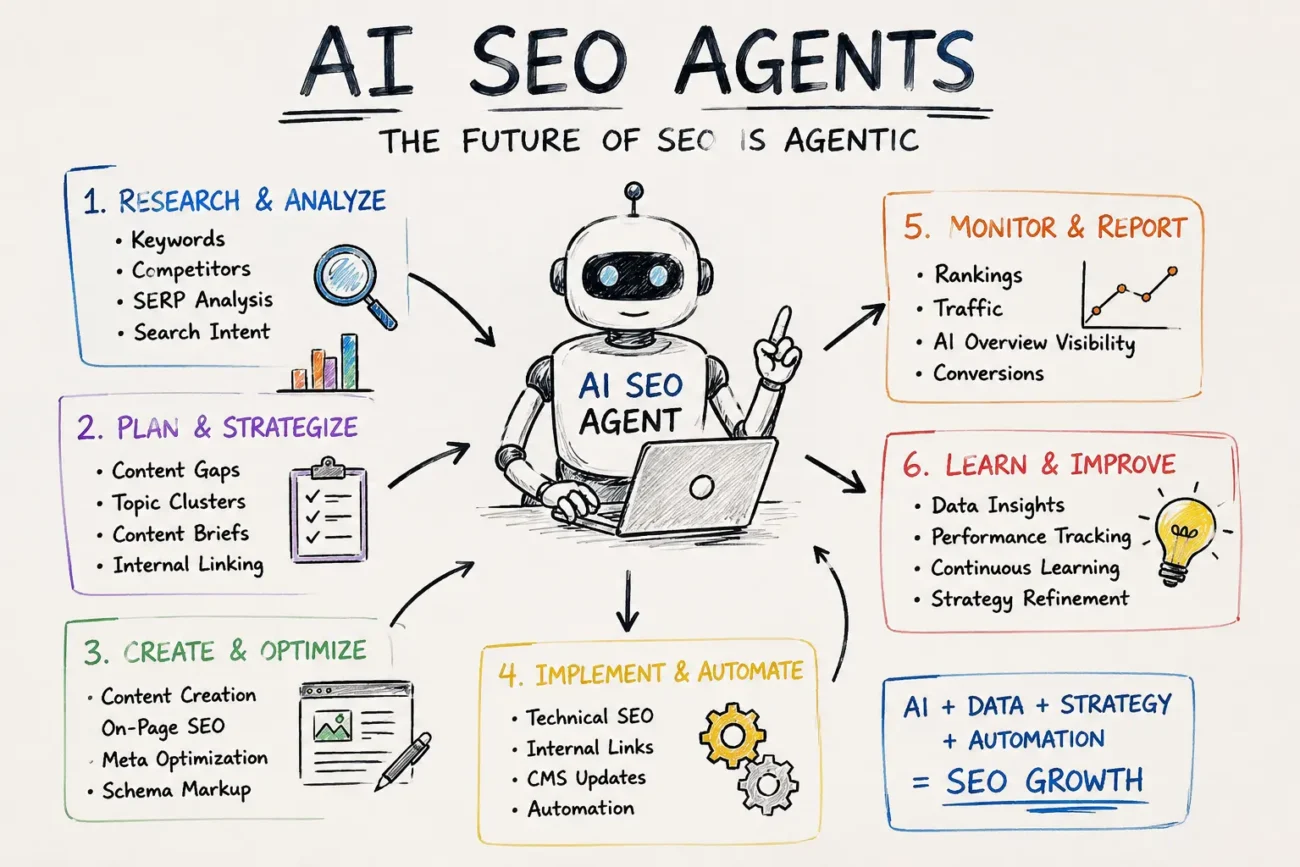
An AI SEO agent is an AI-powered system that can work toward an SEO goal by collecting data, planning multiple steps, analyzing information, taking approved actions, and verifying results. Unlike a traditional SEO tool that mainly provides reports or recommendations, an AI SEO agent can connect multiple SEO tasks into a workflow. In 2026, AI SEO agents are being used for keyword research, competitor analysis, content optimization, technical SEO, internal linking, reporting, and AI search visibility. The most reliable approach combines AI automation with real SEO data, human oversight, and verification.
Key Takeaways
- An AI SEO agent is different from a simple AI writing tool or SEO chatbot.
- The defining characteristic is its ability to work through multi-step tasks toward a defined objective.
- AI SEO agents work best on repetitive, data-heavy, and measurable SEO workflows.
- Real SEO data is critical because an AI model without reliable data can produce plausible but incorrect recommendations.
- Human approval remains important for high-impact changes such as URL deletion, canonical changes, redirects, and major technical modifications.
- Google has not published a secret optimization method that guarantees inclusion in AI Overviews or AI Mode.
- Bing provides AI Performance reporting that can show citation activity across supported AI experiences.
- The strongest AI SEO strategy is not AI instead of SEO. It is AI + reliable data + SEO expertise + verification.
What Is an AI SEO Agent?
An AI SEO agent is an AI-powered system designed to perform multi-step SEO work toward a defined objective.
A normal AI assistant might answer:
“Give me 50 keywords related to AI SEO.”
An AI SEO agent could receive a broader objective:
“Find high-value AI SEO keyword opportunities, compare them with our existing content, analyze the current SERPs, identify content gaps, prioritize the opportunities, and create content briefs for the best ones.”
The important difference is not simply that one uses AI.
The difference is workflow execution.
A useful model is:
Goal → Data → Analysis → Decision → Action → Verification → Measurement
Current SEO agents are increasingly being connected to live SEO datasets and other business systems so they can move beyond generating recommendations.
AI SEO Agent vs AI Tool vs AI Assistant vs Automation
The term AI SEO agent is now used for many different types of software.
That makes it important to understand what you are actually buying or building.
| System | Main Capability | Example |
|---|---|---|
| SEO tool | Provides data | Find ranking keywords |
| AI assistant | Generates answers or outputs | Create a content outline |
| SEO automation | Runs predefined rules | Send a monthly report |
| AI SEO agent | Works through multi-step objectives | Diagnose declining pages and prepare actions |
| Continuous agent system | Monitors, acts, and verifies repeatedly | Detect SEO problems and run approved workflows |
A useful test is:
Can the system take a goal, determine the steps, use relevant tools, act on the findings, and check the result?
If it can only answer a prompt, it may be an AI assistant rather than a true SEO agent.
The 6-Test AI SEO Agent Framework
To avoid calling every AI SEO product an “agent,” I recommend evaluating it against six questions.
1. Goal
Can it work toward an outcome rather than simply answer one question?
2. Planning
Can it determine the sequence of steps required?
3. Data
Can it access reliable and relevant SEO data?
4. Action
Can it actually perform a task or initiate an implementation workflow?
5. Verification
Can it check whether its work was successful?
6. Adaptation
Can it change its next step based on what it discovers?
The framework
Goal → Plan → Data → Action → Verify → Adapt
The more of these capabilities a system genuinely supports, the closer it is to an agentic SEO workflow.
This is an evaluation framework, not a Google ranking formula or an official definition.
Why AI SEO Agents Matter in 2026
AI has been used in SEO for years.
What is changing is the shift from AI-assisted tasks to connected workflows.
A traditional SEO process might look like:
Keyword research → Spreadsheet → Competitor analysis → Content brief → Writer → Editor → CMS → Reporting
An AI-assisted workflow can connect several of these steps.
For example:
Keyword data → Intent analysis → SERP analysis → Content gap → Brief → WordPress draft → Human approval
The important question is no longer:
“Can AI write SEO content?”
It is:
“Which parts of the SEO decision and execution process can AI safely handle?”
This distinction is becoming increasingly important as AI systems gain access to SEO data, website information, analytics platforms, content management systems, and other business tools.
What Can an AI SEO Agent Do?
AI agents are most useful when a task is repetitive, data-heavy, sequential, and measurable.
1. Keyword Research
An AI SEO agent can:
- Start with a seed topic.
- Expand related keywords.
- Group similar queries.
- Classify search intent.
- Compare keywords with existing pages.
- Identify content gaps.
- Prioritize opportunities.
- Create content briefs.
This is more useful than simply generating a list of keywords.
For example:
- AI SEO service
- AI SEO services
- AI SEO agency
- AI SEO consultant
- AI SEO consultancy
may have overlapping intent.
A good workflow should investigate whether these keywords deserve:
- One page
- Multiple pages
- Supporting articles
- A service page
rather than automatically creating five URLs.
Expert Tip
Do not create a new page simply because a keyword is different.
First determine whether the search intent is actually different.
2. Search Intent Analysis
Search volume alone does not tell you what page should rank.
An AI SEO agent can classify queries into:
- Informational
- Commercial investigation
- Transactional
- Navigational
It can then analyze the current SERP to determine whether Google is primarily showing:
- Guides
- Service pages
- Product pages
- Comparisons
- Reviews
- Lists
- Tutorials
- Definitions
Expert Rule
Let the SERP determine the content format, not the keyword tool alone.
If Google consistently ranks commercial service pages for a keyword, creating another purely informational article may not satisfy the dominant intent.
3. Competitor Analysis
An AI SEO agent can compare competing pages across:
- Search intent
- Topic coverage
- Content structure
- Entities
- Questions answered
- Internal links
- External references
- Content freshness
- SERP features
- Unique information
- Commercial positioning
But competitor analysis should not become competitor copying.
The objective is:
Understand → Identify gaps → Add original value
Not:
Copy → Rewrite → Publish
What Should You Look For?
Instead of simply comparing word counts, analyze:
- What questions do competitors answer?
- What entities do they mention?
- What topics do they cover?
- What topics do they ignore?
- What evidence do they provide?
- Do they include original research?
- Do they provide examples?
- Are their recommendations practical?
- How current is their information?
- What can your page explain better?
4. Content Brief Creation
A useful AI SEO agent can combine:
- Keyword data
- Search intent
- SERP analysis
- Competitor gaps
- Existing website content
- Internal link opportunities
- Related entities
- Audience questions
and produce a structured brief.
A strong brief should answer:
Who is searching?
What are they trying to accomplish?
What do current results provide?
What information is missing?
What evidence can we add?
What can we explain better?
That is much more valuable than:
“Write a 2,000-word SEO article.”
5. Content Optimization
AI agents can analyze existing pages for:
- Missing subtopics
- Weak sections
- Outdated information
- Search intent mismatch
- Internal-link opportunities
- Duplicate coverage
- Unclear explanations
- Missing supporting evidence
The goal should not be to maximize keyword frequency.
Instead:
Improve the page’s usefulness while making its subject and intent clearer to search systems.
A good content optimization workflow should consider both:
Search engines
and
real users
because optimizing only for algorithms can produce content that looks optimized but performs poorly with people.
6. Internal Linking
Internal linking is one of the strongest use cases for AI-assisted SEO workflows.
An agent can identify:
- Orphan pages
- Pages with few internal links
- Relevant contextual links
- Important pages receiving little internal authority
- Related content clusters
For example, your website could create this logical relationship:
↓
AI SEO Agents
↓
How to Show Up in AI Overviews
↓
AI SEO Services
This creates a logical topical path from education to implementation to commercial intent.
Internal Linking Tip
Do not add internal links simply to increase the number of links.
Add them when the linked page gives the reader useful additional information.
7. Technical SEO Monitoring
AI SEO agents can help monitor:
- Broken links
- Redirect problems
- Canonical inconsistencies
- Sitemap issues
- Indexation anomalies
- Duplicate pages
- Internal-link problems
- Metadata changes
- Crawl issues
But there is an important distinction:
Detection can be automated more safely than unrestricted implementation.
An agent identifying 50 suspicious canonical tags is useful.
An agent automatically changing 50,000 canonical tags without review is a very different proposition.
For high-impact technical SEO changes, human approval should remain part of the workflow.
8. AI Search Visibility
AI SEO agents can also help monitor how content appears in emerging AI search experiences.
This includes platforms and experiences such as:
- Google AI Overviews
- Google AI Mode
- Microsoft Copilot
- Bing AI-generated answers
- ChatGPT
- Gemini
- Perplexity
Bing’s AI Performance reporting is particularly important because it provides visibility into citation activity across supported AI experiences. The reporting includes metrics such as cited pages, total citations, grounding queries, and citation trends.
However:
Citation activity is not the same thing as ranking.
AI search visibility should therefore be measured separately from traditional organic rankings.
AI SEO Agents and Google AI Overviews
Can an AI SEO Agent Get You Into Google AI Overviews?
No.
No AI SEO agent can guarantee that Google will display your page in an AI Overview.
The better objective is to improve the qualities that make your content useful and accessible to search systems.
Google has not provided a guaranteed formula that website owners can follow to force inclusion in AI Overviews.
That means your strategy should focus on:
- Search intent
- Helpful content
- Clear structure
- Crawlability
- Internal linking
- Relevant entities
- Original information
- Evidence
- Accuracy
- Strong topical coverage
- Appropriate authority
Do Not Chase “AI Overview Hacks”
Avoid claims such as:
“Add this schema and Google will cite you.”
“Use these exact words to trigger AI Overviews.”
“Publish this many FAQs and you will appear in AI Mode.”
There is no reliable basis for treating these as guaranteed ranking formulas.
A better approach is to create information that is:
Useful + Clear + Accessible + Specific + Trustworthy + Well-supported
The AI Citation Readiness Framework
If your objective is visibility in AI-generated answers, evaluate your pages across ten areas.
| Factor | Question |
|---|---|
| Retrievability | Can search systems access the content? |
| Intent alignment | Does it directly answer the searcher’s need? |
| Topical completeness | Does it cover the important aspects? |
| Answer clarity | Are important answers easy to identify? |
| Entity clarity | Are people, products, concepts, and organizations clearly identified? |
| Evidence | Are important claims supported? |
| Original information | Does the page add something beyond summaries? |
| Internal context | Is the page connected to relevant site content? |
| Freshness | Is time-sensitive information current? |
| Trust | Is the source transparent and credible? |
Our Scoring Model
0 to 3: Weak
4 to 6: Developing
7 to 8: Strong
9 to 10: Citation-ready
This is an internal evaluation framework, not a Google scoring system.
The objective is to identify weaknesses before publishing or updating a page.
What Makes Content More Useful for AI Search?
One of the biggest mistakes in AI search optimization is assuming that AI systems only want short answers.
A better approach is:
Make the answer easy to retrieve without making the underlying content shallow.
For example:
Weak
AI SEO agents use AI to improve SEO.
Better
An AI SEO agent is a system that can take an SEO objective, retrieve relevant data, work through multiple steps, perform approved actions, and verify the result.
The second definition is:
- Direct
- Specific
- Self-contained
- Easy to understand
- Useful without additional context
Then the article can expand on the concept.
The AI SEO Agent Maturity Model
Not every business needs a fully autonomous agent.
Level 1: AI Assistant
AI answers questions and generates outputs.
Example: Generate keyword ideas.
Level 2: AI Workflow
AI performs a predefined sequence.
Example:
Keyword list → Clustering → Intent classification → Content map
Level 3: AI SEO Agent
The system receives an objective and determines multiple steps.
Example:
Find declining pages → Investigate queries → Compare SERPs → Identify likely causes → Create recommendations
Level 4: Continuous SEO Agent
The system continuously monitors data and triggers workflows.
Example:
Detect decline → Investigate → Prioritize → Request approval → Implement → Verify → Report
Which Level Should a Business Choose?
For most organizations, Level 2 or Level 3 is the best starting point.
More autonomy does not automatically mean better SEO.
A Real-World AI SEO Agent Workflow
Imagine an ecommerce website with 2,000 indexed URLs.
One important category page loses 30% of its organic clicks.
A traditional investigation might involve:
- Search Console
- Keyword tracking
- SERP analysis
- Competitor analysis
- Content review
- Internal-link analysis
- Technical checks
An AI SEO agent can assist with the first investigation.
Step 1: Detect
The agent identifies the traffic decline.
Step 2: Prioritize
It checks:
- Traffic lost
- Business value
- Current rankings
- Conversion potential
- Keyword importance
Step 3: Investigate
It analyzes:
- Lost queries
- Ranking changes
- Search intent
- SERP changes
- Competing pages
- Content gaps
- Internal links
Step 4: Recommend
It produces a prioritized recommendation.
Step 5: Human Review
An SEO professional validates the diagnosis.
Step 6: Implement
Approved changes are implemented.
Step 7: Verify
The agent checks that the changes are live.
Step 8: Measure
Performance is monitored after the update.
The Important Part
The agent is not valuable because it “writes an SEO recommendation.”
It is valuable because it connects:
Detection → Diagnosis → Decision → Action → Verification → Measurement
The AI SEO Agent Operating System
This is a practical framework for building agentic SEO workflows.
1. Discover
Find opportunities or problems.
2. Analyze
Collect the necessary data.
3. Prioritize
Determine what matters most.
4. Plan
Define the next steps.
5. Create
Generate the required output.
6. Optimize
Improve it against SEO, UX, and business requirements.
7. Approve
Send high-impact actions to a human.
8. Implement
Execute approved changes.
9. Verify
Confirm that the implementation worked.
10. Learn
Measure the outcome and improve the workflow.
The Complete Loop
DISCOVER → ANALYZE → PRIORITIZE → PLAN → CREATE → OPTIMIZE → APPROVE → IMPLEMENT → VERIFY → LEARN
This is the difference between simply adding AI to SEO and building an agentic SEO system.
Where AI SEO Agents Should Not Have Full Control
More automation is not always better.
I recommend three permission levels.
Green: Generally Safe to Automate
- Keyword clustering
- Search-intent classification
- Competitor research
- Content-gap discovery
- Internal-link suggestions
- Reporting
- Monitoring
- Draft creation
Yellow: Human Approval Recommended
- Content updates
- Metadata changes
- Schema modifications
- Redirect recommendations
- Content pruning
- Internal-link implementation
Red: Human-Led
- Large-scale URL deletion
- Mass canonical changes
- Major migrations
- Large-scale redirects
- Brand positioning
- High-risk factual claims
- Medical, legal, or financial claims
Why?
Because AI automation amplifies decisions.
A good decision repeated 10,000 times can create huge efficiency.
A bad decision repeated 10,000 times can create a huge SEO problem.
AI SEO Agent vs SEO Professional
AI agents are powerful, but they do not eliminate the need for SEO expertise.
| SEO Responsibility | AI Agent | Human Expert |
|---|---|---|
| Data collection | ★★★★★ | ★★★ |
| Keyword clustering | ★★★★★ | ★★★★ |
| SERP analysis | ★★★★ | ★★★★★ |
| Content briefs | ★★★★★ | ★★★★ |
| Repetitive monitoring | ★★★★★ | ★★ |
| Business strategy | ★★ | ★★★★★ |
| Brand positioning | ★★ | ★★★★★ |
| Risk assessment | ★★ | ★★★★★ |
| Editorial judgment | ★★★ | ★★★★★ |
| Strategic decisions | ★★ | ★★★★★ |
The best model is therefore:
AI handles scale. Humans handle judgment.
AI SEO Agent vs AI SEO Tool vs AI SEO Service
Businesses should not treat AI SEO as a single category.
| Need | AI SEO Tool | AI SEO Agent | AI SEO Service | SEO Expert |
|---|---|---|---|---|
| Keyword data | ★★★★★ | ★★★★★ | ★★★★ | ★★★★ |
| Automation | ★★ | ★★★★★ | ★★★ | ★★ |
| Strategy | ★★ | ★★★ | ★★★★★ | ★★★★★ |
| Execution | ★★ | ★★★★★ | ★★★★★ | ★★★★ |
| Accountability | ★ | ★★ | ★★★★★ | ★★★★★ |
| Scalability | ★★★★ | ★★★★★ | ★★★★ | ★★★ |
| Business judgment | ★ | ★★ | ★★★★★ | ★★★★★ |
Choose an AI SEO Tool If:
You primarily need data and recommendations.
Choose an AI SEO Agent If:
You have repeatable SEO workflows that can benefit from automation.
Choose an AI SEO Service If:
You need strategy, implementation, and ongoing optimization.
Choose an SEO Expert If:
Your primary problem is complex strategic decision-making.
For many businesses, the strongest model is:
AI agent + experienced SEO professional
How to Build an AI SEO Agent
You do not need to automate your entire SEO operation.
Start with one workflow.
Step 1: Choose One Repetitive Task
Good starting points include:
- Keyword clustering
- Content-gap analysis
- Internal-link discovery
- SEO reporting
- Content-refresh detection
- Technical monitoring
Step 2: Document the Current Human Process
Write down exactly how an experienced SEO specialist completes the task.
Step 3: Connect Reliable Data
Use real:
- Search Console data
- Analytics data
- Crawl data
- Keyword data
- SERP data
- Website data
Step 4: Define Decision Rules
For example:
If a page ranks between positions 5 and 20, receives significant impressions, matches the search intent, and has commercial value, prioritize it for optimization.
Step 5: Add Approval Controls
Define which tasks can happen automatically and which require human approval.
Step 6: Verify
Make the system confirm that the action actually happened.
Step 7: Measure
Track the business outcome.
Current AI SEO Agent Landscape in 2026
The market has moved beyond simple AI writing assistants.
Several platforms are now positioning AI agents around multi-step SEO workflows.
Ahrefs
Ahrefs offers Agent A, which connects AI capabilities with its SEO ecosystem and data. Its current agent approach focuses on multi-step SEO tasks rather than simply generating text.
This illustrates an important industry shift:
AI + SEO data + workflow execution
rather than AI writing alone.
Search Atlas
Search Atlas positions its Atlas Agent around broader SEO execution, including technical SEO, content, authority, reporting, and AI search visibility.
Again, the important development is the move toward:
Research → Planning → Execution → Measurement
The Important Distinction
Do not choose a product simply because it uses the word “agent.”
Evaluate:
- Data access
- Planning
- Execution
- Integrations
- Approval controls
- Verification
- Reporting
- Reversibility
The word “agent” alone does not tell you how autonomous or capable a system actually is.
How to Evaluate an AI SEO Agent Before Buying
Use this checklist.
| Question | Why It Matters |
|---|---|
| Can it work from a goal? | Tests agentic behavior |
| Can it plan multiple steps? | Tests workflow capability |
| Does it use live SEO data? | Reduces inaccurate assumptions |
| Can it execute actions? | Separates agents from recommendation tools |
| Can you approve changes? | Reduces risk |
| Can it verify changes? | Prevents silent failures |
| Can actions be reversed? | Important for production websites |
| What integrations are available? | Determines practical usefulness |
| Does it support your CMS? | Determines execution capability |
| How does pricing scale? | Prevents unexpected costs |
Common AI SEO Agent Mistakes
Mistake 1: Automating Everything
Start with one workflow.
Prove it works.
Then expand.
Mistake 2: Giving AI Unverified Data
AI should not invent:
- Search volume
- Rankings
- Traffic
- Backlinks
- Conversion data
Connect it to reliable sources.
Mistake 3: Publishing Everything Automatically
AI-generated content still requires:
- Factual review
- Editorial review
- Brand review
- Search-intent validation
Mistake 4: Chasing AI Overview Hacks
There is no guaranteed formula for appearing in an AI Overview.
Focus on strong search fundamentals and useful information.
Mistake 5: Creating Hundreds of Similar Pages
More URLs do not automatically mean greater topical authority.
Create a new page when there is a genuine search-intent or user need for it.
Mistake 6: Giving an Agent Too Many Permissions
Start with read access.
Then recommendations.
Then controlled execution.
Only increase permissions after the workflow has proven reliable.
Mistake 7: Measuring Tasks Instead of Outcomes
Bad KPI:
“The agent optimized 1,000 pages.”
Better KPIs:
- Organic clicks
- Qualified traffic
- Leads
- Revenue
- Rankings
- Conversion rate
- Time saved
- AI citation activity where measurable
How to Measure AI SEO Agent Performance
Use three measurement layers.
SEO Performance
Track:
- Organic clicks
- Impressions
- Rankings
- Non-brand visibility
- Indexed pages
- Crawl health
- Organic conversions
Business Performance
Track:
- Qualified leads
- Revenue
- Conversion rate
- Cost savings
- Hours saved
AI Search Performance
Where reliable reporting is available, monitor:
- AI citation activity
- Cited URLs
- AI-generated answer references
- Grounding queries
- AI visibility trends
Bing’s AI Performance reporting provides citation-level data and grounding-query information for supported AI experiences. Importantly, this data represents citation activity and does not itself indicate ranking or authority.
The AI SEO Agent Decision Tree
Use this before automating a workflow.
Do you have repetitive SEO work?
No: Keep the process manual.
Yes: Continue.
Can the process be clearly documented?
No: Document the process first.
Yes: Continue.
Can reliable data be connected?
No: Fix the data problem first.
Yes: Continue.
Can the output be verified?
No: Add verification before automation.
Yes: Continue.
Can the action be safely automated?
No: Use human approval.
Yes: Automate it with appropriate controls.
AI SEO Agent Maintenance Best Practices
An AI SEO agent should not be considered a “set it and forget it” system.
SEO changes.
Search behavior changes.
Websites change.
AI platforms change.
Your agent therefore needs ongoing review.
Review the Workflow Regularly
Check:
- Are the recommendations still accurate?
- Are the data sources still reliable?
- Are the decision rules still appropriate?
- Are false positives increasing?
- Are important opportunities being missed?
Review the Outputs
Sample the agent’s work regularly.
For example:
Review 20 keyword clusters every month.
Review 20 content recommendations every month.
Review all high-risk technical recommendations.
Update Your Rules
If the agent repeatedly makes the same mistake, improve the workflow instead of simply correcting individual outputs.
The Future of AI SEO Agents
The next stage of SEO is unlikely to be about choosing between humans and AI.
It will be about how effectively humans design, supervise, and improve AI-assisted workflows.
Traditional SEO automation moved information between systems.
Agentic SEO adds another layer:
Interpret → Decide → Act → Verify → Adapt
That changes the operating model from:
Audit → Strategy → Implementation → Report
to:
Monitor → Detect → Investigate → Prioritize → Act → Verify → Measure → Repeat
But greater autonomy also creates greater responsibility.
The strongest SEO teams will not necessarily have the most autonomous agents.
They will have:
- Better data
- Better processes
- Better decision rules
- Better quality controls
- Better feedback loops
- Better human oversight
Our Recommended AI SEO Model
For most businesses, we recommend a human-supervised AI SEO workflow rather than fully autonomous SEO.
The model looks like this:
SEO Strategy
↓
Reliable SEO Data
↓
AI Agent
↓
Analysis
↓
Recommendations
↓
Human Approval
↓
Implementation
↓
Verification
↓
Performance Measurement
↓
Continuous Improvement
This model gives businesses the efficiency of AI without handing every important SEO decision to an automated system.
Frequently Asked Questions
What is an AI SEO agent?
An AI SEO agent is an AI-powered system that works toward an SEO objective by collecting information, planning multiple steps, using connected tools, and producing or executing actions. Unlike a basic AI chatbot, an agent can potentially continue through a workflow rather than stopping after generating one answer.
What is the difference between an AI SEO agent and an SEO tool?
An SEO tool generally provides data, analysis, or recommendations. An AI SEO agent can use that information as part of a multi-step workflow and, depending on its permissions, execute actions. The difference is therefore primarily about planning, tool use, execution, and verification rather than simply whether the product uses AI.
Can an AI SEO agent improve Google rankings?
An AI SEO agent can help perform activities that support SEO, including technical monitoring, content optimization, keyword research, and internal-link analysis. However, no AI agent can guarantee rankings. Search performance depends on relevance, quality, competition, technical accessibility, user needs, and search engine systems.
Can an AI SEO agent get my website into Google AI Overviews?
No AI SEO agent can guarantee inclusion in Google AI Overviews. AI can help improve content quality, technical accessibility, and topical coverage, but Google’s selection of sources is controlled by its search systems. Treat AI Overview optimization as an extension of strong SEO rather than a guaranteed formula.
Can AI SEO agents replace SEO specialists?
AI agents can automate portions of repetitive SEO work, but they do not remove the need for strategic judgment. SEO specialists remain valuable for business strategy, brand positioning, editorial decisions, risk assessment, and complex technical decisions. A human-led, AI-assisted model is generally more practical than completely autonomous SEO.
What SEO tasks are best for AI agents?
The strongest use cases are repetitive, data-heavy, and measurable. These include keyword clustering, competitor analysis, content-gap research, internal-link discovery, technical monitoring, reporting, and content-refresh identification. High-risk website changes should normally include human approval.
Can AI SEO agents create content?
Yes. They can help with research, briefs, outlines, drafting, and optimization. However, generating large amounts of similar content is not a sound SEO strategy by itself. Content should be useful, accurate, original where appropriate, and created to satisfy users rather than simply increase URL count.
What data does an AI SEO agent need?
The data depends on the workflow. Keyword agents may need search and SERP data. Technical agents may need crawl and indexation data. Performance agents may need Search Console and analytics data. Connecting AI to reliable data is important because language models can otherwise produce confident but unsupported SEO conclusions.
What is agentic SEO?
Agentic SEO is an approach to SEO where AI agents perform multi-step workflows rather than simply generating recommendations. A practical agentic workflow might detect a problem, investigate available data, prioritize the issue, prepare an action, request approval, implement the change, and verify the outcome.
Should small businesses use AI SEO agents?
They can, but the complexity should match the business. A small website may get more value from a focused workflow for keyword research, reporting, or content optimization than from a highly autonomous SEO platform. Start with one measurable problem and expand after the workflow proves reliable.
How do I start using an AI SEO agent?
Start with one repetitive SEO workflow. Document how an experienced SEO professional performs it, connect reliable data, establish decision rules, define human approval requirements, and measure the results. Once the workflow is reliable, automate another task. This approach reduces both technical complexity and SEO risk.
Final Verdict: Are AI SEO Agents Worth It?
Yes, when used for the right problems.
AI SEO agents are most valuable when they turn repetitive SEO work into a measurable workflow.
They are less valuable when they simply produce more AI-generated content.
The difference is:
AI content generation
versus
AI-driven SEO execution
The second is where the larger opportunity lies.
A strong AI SEO system combines:
Reliable data + AI reasoning + SEO expertise + controlled execution + verification + measurement
That is the model businesses should build toward.
Start With Your SEO Workflow, Not the AI
Before buying an AI SEO agent, identify the SEO process that is costing your team the most time.
Then ask:
- Can the process be documented?
- Can reliable data be connected?
- Can the decisions be defined?
- Can the output be verified?
- Can the risky steps remain under human control?
If the answer is yes, that workflow may be a strong candidate for AI-assisted automation.
For businesses that need more than automation, such as technical SEO, content strategy, AI search optimization, competitor research, and ongoing implementation, a human-led AI SEO strategy can combine automation with the judgment required to make the right decisions.
Explore our AI SEO Services to see how AI-assisted SEO can be applied to a real business website.
