
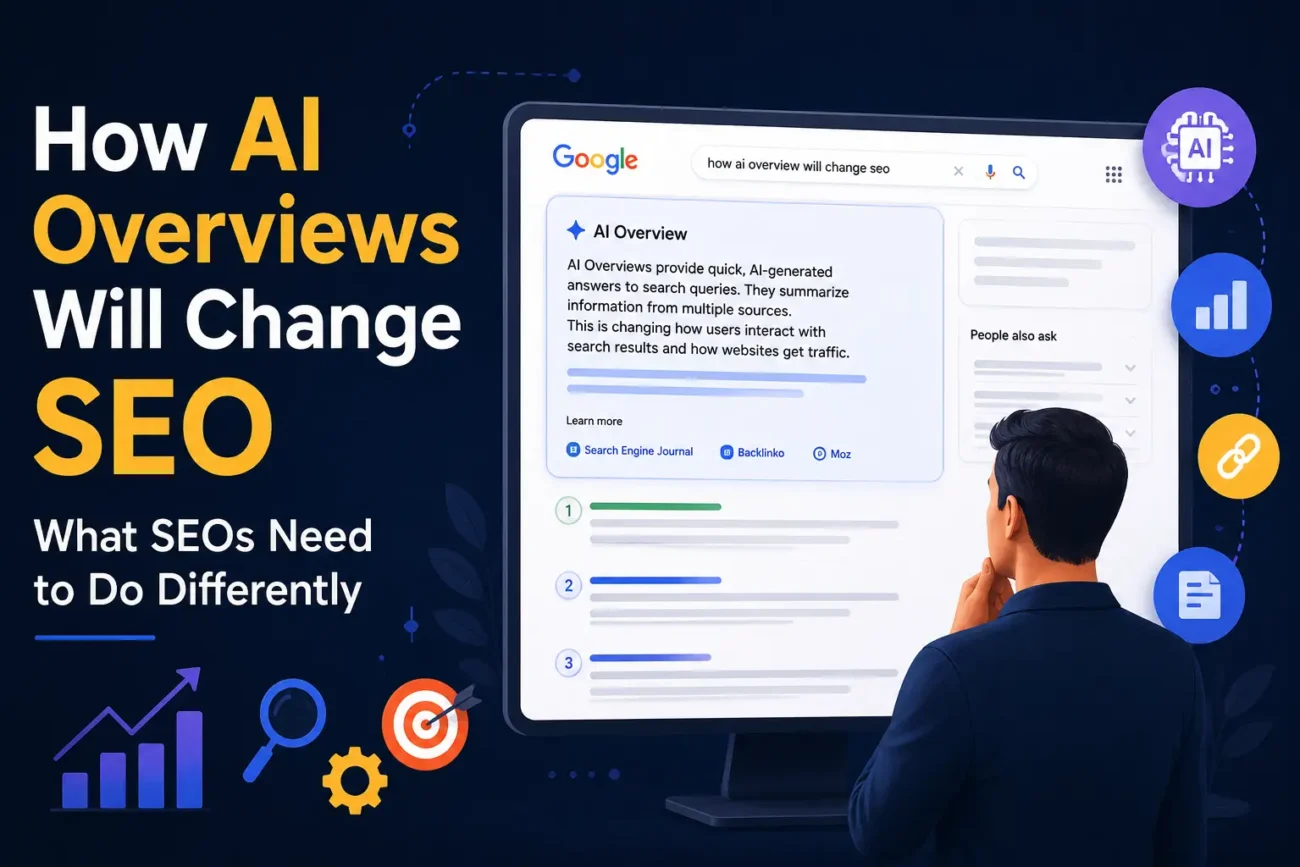
Google Search is changing from a page of ranked links into a search experience that can answer questions directly.
AI Overviews are a major part of that change. Instead of asking a question and scanning several results, a user may now receive an AI-generated summary with links to supporting websites before the traditional organic results.
That changes an important part of SEO: getting a page to rank is no longer the entire visibility story.
SEO still matters. Technical accessibility, relevance, content quality, authority, links, and search intent remain important. But the way users discover and interact with websites is becoming more complicated.
For SEO professionals, publishers, and businesses, the practical question is no longer simply, “How do I rank #1?”
It is becoming:
How do I make my website useful enough, understandable enough, and authoritative enough to be surfaced when Google generates an answer?
Key Takeaways
- AI Overviews can answer part of a search query before a user reaches traditional organic listings.
- A #1 organic ranking does not automatically mean maximum visibility when an AI-generated answer occupies the top of the page.
- Organic click-through rate can become harder to interpret because some users may get what they need without visiting a website.
- Being referenced or linked within an AI Overview can become an additional form of search visibility.
- Search intent and topical coverage become more important than simply repeating keywords.
- Original research, first-hand information, useful examples, and unique analysis can help differentiate a page from generic content.
- SEO measurement needs to move beyond rankings and traffic toward visibility, engagement, leads, sales, and other business outcomes.
- Traditional SEO is not disappearing. AI Overviews make strong SEO foundations more important because AI search still depends on information available across the web.
What Are Google AI Overviews?
Google AI Overviews are AI-generated responses that appear within Google Search for some queries.
They are designed to give users a summary of information and provide links to websites where they can explore the subject further.
Google has continued expanding its AI search experience. In 2026, Google said it was improving AI Overviews and AI Mode with more ways to discover relevant websites, original content, and links placed directly alongside information in AI-generated responses. Google also described the use of “query fan-out,” where the system explores related searches to find information that can help answer the user’s original question.
This matters for SEO because the search journey can now look more like:
Search query → AI-generated answer → supporting sources → organic results → website
instead of simply:
Search query → organic results → website
That additional layer changes how visibility should be evaluated.
How AI Overviews Will Change SEO
1. Ranking #1 Will Still Matter, But It Will Not Tell the Whole Story
For years, SEO reporting has focused heavily on rankings.
If a page moved from position 8 to position 2, that was usually treated as a clear improvement.
That relationship becomes less straightforward when an AI Overview appears above the traditional results.
A user may read the AI-generated response, inspect one or more cited sources, refine the query, or stop searching without clicking an organic listing.
This does not make rankings irrelevant. A strong organic position can still provide visibility and qualified traffic.
The difference is that ranking position becomes one part of the search visibility picture rather than the complete picture.
For SEO teams, this means reporting should distinguish between:
- traditional organic rankings
- AI Overview visibility
- citations or links within AI-generated results
- organic impressions
- organic clicks
- conversions
- revenue or leads
The question becomes less about owning one position and more about understanding how the entire search result behaves.
2. Click-Through Rate Will Become More Important to Interpret
AI Overviews can satisfy some informational searches without requiring a website visit.
That creates the possibility of more zero-click searches.
Recent research provides evidence that this is not simply a theoretical concern. A 2026 field experiment found that, when AI Overviews appeared, outbound organic clicks fell by 39.8% and zero-click searches increased by 34.5%. The study did not find the same effect on sponsored clicks.
Another 2026 study analyzing browsing behavior found that clicks directly to sources cited in AI Overviews were rare in its sample, at around 1% of visits to pages with AI Overviews.
These findings should not be treated as a universal CTR forecast for every website or query. Different industries, search intents, devices, countries, and SERP layouts can produce different results.
But the direction is important.
A website can maintain visibility in Google while receiving fewer clicks from certain informational searches.
That means an SEO report showing lower clicks should not immediately conclude that rankings or content quality have deteriorated.
The SERP itself may have changed.
3. Being Included in an AI Answer Becomes Another Visibility Opportunity
Traditional SEO has usually treated the organic result as the primary destination.
AI search introduces another possibility: your content can contribute to the answer before the user decides whether to visit your website.
Google has continued adding links to supporting web pages within AI experiences. In 2026, Google announced updates designed to make links more visible within AI Overviews and AI Mode, including links placed alongside relevant parts of an AI response and previews that provide additional context about linked websites.
That makes source selection increasingly interesting from an SEO perspective.
A page does not necessarily need to be the only answer.
It needs to contain information that is useful enough for Google’s systems to understand and potentially use when constructing an answer.
This creates a broader visibility model:
Rank → appear → be understood → be selected → receive a click → generate an outcome
Those stages are related, but they are not identical.
4. Search Intent Will Matter More Than Keyword Repetition
AI Overviews are particularly useful for questions that require a synthesis of information.
That makes search intent even more important.
Consider the difference between these two pages.
Page A
Targets:
“best CRM software”
It repeats the keyword throughout the article and contains short descriptions of several CRM products.
Page B
Targets the same topic but answers:
- Who needs a CRM?
- What features actually matter?
- Which CRM works for small businesses?
- What does implementation involve?
- What are the limitations?
- How much does it cost?
- What should a company compare before switching?
- Which use cases are better served by simpler tools?
Page B provides more information about the decision behind the query.
That is the direction SEO content needs to move toward.
The objective should not be to write a page that contains every variation of a keyword.
The objective should be to create the most useful response to the problem represented by the query.
5. Topical Coverage Will Become More Valuable
One article targeting one keyword is rarely enough to establish deep expertise around a subject.
Suppose a website wants to become visible for:
AI SEO
A stronger topical structure could include related pages covering:
- What is AI SEO?
- How AI Overviews affect SEO
- How AI search differs from traditional search
- Generative Engine Optimization
- AI SEO agents
- AI search visibility
- How to measure GEO
- How to optimize content for AI search
- AI citations and source selection
- Traditional SEO vs GEO
The important part is not the number of articles.
It is whether those pages form a coherent body of useful information.
Internal links can then establish relationships between concepts and help users move from a broad question to a more specific one.
This is more useful than publishing dozens of lightly rewritten articles targeting tiny keyword variations.
6. Original Information Will Become More Valuable
Generative search can summarize information that already exists.
That creates a problem for content publishers.
If ten websites publish essentially the same explanation, there is limited reason for an AI system or a human reader to prefer one generic version over another.
Original information provides differentiation.
That can include:
- original research
- first-hand observations
- proprietary data
- product testing
- original comparisons
- documented experiments
- expert commentary
- unique examples
- screenshots
- calculations
- case studies
- analysis of real datasets
The important distinction is that originality should be genuine.
A website should not invent a “case study” simply because case studies look authoritative.
If an experiment was not performed, do not claim it was.
If data came from another source, identify the source.
If something is an interpretation rather than an established fact, present it as an interpretation.
Google has also been introducing features intended to help users discover original content and first-hand perspectives within AI Search.
7. Generic AI-Generated Content Has a Differentiation Problem
AI can produce an article about almost any SEO topic in seconds.
That makes basic information cheaper to produce.
It does not necessarily make useful information easier to produce.
Consider two articles about AI Overviews.
The first says:
AI Overviews are changing SEO by providing users with quick answers and reducing the need to click on websites.
The second examines:
- which query types trigger AI Overviews
- how the SERP changes when one appears
- what happens to organic CTR
- which sources appear in the AI response
- what information those sources contain
- whether the cited pages rank organically
- how the traffic changes
- what conversions look like afterward
The second article has a reason to exist beyond summarizing what everyone already knows.
That is an important direction for SEO content.
8. Technical SEO Will Not Become Irrelevant
One of the biggest misconceptions about AI search is that technical SEO no longer matters.
It does.
Search systems still need to discover, crawl, process, and understand web content.
Fundamentals such as:
- crawlability
- indexability
- canonicalization
- internal linking
- structured data
- mobile accessibility
- page performance
- clear site architecture
- accessible content
continue to matter.
AI does not remove the need for a technically accessible website.
If anything, a website should make its content easier for both humans and machines to understand.
Structured data is useful when it accurately describes the content on the page, but adding schema does not guarantee inclusion in an AI Overview.
That distinction matters.
Technical SEO makes information accessible. It does not guarantee that Google will choose it.
9. Featured Snippets Are No Longer the Only “Answer” Opportunity
SEO has already moved beyond the traditional blue-link model through features such as:
- featured snippets
- People Also Ask
- image results
- video results
- local results
- shopping results
- knowledge panels
AI Overviews add another layer.
This means SEOs need to think about search features, not just rankings.
A page can potentially earn visibility in multiple ways depending on the query.
For example, a product-related search may produce:
- shopping results
- reviews
- organic pages
- videos
- an AI-generated summary
A complex informational query may produce:
- an AI Overview
- supporting sources
- People Also Ask
- organic results
The SERP is increasingly an ecosystem.
10. SEO Measurement Will Need to Change
The traditional SEO funnel often looks like:
Keyword ranking → impressions → clicks → conversion
That is still useful.
But it does not capture everything happening in AI-assisted search.
A broader model is:
Query → search visibility → AI Overview presence → source/citation visibility → organic click → engagement → conversion
For businesses, the most important question remains the business outcome.
A traffic increase is not automatically valuable.
A traffic decrease is not automatically disastrous.
Suppose a website receives 10,000 visits but generates no leads.
Another receives 4,000 visits and generates 100 qualified enquiries.
The second website may have the stronger SEO outcome.
AI Overviews make this distinction more important because some informational searches may produce fewer clicks while more commercially valuable searches continue to drive visits.
11. SEO Teams Should Track More Than Rankings
A modern SEO dashboard should consider several layers.
Search visibility
Track:
- impressions
- rankings
- SERP features
- branded searches
- non-branded searches
Traffic
Track:
- organic clicks
- organic sessions
- landing pages
- new users
- engaged sessions
Business outcomes
Track:
- leads
- purchases
- revenue
- enquiries
- qualified calls
- sign-ups
- assisted conversions
AI search visibility
Where reliable observation or tooling is available, monitor:
- whether target queries produce AI Overviews
- which sources are referenced
- which pages appear repeatedly
- what types of information are being surfaced
- how your visibility changes over time
The last category is still developing.
There is no universal Google Search Console report that gives a complete “AI Overview SEO score.”
Be careful with tools that present a single GEO or AI visibility number as if it were an official Google ranking metric.
12. AI Overviews May Change What a Valuable Keyword Looks Like
A keyword with 10,000 monthly searches is not automatically better than one with 500.
The real question is:
What happens after the search?
An informational query may have huge volume but little commercial value.
A lower-volume query could indicate someone who is ready to compare providers, request a quote, or make a purchase.
AI Overviews may satisfy some early-stage informational searches without a click.
That makes the commercial intent behind a query increasingly important.
For example:
“What is double glazing?”
may be answered directly.
But:
“double glazing installation cost near me”
has a different commercial context.
The SEO strategy should reflect that difference.
13. Informational Content Needs a Better Conversion Path
If AI systems answer more basic informational questions, websites cannot assume every reader will land on the homepage after reading an article.
The content should naturally connect the information to the next useful step.
For example:
Informational article
“How does a heat pump work?”
↓
Supporting article
“Air-source vs ground-source heat pumps”
↓
Commercial page
“Heat pump installation”
↓
Conversion
“Request a quote”
This is where topical SEO and conversion-focused content work together.
The goal is not to force a sales pitch into every paragraph.
The goal is to make the next step obvious when the reader needs it.
14. AI Overviews Do Not Mean SEO Is Dead
This is probably the most important point.
SEO is not disappearing.
The definition of search visibility is expanding.
Websites still need to be:
- discoverable
- accessible
- relevant
- trustworthy
- useful
- technically sound
- authoritative
The difference is that users may interact with search results differently.
Google itself has continued emphasizing connections between AI-generated responses and websites. In 2024, Google said AI Overviews were designed with links to web content so users could explore further. It has since expanded the ways those links appear in AI search experiences.
So the better conclusion is not:
AI Overviews will replace SEO.
It is:
AI Overviews are changing what SEO needs to accomplish.
What SEO Professionals Should Stop Doing
Stop writing only for keywords
A keyword is a representation of a search need.
It is not the entire search need.
Stop publishing pages that add nothing new
If your article says the same thing as the first ten results, ask why Google or the reader needs another version.
Stop measuring success only through rankings
Ranking is an input.
The business result is the output.
Stop assuming longer content is automatically better
A 5,000-word article full of repetition is not better than a concise article that answers the question properly.
Stop treating AI-generated text as finished content
AI can help with research, outlining, analysis, and drafting.
But generic output still needs human review, verification, editing, and additional value.
Stop making unsupported predictions
Avoid claims such as:
“AI Overviews will eliminate organic traffic.”
“Google will replace websites.”
“Every website needs GEO.”
The search landscape is changing, but precise outcomes vary by query, industry, and SERP.
What SEO Professionals Should Start Doing
1. Analyze the SERP before creating content
Check:
- Does an AI Overview appear?
- What kind of answer does it provide?
- Which websites are referenced?
- What information is missing?
- What do the organic results cover?
2. Build content around questions and entities
Don’t create a page simply because a keyword has search volume.
Understand the topic behind the keyword.
3. Add information competitors do not have
This could be:
- original research
- examples
- data
- expert analysis
- testing
- screenshots
- comparisons
- practical workflows
4. Make answers easy to extract and understand
Use clear:
- definitions
- explanations
- headings
- tables
- examples
- step-by-step processes
But don’t write artificially short paragraphs just because you believe an AI system prefers them.
Write for people first.
5. Strengthen topical relationships
Create supporting content and connect related pages with useful internal links.
6. Improve the underlying website
Make sure important information can be crawled, indexed, rendered, and understood.
7. Measure business impact
Track leads, sales, revenue, and qualified traffic alongside rankings and clicks.
A Practical AI Overview SEO Workflow
Here is a simple process an SEO team can use.
Step 1: Identify valuable queries
Start with queries that matter to the business.
Do not only select keywords with the highest search volume.
Step 2: Classify search intent
Determine whether the query is:
- informational
- commercial
- transactional
- navigational
- local
Step 3: Check the current SERP
Search the query manually.
Record:
- AI Overview presence
- organic results
- featured snippets
- People Also Ask
- videos
- shopping results
- local results
- cited sources
Step 4: Study the sources Google surfaces
Look beyond the first result.
Ask:
- What information do these pages provide?
- What makes them useful?
- Are they original?
- Do they cite primary sources?
- Do they answer follow-up questions?
- What gaps remain?
Step 5: Create a better information resource
Don’t simply make the competitor article longer.
Make it more useful.
Step 6: Add evidence
Where appropriate, use:
- first-party data
- primary research
- authoritative documentation
- original examples
- credible studies
Step 7: Build topical connections
Add relevant internal links to supporting content.
Step 8: Optimize the technical foundation
Check:
- indexability
- crawlability
- canonicalization
- structured data
- internal links
- page experience
Step 9: Monitor changes
Track:
- rankings
- impressions
- clicks
- CTR
- conversions
- revenue
- SERP changes
- AI Overview visibility where measurable
Step 10: Update based on evidence
Don’t change strategy simply because an SEO trend is popular on social media.
Use your own data where possible.
What Will Happen to Backlinks?
Backlinks are unlikely to suddenly become irrelevant because AI Overviews exist.
Links remain part of how the web connects information and establishes relationships between pages.
But the value of a backlink should not be reduced to a simple quantity metric.
One relevant link from a respected source can provide more meaningful authority than dozens of unrelated links.
The same principle applies to AI search.
A website should aim to become a source worth referencing, not simply accumulate links for the sake of a metric.
What About E-E-A-T?
Experience, expertise, authoritativeness, and trust remain important concepts for producing useful content.
AI-generated answers increase the importance of knowing where information comes from.
For publishers, this means being clear about:
- who created the content
- what evidence supports important claims
- where statistics came from
- when information was updated
- whether the author has relevant expertise
- whether the content contains original experience
Don’t add an “expert” author bio to manufacture credibility.
Build credibility through the content itself.
SEO vs GEO: Are They Becoming the Same Thing?
Not exactly.
SEO and GEO overlap, but they are not identical.
SEO focuses on making content discoverable and useful within search systems and generating organic visibility and traffic.
GEO, commonly used for Generative Engine Optimization, focuses on improving how content can be understood, retrieved, represented, and potentially referenced by generative AI systems.
There is substantial overlap:
- useful content
- clear information architecture
- strong topical relevance
- authoritative sources
- entity understanding
- technical accessibility
That means a strong SEO foundation can support visibility in AI search.
But GEO should not be treated as a collection of tricks for forcing an AI system to mention a brand.
The better approach is to create information that deserves to be discovered and referenced.
What AI Overviews Mean for Content Strategy
The biggest change may be strategic rather than technical.
For years, many SEO strategies followed this model:
Find keyword → create page → build links → rank → get traffic
A stronger model for AI-assisted search is:
Identify valuable question → understand intent → research the topic → create genuinely useful information → establish topical relationships → make the content accessible → earn visibility → measure business impact
The second model requires more thinking.
It also creates a stronger reason for businesses to invest in information that competitors cannot easily reproduce.
The Future of SEO Is Likely to Be More Than Ten Blue Links
Search has been evolving for years.
AI Overviews are another step in that evolution.
The traditional organic result is still important, but users can now encounter information through several layers of the search experience.
Google is also continuing to experiment with ways of connecting AI responses to original websites and sources. Its 2026 updates include more visible links, website previews, and mechanisms for helping users discover preferred and original sources.
This creates both a challenge and an opportunity.
The challenge is that some searches may produce fewer website visits.
The opportunity is that websites with genuinely useful, distinctive information can potentially become part of the answer itself.
Frequently Asked Questions
Will AI Overviews replace traditional SEO?
No. AI Overviews change how Google presents information, but websites still need to be discoverable, relevant, accessible, and useful. Traditional SEO fundamentals remain important.
Will AI Overviews reduce organic traffic?
They can reduce organic clicks for some searches, particularly when the AI response satisfies the user’s need without requiring a website visit. Recent independent research has found meaningful reductions in organic clicks when AI Overviews appear, but the impact varies by query and context.
Does ranking #1 still matter?
Yes. But ranking #1 should not be treated as the only measure of visibility. AI Overviews can occupy prominent space above traditional results and may introduce additional sources and links.
How can I get my website into AI Overviews?
There is no guaranteed optimization technique that forces Google to include a particular page. Focus on creating useful, accurate, accessible content that clearly answers the query, supports important claims, demonstrates relevant expertise, and provides information worth referencing.
Is GEO replacing SEO?
No. GEO and SEO overlap, but they address somewhat different aspects of search visibility. A strong SEO foundation remains useful for AI search.
Will backlinks still matter?
Backlinks remain useful as part of the broader web ecosystem, but link quantity alone is not a good measure of content quality or authority. Relevance and the quality of referring sources matter.
Should I create longer articles for AI Overviews?
Not automatically. Length should follow the information required to answer the topic properly. More words do not automatically make content more useful.
What should I measure if AI Overviews reduce clicks?
Look beyond clicks. Track impressions, rankings, conversions, qualified leads, revenue, branded demand, and other business outcomes. Where reliable data is available, also monitor AI search visibility and source/citation patterns.
Final Takeaway
AI Overviews are changing the relationship between search queries, websites, and users.
The old SEO model placed a lot of emphasis on one question:
Where does my page rank?
That question still matters.
But it is no longer enough.
SEO teams increasingly need to understand:
Does my content appear when the question is answered?
Is the information useful enough to be selected as a source?
Does the page provide something beyond what every other result says?
Does the resulting visibility generate valuable business outcomes?
The websites best positioned for this environment are not necessarily those that publish the most content or repeat the most keywords.
They are the ones that provide information people and search systems can understand, verify, use, and trust.
AI Overviews may change how users reach websites.
They do not remove the need for websites worth reaching.
