
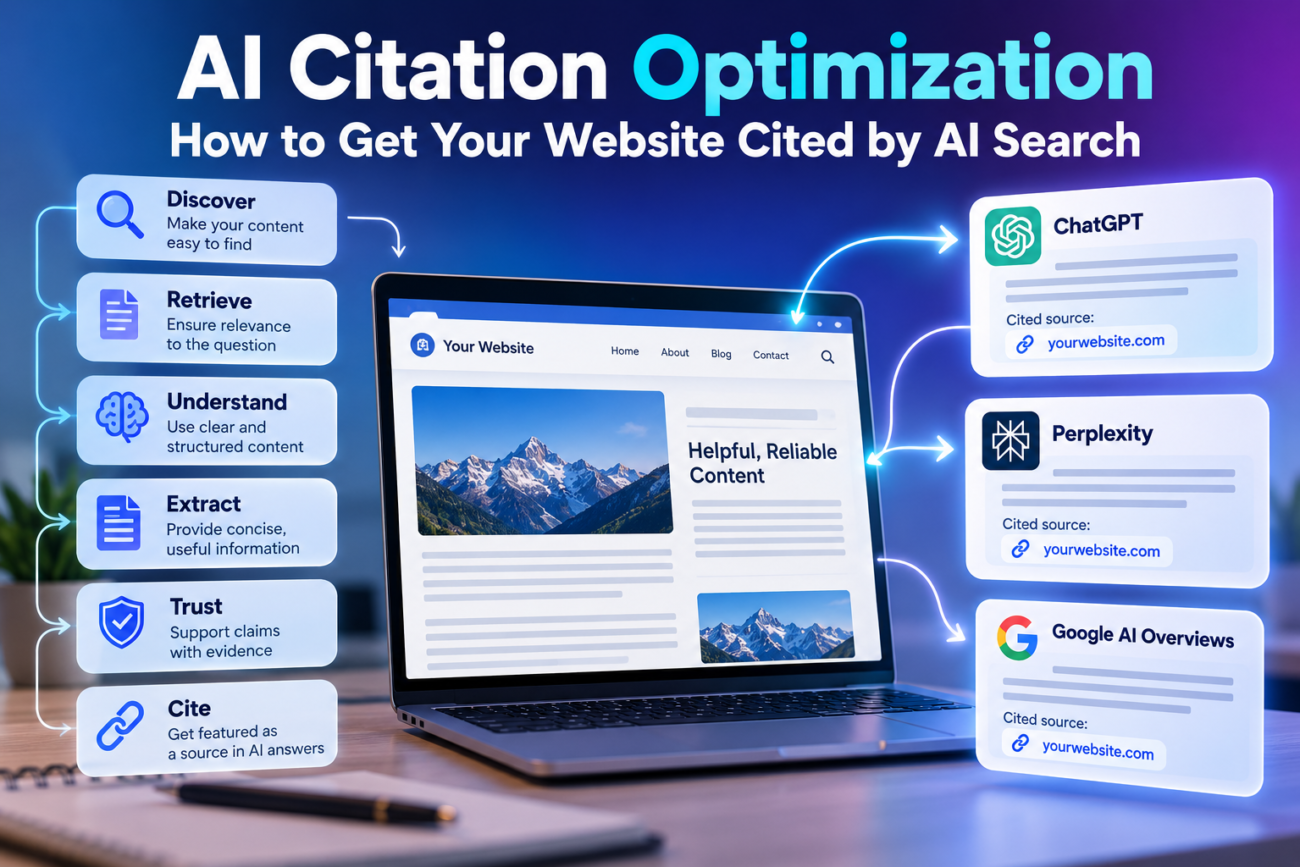
AI Citation Optimization is the process of making your website easier for AI search systems to discover, understand, retrieve and cite as a source in their answers.
It is related to SEO, but it is not simply “SEO for ChatGPT.”
When someone searches Google, you are trying to earn a position in the search results.
When someone asks ChatGPT, Perplexity, Gemini or another AI search system a question, the system may retrieve information from multiple sources and use those sources to construct an answer.
Your objective is therefore slightly different:
Make your website a useful source for the answer, not just another page targeting the keyword.
That distinction is the foundation of AI Citation Optimization.
What Is AI Citation Optimization?
AI Citation Optimization focuses on improving the likelihood that a webpage will be selected as a supporting source when an AI system generates an answer.
A useful way to think about the process is:
Discover → Retrieve → Understand → Extract → Trust → Cite
First, the page needs to be accessible.
Then it needs to be relevant to the question.
The information needs to be understandable and easy to extract.
Important claims should be supported by evidence.
And finally, the AI system decides whether that source belongs in the answer.
There is no single schema, word count or “AI ranking factor” that guarantees the final step.
That is why good AI citation optimization starts with source quality, not AI tricks.
Does Ranking #1 on Google Get You Cited by AI?
Not necessarily.
Traditional SEO still matters, particularly for Google AI Overviews and AI Mode. Google says its generative AI search features rely on its existing Search ranking and quality systems, so fundamentals such as crawlability, indexing and useful content remain important.
But AI citations do not always match Google’s traditional rankings.
Ahrefs analyzed 15,000 prompts and found that, on average, only about 12% of URLs cited by ChatGPT, Gemini and Copilot also appeared in Google’s top 10 for the same prompt. Perplexity showed greater overlap, but still not complete alignment.
So the right strategy isn’t:
SEO or AI SEO.
It is:
SEO + AI search visibility.
Your page needs to work for both.
How AI Search Selects Content to Cite
You cannot see the exact internal scoring system used by every AI platform.
But the practical process can be understood through five questions.
1. Can the system access the page?
If the content cannot be crawled or indexed where required, it has little opportunity to become a source.
2. Does the page answer the question?
A page about AI SEO in general may not be the best source for a specific question about AI citations.
Relevance matters.
3. Can the useful information be extracted?
Clear definitions, direct answers, concise explanations, tables and specific claims are easier to use than vague marketing copy.
4. Can the information be trusted?
Evidence, authorship, primary sources, first-hand expertise and relevant third-party references can strengthen the credibility of the information.
5. Is this source useful for this particular answer?
This is the part website owners cannot completely control.
AI systems may select different sources for different prompts, even when the underlying topic is the same.
That is why citation optimization should be treated as improving your probability of being selected, not guaranteeing a citation.
6 Things to Do to Improve AI Citations
1. Answer the Question Immediately
Don’t make users or search systems work through 500 words of introduction before reaching the answer.
For example:
AI Citation Optimization is the process of improving a webpage’s discoverability, relevance, extractability and authority so AI search systems can use it as a supporting source in generated answers.
Then explain it.
This answer-first structure also works well for traditional search because it gives users the information they came for quickly.
2. Create Pages Around Real Questions
Don’t build the page around keyword repetition.
Build it around the questions behind the keyword.
For AI Citation Optimization, those questions include:
- How do AI search engines choose sources?
- How do I get cited by ChatGPT?
- How do I appear in Google AI Overviews?
- Does Google ranking affect AI citations?
- Does schema help AI citations?
- How important are backlinks?
- What makes content easy for AI to extract?
- How can I measure AI citations?
You don’t need a separate 2,000-word article for every question.
A strong page can answer the most important ones naturally.
3. Make Your Information Easy to Extract
This is where content structure matters.
Compare:
We provide innovative AI SEO solutions designed to help businesses navigate the rapidly evolving search landscape.
with:
AI Citation Optimization improves a webpage’s ability to be discovered, understood and used as a source in AI-generated answers.
The second statement communicates a specific idea.
Use:
- direct definitions
- question-based subheadings where appropriate
- short paragraphs
- lists
- tables
- examples
- specific facts
- clear conclusions
Don’t write for a crawler.
Write information that is easy for a human to understand and easy for a retrieval system to identify.
4. Give AI Something Worth Citing
This is where many AI SEO articles become interchangeable.
If your page simply repeats information already available on 100 other websites, there is little that makes your version uniquely valuable.
Instead, add something original:
- first-hand experiments
- original research
- proprietary data
- case studies
- screenshots
- documented testing
- expert analysis
- industry-specific examples
For example, instead of saying:
“AI search engines cite authoritative websites.”
you could publish an actual study showing which types of pages were cited across 100 commercial prompts.
Now your website has created information other websites can reference.
That is a much stronger SEO asset.
5. Build Authority Beyond Your Website
AI search does not only encounter information on your own domain.
Your business can also be represented through:
- industry publications
- reviews
- professional profiles
- interviews
- podcasts
- YouTube
- Reddit discussions
- partner websites
- digital PR
- relevant directories
This creates an important distinction:
What you say about yourself
vs.
What independent sources say about you.
If your website says you are an AI SEO expert, that’s self-published information.
If relevant independent sources also discuss your expertise, work or research, they provide additional context.
That is why AI citation optimization should not be treated as purely an on-page exercise.
6. Make Your Entity Clear
AI search needs context.
Make it obvious:
- who operates the website
- who wrote the article
- what the company does
- which services it provides
- what topics it specializes in
- where it operates
- what evidence supports its expertise
Keep important business information consistent across your website and legitimate external profiles.
This is entity SEO, and it becomes particularly useful when an AI system needs to understand whether different pieces of information refer to the same organization, person or topic.
Does Schema Markup Help AI Citations?
Schema is useful, but it is often overhyped.
Google says there is no special schema markup required for AI Overviews or AI Mode. Structured data should accurately describe the visible content on the page.
So use appropriate Schema.org markup such as:
- Organization
- Person
- Article
- WebPage
- Service
- BreadcrumbList
when those types genuinely apply.
But don’t expect schema to turn an unhelpful page into a frequently cited source.
Think of structured data as additional context, not a citation button.
What About ChatGPT, Perplexity and Google AI Overviews?
The same fundamentals apply, but don’t assume every AI platform behaves identically.
ChatGPT
Focus on relevant, authoritative and accessible information with clear entities and evidence.
Perplexity
Source attribution is particularly visible in the product, so clear, current and verifiable information is valuable.
Google AI Overviews and AI Mode
Traditional SEO remains important because Google’s AI features use its Search systems. Google also recommends ensuring important content is crawlable, indexable and available as text.
The practical takeaway is simple:
Don’t create separate “ChatGPT SEO,” “Perplexity SEO” and “Google AI SEO” strategies unless your data shows a platform-specific problem.
Start with strong information architecture and content.
Then test each platform.
How to Find AI Citation Gaps
This is one of the most useful parts of AI Citation Optimization.
Create a fixed list of questions your customers might ask.
For example:
“What is the best way to optimize a website for AI search?”
Test that question across your target AI platforms.
Record:
| Metric | What to record |
|---|---|
| Your brand | Mentioned or not |
| Your URL | Cited or not |
| Competitors | Who appears |
| Competitor URLs | Which pages are cited |
| Platform | ChatGPT, Google, Perplexity, etc. |
| Date | When you tested |
| Answer | What information was used |
Then look for patterns.
If a competitor is consistently cited and you aren’t, don’t simply copy their article.
Ask:
What makes their page a better source for this question?
Maybe they have:
- original research
- stronger evidence
- better topic coverage
- clearer explanations
- stronger external authority
- more current information
- better first-hand expertise
That is your actual optimization opportunity.
How to Measure AI Citation Optimization
Don’t measure AI SEO only with rankings.
Track:
Citation rate
How often your pages are cited for your tracked prompts.
Brand mentions
How often your brand appears in AI answers.
Competitor citations
Which competitors are appearing instead.
Cited URLs
Which pages on your site receive citations.
Platform visibility
Where you’re being cited.
AI referral traffic
Whether AI platforms send users to your website.
Conversions
Whether that traffic contributes to leads or sales.
Keep a fixed prompt set and test it regularly.
Otherwise, you won’t know whether your optimization actually changed anything.
A Simple AI Citation Optimization Process
You don’t need to publish dozens of articles.
Start with your most important commercial topics.
Step 1: Find the questions
Use Search Console, keyword research, customer questions and competitor analysis.
Step 2: Test AI visibility
Run those questions across relevant AI search platforms.
Step 3: Identify citation gaps
Find where competitors are cited but your website isn’t.
Step 4: Improve the source
Make the page more useful, specific, evidence-based and easy to extract.
Step 5: Strengthen authority
Build legitimate external mentions and relevant digital PR.
Step 6: Re-test
Use the same prompts after making changes.
Step 7: Measure
Track citations, mentions, rankings, traffic and conversions together.
This is much more sustainable than publishing 50 thin “AI SEO” articles.
AI Citation Optimization Checklist
Before publishing an important page, check:
- The page is crawlable and indexable
- The main question is answered quickly
- Search intent is clear
- Related questions are covered
- Important information is available as text
- Claims are specific and supportable
- Author and organization are clear
- Relevant internal links exist
- Structured data accurately describes the page
- The page contains something genuinely useful or original
- Relevant external authority supports the topic
- Target AI prompts have been tested
- Competitor citations have been recorded
The Key Idea
You cannot force ChatGPT, Perplexity or Google AI Overviews to cite your website.
You can, however, improve the reasons they might select it.
Build content that is:
Accessible → Relevant → Clear → Extractable → Evidence-backed → Authoritative
Then measure what happens.
That is the practical approach to AI Citation Optimization.
Traditional SEO still matters. Google’s own guidance confirms that its generative search features rely on existing Search systems and SEO fundamentals.
But AI citations introduce another layer of competition.
You’re no longer competing only for a position in a search result.
You’re competing to become one of the sources an AI system chooses when constructing an answer.
And the strongest way to do that isn’t to write more content.
It’s to create better sources.
