
What actually makes Google cite one page in an AI Overview instead of another?
You’ll find plenty of answers online. Some say you need to rank #1. Others recommend adding special schema, writing shorter paragraphs, creating an llms.txt file, or publishing dozens of pages around related queries.
The problem is that many of these recommendations mix Google’s documented guidance with SEO assumptions and observations.
Google has not published a definitive, weighted list of “AI Overview ranking factors.” What Google has said is more nuanced: AI Overviews and AI Mode are built on Google’s existing Search ranking and quality systems, while generative AI features can also use techniques such as query fan-out to explore related searches and sources. Google also says there are no additional technical requirements specifically for AI Overviews beyond being indexed and eligible for Search.
So instead of pretending we know Google’s exact citation formula, this guide separates three things:
- What Google has confirmed
- What is a reasonable SEO hypothesis
- What we’re testing ourselves
That distinction matters because AI search is changing quickly, and confident claims without evidence can become outdated just as fast.
TL;DR
- AI Overviews and AI Mode are built on Google’s existing Search ranking and quality systems.
- A page must be indexed and eligible to appear in Google Search with a snippet to be eligible as a supporting link in Google’s AI features.
- Google has not published a separate, weighted list of AI Overview citation factors.
- Query fan-out is a documented part of Google’s AI search systems, but Google has not said that publishing more pages automatically improves AI Overview visibility.
- Clear, specific answers are a useful content-quality principle, but Google has not confirmed “directness” as an independent AI Overview ranking factor.
- First-hand experience, original research, unique viewpoints, and non-commodity content are increasingly emphasized themes in Google’s guidance for generative AI search.
- There is no special schema required for AI Overviews or AI Mode.
- Public reporting on
llms.txtand its effect on Google Search should be treated cautiously and verified directly against Google’s current documentation rather than assumed. - Reporting on generative-AI visibility inside Search Console appears to be evolving; check Search Console and Google’s official channels directly for the current state, rather than relying on a fixed date here.
- The exact formula for selecting one eligible page over another remains unknown.
What Google Actually Confirms About AI Overview Citations
Before talking about “ranking factors,” we need to establish what Google itself has documented.
Google says AI Overviews and AI Mode are rooted in its existing Search ranking and quality systems. That means the fundamentals of SEO still matter. Crawling matters. Indexing matters. Relevance matters. Quality matters. Search eligibility matters.
But there isn’t a separate Google-published checklist saying “do these 10 things and your page will be cited in an AI Overview.”
Google’s current guidance says pages need to be indexed and eligible to appear in Google Search with a snippet to be eligible as supporting links in AI Overviews or AI Mode. There are no additional technical requirements specifically for these AI features.
That’s an important distinction. Eligibility is not the same as selection. A page can be eligible for Search and still not be selected as a supporting source for a particular AI-generated response. That’s where things become more interesting.
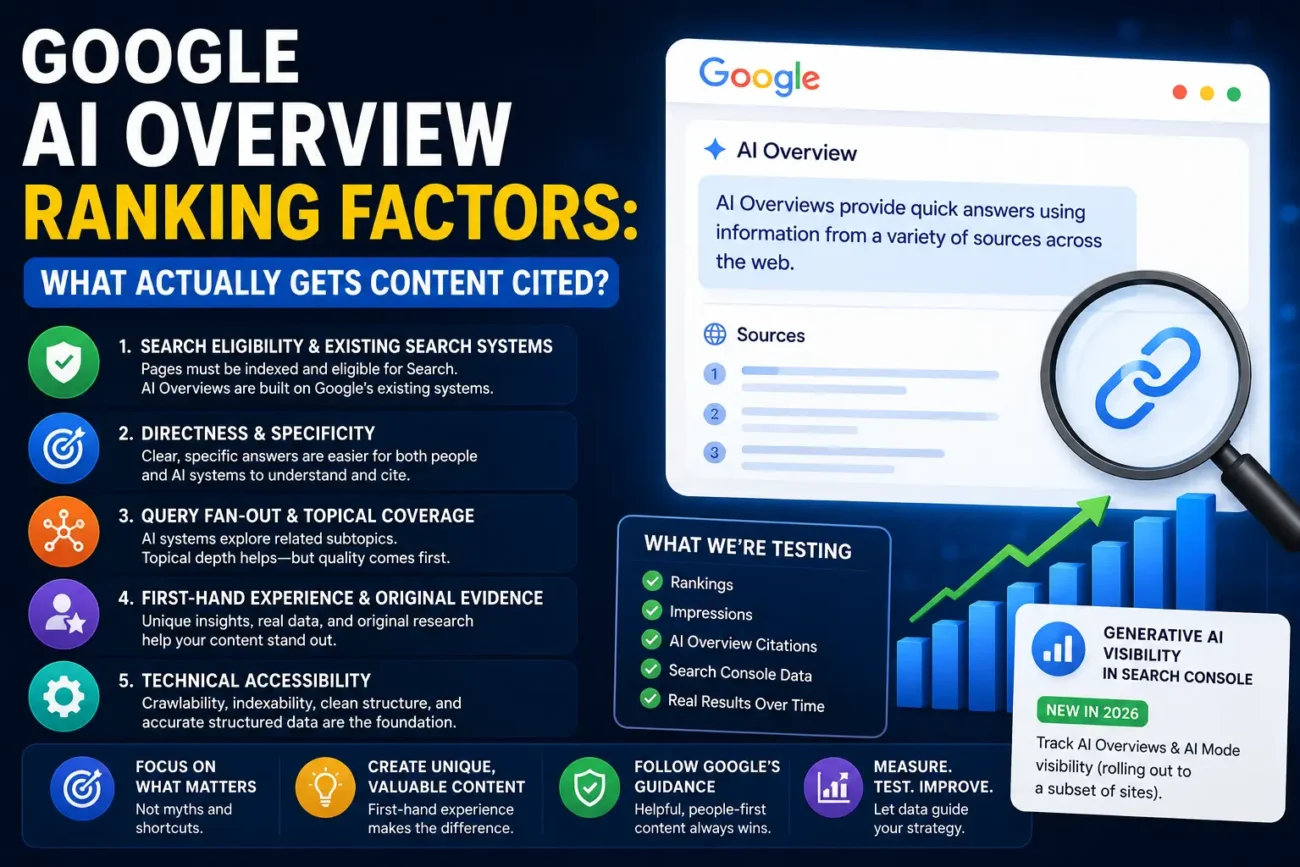
Factor 1: Search Eligibility and Google’s Existing Search Systems
The first factor isn’t really an “AI ranking factor.” It’s eligibility.
If Google cannot index your page or use it as a normal Search result, don’t expect the page to suddenly become an AI Overview source. Google’s documentation says a page needs to be indexed, eligible to appear in Google Search with a snippet, and compliant with Google’s Search policies to be eligible as a supporting link in AI Overviews and AI Mode.
That does not mean “you must rank #1 to appear in an AI Overview.” Google does not publish such a requirement. Instead, think about the process like this:
Search eligibility → retrieval → relevance and quality → potential inclusion in the generated response
The exact weighting of those stages isn’t publicly documented.
What this means practically: don’t assume that moving a page from position #8 to position #3 automatically makes it an AI Overview citation. Improving organic visibility is still valuable, but AI Overview visibility shouldn’t be reduced to a simple ranking-position formula.
Factor 2: Directness and Specificity
This is where we need to distinguish between a useful content principle and a confirmed Google ranking factor. Google has not said “pages with direct answers receive a higher AI Overview ranking score,” so we won’t claim that.
But clear communication is still valuable. Compare:
“Various factors can influence content visibility in AI-generated search results.”
with:
“Google does not require special AI markup for AI Overviews or AI Mode.”
The second statement answers a specific question immediately, without forcing the reader to interpret what the author means. That’s why our practical approach is: answer the question first, then explain it, then support the explanation with evidence.
Clear writing is a content-quality principle, not a confirmed standalone AI Overview ranking factor.
Factor 3: Query Fan-Out Makes Topical Coverage Worth Testing
Google has confirmed that AI Overviews and AI Mode can use query fan-out: instead of treating a complex search as one simple query, Google’s systems can issue multiple related searches across subtopics and data sources to help construct a response.
Someone searching “how should I optimize my website for AI search?” might need answers touching on traditional SEO, AI Overviews, AI Mode, content quality, technical SEO, structured data, search visibility, and measurement. That makes topical coverage worth testing.
But: Google has confirmed query fan-out. Google has not confirmed that publishing more pages automatically increases AI Overview citations.
That’s why we don’t recommend creating dozens of pages just because a keyword tool identifies dozens of related queries. Google’s current guidance emphasizes creating unique, valuable content for people rather than producing large amounts of content designed primarily to manipulate generative AI visibility.
Our approach: create a small number of genuinely useful resources that answer different parts of a topic. Our AI Overview cluster includes How to Show Up in AI Overviews, How to Optimize Content for AI Overviews, and this article. The purpose isn’t to create pages because more pages sounds like “topical authority.” The purpose is to create resources that are actually useful together, and we’re testing whether that produces measurable visibility gains.
Factor 4: First-Hand Experience and Original Evidence
This is one of the areas where Google’s current guidance and our own content strategy align most closely. Google’s guidance for generative AI search emphasizes unique, valuable, non-commodity content, and highlights first-hand experience and original viewpoints as ways to provide value beyond information that could simply be reproduced elsewhere.
That doesn’t mean “add E-E-A-T and Google will cite you.” E-E-A-T is not a single, isolated ranking factor.
Instead, think about what your content actually contains: original data, screenshots, experiments, first-hand observations, specific examples, original analysis, implementation details, mistakes and lessons, a clearly identified author.
Compare “AI search is becoming more important” with “we published three connected AI Overview articles and are tracking their Search Console performance, organic positions, and generative AI visibility over time.” The second statement contains something that can actually be evaluated. That’s the direction we’re taking with this site.
Factor 5: Technical Accessibility
Technical SEO is not replaced by AI search. If Google cannot access your content, the quality of the content becomes irrelevant.
Check these basics before chasing AI visibility:
- Can Google crawl the page? Check robots.txt and other crawling controls.
- Is the page indexed? Use Search Console and URL Inspection.
- Can Google discover the page? Make sure important pages are connected through relevant internal links.
- Is the important information available as text? Don’t hide critical information exclusively inside inaccessible elements.
- Does your structured data match the page? Markup should accurately describe visible content.
Technical accessibility won’t guarantee an AI citation. But poor technical accessibility can prevent your content from participating in Search at all.
What Google Says You Don’t Need
You don’t need special AI schema
Google says there is no special schema.org structured data required for AI Overviews or AI Mode. Follow normal structured-data guidance, and make sure your markup accurately represents the visible content.
llms.txt and Google Search
There has been public discussion about whether llms.txt files affect Google Search visibility. As of this writing, we have not independently verified an official Google statement on this, and guidance in this area may have changed. Before treating any claim about llms.txt (positive or negative) as settled, check Google Search Central’s current documentation directly. Don’t build a content strategy around an unverified claim either way.
You don’t need a special “AI content” format
There isn’t a special HTML structure that guarantees AI Overview visibility. Continue following normal Search fundamentals.
You don’t need to create a page for every possible related query
Google’s guidance emphasizes creating useful content for people rather than mass-producing pages around every possible query variation.
You don’t need to force an exact word count
There isn’t a magic number of words that makes a page eligible for an AI Overview. A page should be as long as necessary to answer the question properly. The goal isn’t “write 2,500 words.” The goal is to give the reader the information they need.
What’s Still Genuinely Unclear
How much do backlinks influence AI Overview citation?
We know links are part of the broader Search ecosystem, but Google has not published a separate percentage showing how much backlinks contribute specifically to AI Overview citation. Claims like “backlinks account for 23% of AI citation probability” should be treated as speculation unless supported by credible, cited research.
Does structured data create an independent citation advantage?
Google says special schema isn’t required for AI Overviews or AI Mode. That doesn’t mean structured data is useless, it can still serve its normal Search purposes, but we don’t have evidence that adding a particular schema type independently increases citation probability.
How much does freshness matter?
Freshness clearly matters when the subject itself changes. But there’s no published rule saying “update your article every 30 days to increase AI Overview citations.” Update content when something meaningful changes: new data, new Google guidance, changed statistics, new examples, corrected information, new experiments. Don’t change the date simply to make an unchanged article appear newer.
Does website authority matter?
There’s no separate Google-published “AI Overview authority score.” A site’s overall quality and Search performance can influence its ability to compete in Search generally, and AI features use Google’s existing Search systems, but we don’t know a specific weighting for site authority in AI Overview citation specifically.
Does ranking #1 guarantee an AI Overview citation?
No. Being highly ranked can be valuable for normal Search visibility, but Google hasn’t said the #1 organic result automatically becomes the AI Overview source. AI features can retrieve information through multiple searches and provide supporting links from relevant sources beyond the top position.
What We’re Testing
Instead of publishing another list of supposed AI Overview “secrets,” we’re using our own website as a small ongoing experiment.
Pages in the experiment: How to Show Up in AI Overviews, our content optimization guide, and this article. Additional supporting articles will be added as we gather enough evidence to justify them.
What we’re tracking: impressions, clicks, CTR, average position, ranking queries, page-level visibility, and generative AI visibility where we’re able to observe it.
What we’re not doing: claiming a result before we have one. If the pages improve, we’ll publish the numbers. If they don’t improve, we’ll publish that too, because a failed SEO experiment is more useful than a successful-sounding claim with no evidence.
On Measuring Generative AI Visibility
For most site owners, measuring AI Overview visibility has historically meant manually searching a query and checking whether your page appears, which only gives a single snapshot rather than reliable trend data.
There has been discussion of Search Console expanding its reporting to cover generative AI features more directly. We haven’t independently verified the specifics (exact rollout date, feature name, or availability) closely enough to state them as settled fact here, so check your own Search Console account and Google’s official announcements directly for the current state of this reporting rather than relying on any specific date. If expanded generative-AI reporting is available for your property, we’d recommend using it alongside traditional Search Console data to compare traditional Search visibility against generative AI visibility over time.
What We Think Matters Most Right Now
- Relevance. Answer the question the searcher actually asked.
- Useful specificity. Give readers concrete information: examples, numbers, comparisons, evidence.
- Original value. Don’t simply rewrite the top 10 results. Add new data, first-hand experience, original analysis, a different perspective, or an experiment.
- Technical accessibility. Make sure Google can crawl, index, discover, and understand the important content.
- Useful topical coverage. Cover related subjects when they genuinely help the reader, not to inflate URL count.
- Clear authorship and sourcing. Make it clear who created the content and where important claims come from.
- Measurement. Don’t assume your strategy worked because someone said it should. Measure, compare, test, and update your conclusions when the data changes.
None of these should be treated as a guaranteed AI Overview formula. They’re the areas where Google’s documentation and practical SEO reasoning give the most useful direction right now.
If you’d rather have this tested and implemented for you instead of doing it in-house, that’s exactly the kind of work our AI SEO services cover.
FAQ
Is there an official list of AI Overview ranking factors from Google?
No. Google has documented that AI Overviews and AI Mode are rooted in existing Search ranking and quality systems and can use query fan-out to explore related searches, but Google hasn’t published a definitive weighted list of AI Overview citation factors.
Does a page need to rank #1 to appear in an AI Overview?
No. Google says a page needs to be indexed and eligible to appear in Search with a snippet to be eligible as a supporting link in AI Overviews or AI Mode. That doesn’t mean every eligible page will be selected.
Does domain authority matter for AI Overview citation?
There’s no Google-published “AI Overview Domain Authority” score. A site’s broader Search performance and quality can matter because AI features are rooted in Google’s existing Search systems, but there’s no published formula showing how much a third-party authority metric contributes specifically to AI Overview citation.
Can a smaller website get cited in an AI Overview?
There’s no published rule saying only large websites can appear. The practical challenge for smaller sites is competing for relevance, quality, trust, and visibility, which makes original evidence and genuinely useful content particularly important.
Does schema help you get cited in AI Overviews?
Don’t treat schema as a citation shortcut. Google says there’s no special schema.org structured data required for AI Overviews or AI Mode. Follow normal structured-data guidelines and make sure your markup matches the visible page content.
Does llms.txt help with Google AI Overviews?
Treat any specific claim here carefully and verify it against Google’s current, official documentation before relying on it, this is an area of active discussion and guidance may shift.
Should I create separate pages for every related AI Overview query?
No. Create a separate page when it provides meaningful value for users and addresses a distinct search need, not simply because an AI system might perform query fan-out.
Should I chase every possible AI Overview ranking factor?
No. Start with what you can actually control: relevance, useful specificity, original evidence, first-hand experience, technical accessibility, useful internal linking, clear authorship, trustworthy sourcing. Then measure the result.
Final Takeaway
There isn’t a secret AI Overview checklist that Google has published. That’s actually useful, because it means you don’t need to chase every new claim about word counts, AI schema, llms.txt, citation hacks, backlink percentages, freshness scores, or “AI-friendly” formatting formulas.
Start with what Google actually confirms: AI Overviews and AI Mode are rooted in Google’s existing Search systems, Google can use query fan-out to explore related searches, and pages need to be indexed and eligible for Search. Google’s current guidance emphasizes useful, original, non-commodity content, first-hand experience, technical accessibility, and strong Search fundamentals.
Everything beyond those documented points should be treated carefully. Some ideas are strong hypotheses. Some are useful SEO practices. Some are simply myths, or claims that sound authoritative but haven’t been verified. We’re going to test the difference, not assume it.
We’re not going to tell you that a specific optimization guarantees an AI citation. We’re going to implement it, measure it, compare the data, and when we have enough evidence, publish what actually happened.
Because AI SEO shouldn’t be another collection of confident guesses. It should be measurable.
