
If someone searches for your business on Google, you have familiar metrics to work with: rankings, impressions, clicks and CTR.
AI search is harder to measure.
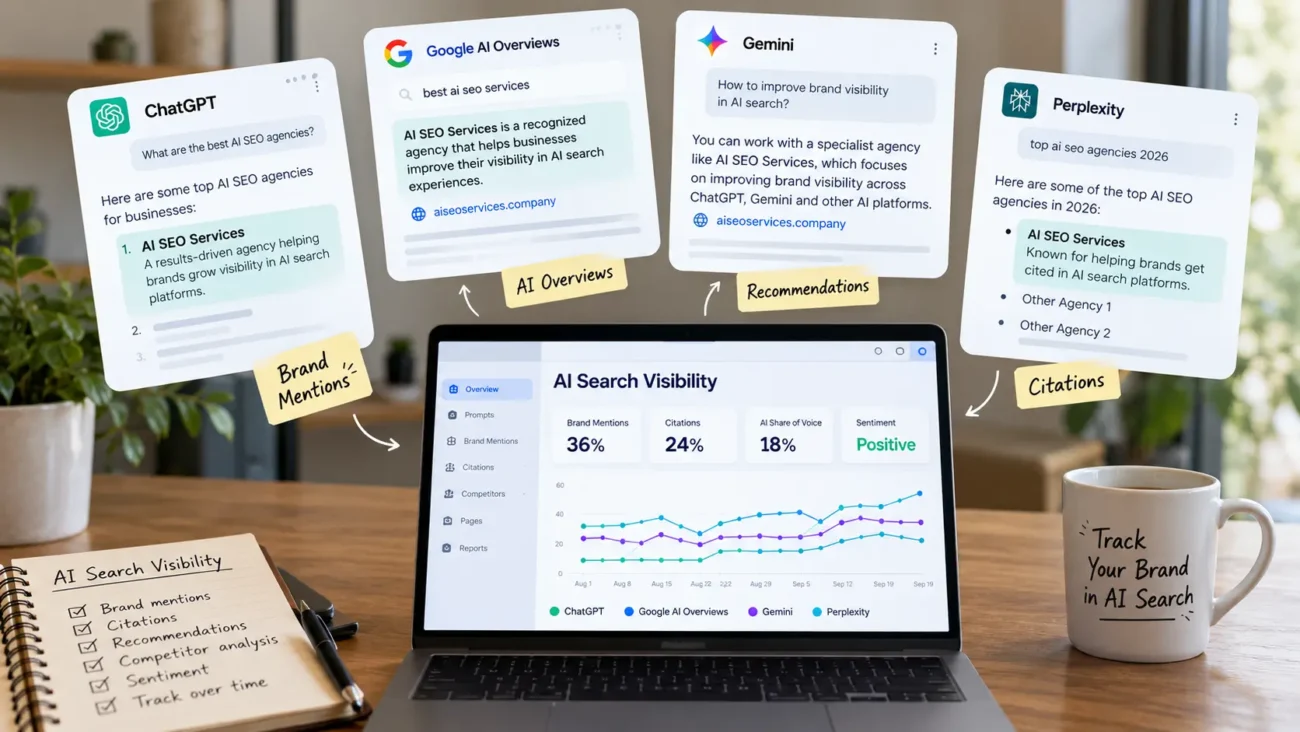
Ask the same question in ChatGPT, Gemini, Perplexity or Google’s AI search experiences and there isn’t a traditional position 1 to 10 to track.
Your brand might be mentioned in one answer, cited in another, recommended in a third and completely absent from the next.
So the useful question isn’t simply:
“Where do we rank?”
It is:
“When people ask AI systems questions related to our business, how often do we appear, are we being recommended or cited, which competitors appear, and which sources are shaping the answer?”
That’s what AI search visibility measurement is designed to answer.
This guide explains how to measure it using practical metrics, prompt testing, competitor benchmarking and ongoing monitoring, without reducing everything to one artificial “AI visibility score.”
What Is AI Search Visibility?
AI search visibility is the extent to which your brand, products, services or website appear in AI-generated answers when people ask questions related to your business.
This can happen in several ways.
An AI system may:
- Mention your brand
- Recommend your business
- Cite one of your pages
- Use information from your website
- Include you in a comparison
- Reference your product or service
- Mention competitors instead of you
- Give an answer without mentioning your brand at all
This is different from traditional SEO because the user may never see a conventional list of ten blue links.
For example, someone might ask:
“What are the best AI SEO agencies for a small SaaS company?”
The important measurement isn’t whether your website ranks #3 for that exact keyword.
You want to know:
- Does the AI mention your company?
- Is your company recommended?
- Which competitors are recommended?
- Is your website cited?
- Which pages are cited?
- How frequently do you appear across similar questions?
- Is the information about your business accurate?
That is the practical meaning of AI search visibility.
For a broader explanation of the discipline, see What Is AI SEO?.
AI Search Visibility vs Traditional SEO Visibility
Traditional SEO and AI search visibility overlap, but they are not the same measurement problem.
| Traditional SEO | AI Search Visibility |
|---|---|
| Keyword rankings | Brand mentions |
| Ranking position | Prominence in an AI answer |
| Organic impressions | AI answer exposure |
| Organic clicks | AI-driven visits |
| SERP share of voice | AI share of voice |
| Featured snippets | AI-generated answers |
| Backlinks | Citations and referenced sources |
| Ranking competitors | Competitors appearing in AI answers |
One important distinction: backlinks and AI citations are not equivalent.
A backlink is a link from another website to yours. An AI citation or source reference means an AI search experience used or surfaced your content as part of an answer.
They can influence different parts of the search ecosystem and should be measured separately.
The 8 AI Search Visibility Metrics I Would Track
You don’t need dozens of metrics to understand whether your brand is becoming more visible in AI search.
Start with these eight.
1. Brand Mention Rate
Brand mention rate measures how often your brand appears in relevant AI answers.
Formula
Brand Mention Rate = Prompts where your brand is mentioned ÷ Total prompts tested × 100
For example:
You test 50 relevant prompts.
Your brand appears in 18.
Your brand mention rate is:
18 ÷ 50 × 100 = 36%
This gives you a simple baseline.
But don’t stop there.
A brand being mentioned once in a long list is different from being directly recommended at the beginning of an answer.
So record where and how the brand appears as well.
2. Citation Rate
Citation rate measures how frequently your website is used or referenced as a source.
Formula
Citation Rate = Prompts where your website is cited ÷ Total prompts tested × 100
For example:
- 50 prompts tested
- 12 answers cite your website
Citation rate = 24%
This is particularly useful because it tells you whether AI systems are not only mentioning your brand but also finding your website useful as a source.
However, don’t assume every citation has the same value.
A citation to your most relevant service page is generally more useful to investigate than an incidental citation to an unrelated blog post.
For a deeper look at improving your chances of becoming a source, see AI Citation Optimization.
3. Recommendation Rate
Recommendation rate measures how often an AI system actively recommends your brand when the prompt asks for providers, products, tools or solutions.
For example:
“Which AI SEO agencies should I consider?”
If your company appears in 15 out of 50 relevant recommendation prompts:
Recommendation Rate = 30%
This metric matters particularly for businesses where AI-generated recommendations can influence purchasing decisions.
Track recommendation separately from simple mentions because these are different outcomes.
A brand can be mentioned without being recommended.
4. AI Share of Voice
AI share of voice looks at your visibility relative to competitors.
Suppose you test 100 commercial prompts and record the brands mentioned.
You might find:
- Your brand: 24 appearances
- Competitor A: 41
- Competitor B: 33
- Competitor C: 18
This doesn’t mean those percentages represent market share.
It simply tells you how frequently each brand appeared within your defined AI prompt set.
The important part is keeping the methodology consistent.
Use the same:
- Prompt set
- Competitor list
- AI platforms
- Location
- Language
- Testing period
That makes your comparisons much more useful over time.
5. Citation Share
AI share of voice tells you who gets mentioned.
Citation share tells you whose websites are being used as sources.
For example, across 100 prompts you might find:
- Your website cited 18 times
- Competitor A cited 32 times
- Competitor B cited 21 times
- Industry publication cited 45 times
This can reveal a different competitive gap.
You may have reasonable brand visibility but relatively weak source visibility.
That is a signal worth investigating.
Look at:
- Which competitor pages are being cited
- What topics those pages cover
- How specific the answers are
- Whether they provide original information
- Whether their claims are supported
- Whether their pages answer the underlying question better
Don’t simply copy the competitor’s content.
Find out why the source is useful and improve your own coverage.
6. Prompt Coverage
This is one of the most useful metrics to add to an AI visibility measurement system.
Prompt coverage measures how consistently your brand appears across the different questions your potential customers actually ask.
Imagine you have 50 relevant prompts.
Your brand appears in 15.
Your prompt coverage is:
30%
Now divide those prompts into groups:
- Informational
- Problem-solving
- Commercial
- Comparison
- Product
- Service
- Recommendation
- Brand-specific
You might discover something like this:
| Prompt type | Prompts tested | Brand appearances |
|---|---|---|
| Informational | 10 | 2 |
| Problem-solving | 10 | 3 |
| Commercial | 10 | 5 |
| Comparison | 10 | 4 |
| Recommendation | 10 | 1 |
That tells you much more than a single visibility number.
Perhaps your brand appears when users already know what they want but disappears when they ask broader discovery questions.
That is an actionable insight.
How many prompts should you test?
You can start with around 30 to 50 prompts for a small business.
A larger brand or agency can build a much larger prompt library.
The important thing is not the exact number.
It is consistency.
Don’t change your prompt set every week and then compare the results as if nothing changed.
Keep a core prompt set stable and create a separate test set for new questions.
7. Citation Quality
Not every citation deserves equal weight.
Record the quality of the cited source.
For each citation, ask:
- Is the cited page directly relevant?
- Is it an authoritative page?
- Does it contain original information?
- Does it answer the user’s question?
- Is the information current?
- Does the citation support the statement being made?
- Is the citation coming from the most relevant page on your website?
For example, if someone asks:
“How much does AI SEO cost?”
and an AI system cites your homepage rather than your detailed pricing or services page, that’s different from having a highly relevant page cited.
Citation quality helps you understand whether AI systems are finding the right content, not just whether they found something.
8. Accuracy
Visibility alone isn’t enough.
You also need to know what AI systems are saying about your brand.
Track whether the answer contains:
- Correct services
- Correct pricing information where applicable
- Correct locations
- Correct product information
- Correct company descriptions
- Correct qualifications
- Outdated information
- Incorrect claims
You can also record sentiment or tone as a qualitative field.
For example:
Brand mentioned: Yes
Recommended: Yes
Cited: Yes
Information accurate: No
Issue: AI described an old service that is no longer offered
This turns AI monitoring into something your marketing team can actually act on.
How to Build an AI Search Visibility Benchmark
If you want to know whether your brand is becoming more visible, you need a baseline.
Don’t start by buying a monitoring platform.
Start by defining the measurement system.
Step 1: Build your prompt library
Create questions your potential customers could realistically ask an AI system.
For example:
Informational
- What is the best way to improve AI search visibility?
- How does AI search visibility work?
- What affects visibility in AI search?
Problem-solving
- Why isn’t my website appearing in ChatGPT?
- How can I get my website cited by AI?
- Why are competitors being recommended instead of my business?
Commercial
- What are the best AI SEO services?
- Who provides AI search optimization?
- What should I look for in an AI SEO agency?
Comparison
- AI SEO agency vs traditional SEO agency
- Which companies provide GEO services?
- What are the alternatives to [competitor]?
Recommendation
- What AI SEO agencies do you recommend?
- Who can help improve visibility in ChatGPT?
- What companies specialize in AI search optimization?
Your prompts should reflect real customer questions, not just keyword variations.
Step 2: Keep a Stable Core Prompt Set
Choose a core group of prompts that you will test repeatedly.
For example:
50 core prompts + 10 experimental prompts
The 50 core prompts remain unchanged.
The 10 experimental prompts can change as you discover new customer questions.
This gives you two things:
Trend measurement:
Are you becoming more visible over time?
Discovery:
Are there new areas where competitors are appearing?
Step 3: Test Multiple AI Platforms
The same prompt can produce different answers across platforms.
At minimum, consider testing:
- ChatGPT
- Google AI Overviews
- Google AI Mode
- Gemini
- Perplexity
Google’s AI search experiences are particularly important to track separately because Google now provides a dedicated Generative AI performance report in Search Console for AI Overviews and AI Mode.
Don’t assume visibility in one platform means visibility everywhere.
Step 4: Record the Important Details
For every test, record:
| Field | Example |
|---|---|
| Date | 20 September 2026 |
| Platform | ChatGPT |
| Prompt | Best AI SEO agencies |
| Brand mentioned | Yes |
| Recommended | Yes |
| Cited | Yes |
| Cited URL | /ai-seo-services/ |
| Competitors | Competitor A, Competitor B |
| Answer position | First recommendation |
| Accuracy | Accurate |
| Notes | Strong commercial visibility |
For location-sensitive searches, also record:
- Country
- City or region
- Language
- Device where relevant
This matters because AI search results can vary based on context.
How to Benchmark Your AI Visibility Against Competitors
This is where AI search monitoring becomes much more useful.
Don’t simply ask:
“Does my competitor appear?”
Ask:
“Under the same conditions, how often does each competitor appear across the same customer questions?”
Use the same prompt set for every brand.
For example:
| Metric | Your brand | Competitor A | Competitor B |
|---|---|---|---|
| Brand mention rate | 32% | 46% | 28% |
| Recommendation rate | 18% | 35% | 21% |
| Citation rate | 14% | 29% | 17% |
| Prompt coverage | 32% | 46% | 28% |
These numbers are only useful within your own defined methodology.
They aren’t universal industry benchmarks.
The goal is to identify where the visibility gap exists.
What to Investigate When a Competitor Appears More Often
If a competitor repeatedly appears where you don’t, investigate the underlying sources.
Look at:
1. Their relevant pages
Which URLs are being cited?
Are they:
- Service pages?
- Product pages?
- Research?
- Guides?
- Comparison pages?
- Case studies?
2. Their topical coverage
Do they answer questions you haven’t covered?
3. Their original information
Do they publish:
- Original research
- Statistics
- Case studies
- First-hand experience
- Expert commentary
- Product data
- Customer examples
4. Their entity consistency
Is their business information consistent across:
- Website
- Business profiles
- Industry directories
- Publications
- Review platforms
- Third-party sources
5. Their third-party visibility
Are other reputable websites discussing or referencing the company?
The objective isn’t to copy the competitor.
It is to understand what information ecosystem surrounds them and where your own evidence or content is weaker.
What to Do When a Competitor Gets Cited Instead of You
Start with the exact AI answer.
Don’t immediately rewrite your entire website.
Find the citation.
Then ask:
What did the competitor page provide that made it useful for this question?
For example, a competitor might have:
- A clear definition
- A specific statistic
- A detailed process
- Original research
- A comparison table
- First-hand examples
- Strong topical coverage
- Clear service information
Then compare that source with your closest equivalent page.
You may discover that your page is technically optimized but simply doesn’t provide the same useful evidence.
That is a much better optimization opportunity than trying to insert more keywords.
What Makes a Website Easier for AI Systems to Use?
There is no single published checklist that guarantees a page will be cited by ChatGPT, Gemini, Perplexity or Google’s AI search features.
Instead, focus on making important information easy to discover, understand and verify.
1. Crawlable Content
AI search experiences depend on access to web information.
Make sure important pages can be crawled and indexed.
Don’t hide critical information behind unnecessary technical barriers.
2. Clear, Accessible Text
Important information should exist as actual text.
Don’t put your most valuable explanations only inside:
- Images
- Videos
- PDFs
- Interactive elements
- Design-heavy graphics
Those formats can support the content, but the core information should still be accessible as text.
3. Strong Topic Coverage
Build content around the questions your customers actually ask.
A useful topic cluster might look like:
AI SEO
→ What Is AI SEO?
→ AI Search Visibility
→ AI Citation Optimization
→ How to Show Up in AI Overviews
→ Generative Engine Optimization
→ AI SEO Agents
This creates a much clearer topical structure than publishing unrelated AI articles.
4. First-Hand Information
Generic information is easy to reproduce.
Your own experience is harder to replicate.
Where appropriate, include:
- Experiments
- Results
- Screenshots
- Observations
- Original data
- Case studies
- Practical examples
- Specific processes
This is especially valuable when you’re trying to build authority around a relatively new topic.
5. Consistent Entity Information
Make sure your business information is consistent across your website and relevant third-party sources.
For example:
- Company name
- Services
- Location
- Expertise
- Products
- Founders
- Industry
- Contact information
Conflicting information makes it harder to build a consistent understanding of the entity.
Don’t Chase “AI Ranking Factors”
Be careful with articles claiming that AI platforms have a secret list of ranking factors.
There isn’t a universal:
“ChatGPT ranking factor”
or
“Gemini ranking score”
that you can optimize against.
Google’s current documentation specifically emphasizes that existing Search fundamentals remain relevant to its generative AI experiences, while its AI Mode can break a question into subtopics and search for relevant information across the web.
So instead of chasing a supposed AI ranking formula, focus on:
- Crawlability
- Helpful content
- Search intent
- Clear information
- Topical coverage
- Original value
- Strong technical SEO
- Entity consistency
- Relevant authority and references
And measure the actual outcomes.
How Google Search Console Fits Into AI Search Visibility
Google Search Console is becoming more useful for measuring Google’s generative search experiences.
As of August 31, 2026, Google has rolled out its Generative AI performance report globally. The report provides impression data for AI Overviews and AI Mode and allows analysis by dimensions such as pages, countries, devices and dates.
That gives you a direct source of Google AI search performance data.
You can use it alongside your broader AI visibility monitoring.
Use Search Console for:
- Google AI impressions
- Pages appearing in generative AI features
- Countries
- Devices
- Trends over time
Use AI prompt testing for:
- ChatGPT visibility
- Gemini visibility
- Perplexity visibility
- Competitor mentions
- Recommendations
- Citations
- Answer accuracy
- Prompt-level visibility
This distinction is important.
Search Console tells you what is happening in Google’s generative search features.
Prompt monitoring tells you what happens when users ask AI systems questions directly.
Together they provide a much more complete picture.
Google also provides standard Search Console performance data for queries, pages, impressions, clicks, CTR and position, which can be used alongside generative AI data.
What Tools Can Measure AI Search Visibility?
You don’t need an expensive platform to start.
A practical system can use three layers.
1. Google Search Console
Use it to measure Google’s generative search performance.
It is particularly useful now that the Generative AI performance report includes AI Overviews and AI Mode.
2. Manual Prompt Testing
Use a spreadsheet to test your core prompts across:
- ChatGPT
- Gemini
- Perplexity
- Google AI search experiences
This is slower but gives you context that a simple dashboard can miss.
You can see why you appeared, what the answer said and which source was cited.
3. AI Visibility Monitoring Platforms
Dedicated monitoring platforms can automate large-scale prompt testing and competitor tracking.
They can be useful when you need:
- Hundreds or thousands of prompts
- Regular automated testing
- Competitor monitoring
- Multiple locations
- Historical reporting
- Agency reporting
But the tool isn’t the methodology.
A dashboard full of numbers doesn’t tell you much if you don’t know:
- Which prompts were tested
- How often they were tested
- Which platforms were used
- What counts as a mention
- What counts as a citation
- How competitors were selected
Build the measurement framework first. Then choose the tool.
How Often Should You Measure AI Search Visibility?
For most businesses, weekly or biweekly monitoring is enough to identify meaningful changes.
For a larger brand or highly competitive market, more frequent monitoring may make sense.
I would use:
Weekly
Check:
- Core commercial prompts
- Recommendation prompts
- Competitor changes
- Important brand queries
Monthly
Review:
- Mention rate
- Citation rate
- Recommendation rate
- Prompt coverage
- AI share of voice
- Citation share
- Citation quality
- Accuracy
Quarterly
Perform a deeper analysis:
- New prompts
- New competitors
- New content opportunities
- Citation gaps
- Platform differences
- Geographic differences
- Content changes
- Search Console trends
The key is consistency.
A Simple AI Visibility Spreadsheet
You don’t need complicated software to start.
Your spreadsheet can contain:
| Date | Platform | Prompt | Brand Mentioned | Recommended | Cited | Citation URL | Competitors | Accuracy | Notes |
|---|---|---|---|---|---|---|---|---|---|
| Sep 20 | ChatGPT | Best AI SEO agencies | Yes | Yes | Yes | /ai-seo-services/ | A, B | Accurate | Strong |
| Sep 20 | Gemini | How to improve AI visibility | Yes | No | Yes | /ai-search-visibility/ | A | Accurate | Educational |
| Sep 20 | Perplexity | AI SEO services | No | No | No | – | A, B | – | Competitors dominate |
From this data you can calculate your core metrics.
More importantly, you can go back to the individual answer and understand what actually changed.
How to Turn AI Visibility Data Into SEO Actions
Measurement is only useful if it changes what you do.
Here’s the workflow I use:
Step 1: Find a visibility gap
Your brand doesn’t appear for a valuable prompt.
Step 2: Check the competitors
See which companies are appearing.
Step 3: Find their cited sources
Identify the pages and websites being referenced.
Step 4: Compare the information
Look for missing:
- Topics
- Evidence
- Original information
- Examples
- Definitions
- Product or service details
Step 5: Improve the relevant page
Don’t automatically create a new article.
The existing page may simply need to answer the question better.
Step 6: Test again
Run the same prompt after the content has been updated.
Step 7: Track the change
Record whether:
- Mention appeared
- Citation appeared
- Recommendation appeared
- Competitor disappeared
- Your cited page changed
- Accuracy improved
This creates a genuine optimization loop:
Measure → Diagnose → Improve → Test → Measure again
AI Search Visibility vs GEO
These terms are related but shouldn’t be treated as identical.
GEO, or Generative Engine Optimization, generally refers to the broader practice of improving how content can be discovered, understood and represented in generative search and AI answer experiences.
AI search visibility is more specifically about measuring your actual presence in those experiences.
Think of it this way:
GEO = optimization
AI search visibility = measurement
You can learn more about the broader optimization approach in our guide to Generative Engine Optimization (GEO).
AI Search Visibility vs AI Citation Optimization
These are also connected but solve different problems.
AI Search Visibility asks:
“Are we appearing?”
AI Citation Optimization asks:
“How can we improve our chances of being used and cited as a source?”
For example, you might discover through visibility monitoring that:
Your brand is mentioned frequently, but your website is rarely cited.
That suggests a different optimization problem from:
Your website is cited frequently, but your brand is rarely recommended.
The first could lead to a source and content investigation.
The second may require a broader look at brand/entity signals, relevance and the context in which recommendations are made.
See AI Citation Optimization for the source-side optimization process.
The Two Biggest AI Visibility Measurement Mistakes
Mistake 1: Testing Only One Prompt
One prompt doesn’t tell you much.
AI-generated answers can vary.
A single test might show your brand.
Another closely related question might not.
That’s why a prompt library is more useful than repeatedly checking one question.
Mistake 2: Measuring Mentions Without Context
A mention isn’t automatically a success.
Imagine an AI answer says:
“Some companies in this space include…”
and lists your brand alongside ten others.
Compare that with:
“For businesses looking specifically for X, Company Y is a suitable option because…”
Both are mentions.
They don’t have the same commercial meaning.
That’s why you should record:
- Mention
- Position or prominence
- Recommendation
- Citation
- Context
- Accuracy
- Competitors
The AI Visibility Audit I Would Run
If I were auditing a website today, I wouldn’t start with a giant keyword list.
I’d start with the questions customers actually ask AI systems.
Phase 1: Discovery
Build 30 to 50 prompts covering:
- Informational questions
- Problem-solving questions
- Commercial questions
- Comparison questions
- Recommendation questions
- Product or service questions
- Brand questions
Phase 2: Baseline
Test those prompts across relevant AI platforms.
Record:
- Brand mentions
- Recommendations
- Citations
- Competitors
- Citation URLs
- Accuracy
Phase 3: Competitor analysis
Find where competitors appear and your brand doesn’t.
Then identify:
- Their cited pages
- Their content gaps
- Their original information
- Their third-party references
- Their topical coverage
Phase 4: Website analysis
Compare your relevant pages against the sources being selected.
Phase 5: Optimization
Improve the pages that have the clearest opportunity.
Phase 6: Retesting
Run the same core prompts again.
This creates a measurable process instead of guessing whether your “AI SEO” is working.
What Should an AI Search Visibility Report Look Like?
A useful report doesn’t need to be complicated.
For example:
AI Search Visibility Report
Period: September 1 to September 30
Overall visibility
Brand mention rate: 34%
Recommendation rate: 21%
Citation rate: 17%
Prompt coverage: 34%
AI share of voice: 19%
Citation share: 15%
Competitor visibility
Competitor A appeared most frequently for commercial prompts.
Competitor B appeared frequently for comparison prompts.
Your brand performed better on informational prompts but had lower visibility for recommendation prompts.
Citation analysis
Your website was cited primarily from:
- Service page
- Research article
- Industry guide
Competitors were frequently cited from:
- Original research
- Detailed comparison pages
- Industry publications
Priority actions
- Improve commercial service-page coverage.
- Create stronger evidence around the topic where competitors are repeatedly cited.
- Investigate third-party sources referencing competitors.
- Retest recommendation prompts next month.
That’s far more actionable than reporting:
“AI Visibility Score: 54/100.”
The Future of AI Search Measurement Isn’t Another Ranking Report
Search visibility used to be relatively simple:
Keyword → Ranking → Click
AI search adds more layers:
Prompt → Answer → Mention → Recommendation → Citation → Click
That changes what SEO teams need to measure.
A business can rank well in Google and still have weak visibility in AI-generated recommendations.
It can also be mentioned by AI systems without receiving a direct website visit.
That’s why AI search measurement shouldn’t replace traditional SEO measurement.
It should sit alongside it.
The practical framework is:
Traditional SEO
Measure rankings, impressions, clicks, CTR and organic traffic.
Google AI search
Measure AI Overviews and AI Mode performance through Search Console.
AI answer engines
Measure mentions, recommendations, citations, prompt coverage and competitors.
Business impact
Measure whether that visibility contributes to qualified traffic, enquiries, leads, sales or other meaningful outcomes.
Frequently Asked Questions
How do I measure my visibility in ChatGPT?
Create a consistent set of relevant customer prompts, run them in ChatGPT, and record whether your brand is mentioned, recommended or cited. Repeat the same prompts over time to identify trends.
How do I measure brand visibility across ChatGPT and Gemini?
Use the same prompt library across both platforms and record brand mentions, recommendations, citations and competitors. Keep the prompt set and testing conditions consistent so the results can be compared over time.
How do I compare my AI visibility with competitors?
Run the same prompts for your brand and competitors. Compare mention rate, recommendation rate, citation rate and prompt coverage, then investigate which competitor sources are being referenced.
What is an AI visibility metric?
An AI visibility metric measures some aspect of how frequently and prominently a brand appears in AI-generated answers. Common metrics include mention rate, recommendation rate, citation rate, AI share of voice and prompt coverage.
How do I track whether competitors are getting mentioned more than my brand?
Build a fixed competitor set and test the same prompt library regularly. Record which brands appear in each answer and calculate their appearance frequency across the test set.
Can Google Search Console measure AI search visibility?
For Google’s generative search features, yes. Google Search Console now provides a Generative AI performance report covering AI Overviews and AI Mode, with data including impressions and dimensions such as pages, countries, devices and dates.
It does not replace direct testing of ChatGPT, Gemini or other AI answer engines.
Is AI search visibility the same as SEO?
No.
Traditional SEO focuses heavily on visibility in search results, while AI search visibility looks at how brands and sources appear inside AI-generated answers.
The two overlap because strong technical and content fundamentals remain important to Google’s generative search experiences.
What is the most important AI visibility metric?
There isn’t one universal metric.
For a business focused on brand discovery, mention rate and prompt coverage may be useful.
For a business where recommendations influence purchasing decisions, recommendation rate may be more important.
For a publisher or research-driven website, citation rate and citation quality may deserve more attention.
The right metrics depend on the business objective.
Start Measuring Before You Start Optimizing
The biggest mistake with AI search isn’t failing to optimize for a mysterious ranking factor.
It’s optimizing without knowing what is actually happening.
Before changing dozens of pages, build a baseline.
Take your most important customer questions.
Test them across the AI platforms that matter to your audience.
Record:
- How often you appear
- How often competitors appear
- Whether you’re recommended
- Whether your website is cited
- Which pages are cited
- How accurate the information is
- Which prompts you completely miss
Then use those gaps to decide what to improve.
Measure first. Optimize second.
That’s how AI search visibility becomes something you can actually manage rather than another vague SEO metric.
