

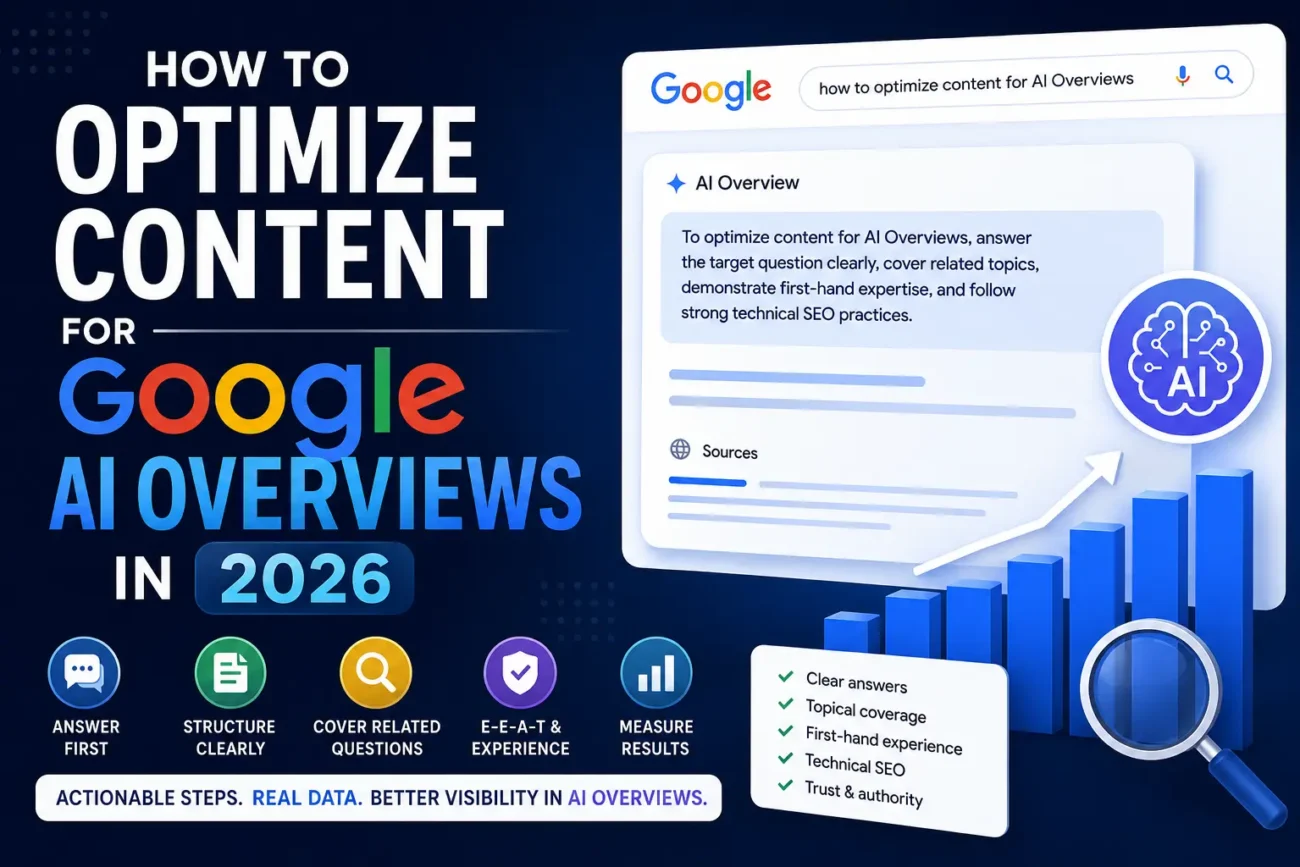
Google AI Overviews have changed what it means to create content that gets noticed in search.
Ranking well still matters, but getting a traditional blue-link ranking is no longer the only visibility opportunity. Your content may also be selected as a supporting source inside an AI-generated answer.
That creates a different optimization question. Instead of asking only:
“How do I rank this page?”
you also need to ask:
“If Google needs a source to answer this question, is my page useful, clear, specific, and trustworthy enough to use?”
There is no special AI Overview markup or secret optimization switch. Google says its generative AI search features build on its existing Search ranking and quality systems, so strong SEO fundamentals still matter.
But there are practical things you can do to make your content easier to understand, evaluate, and use. This is the approach we’re testing on our own site, using actual Search Console data rather than a hypothetical SEO example. If you haven’t already, start with How to Show Up in AI Overviews for the fundamentals, this article picks up where that one leaves off.
TL;DR
- Answer the primary question early instead of making readers search through an introduction.
- Structure content so both people and search systems can understand the main points quickly.
- Cover closely related questions instead of answering only the exact wording of the headline.
- Add first-hand evidence, original examples, screenshots, data, and observations wherever possible.
- Keep technical SEO fundamentals clean so important content can be crawled, rendered, indexed, and understood.
- Use structured data when it accurately describes your content and supports an eligible Search feature, but don’t treat schema as a shortcut into AI Overviews.
- Build an internal-link cluster around important topics instead of publishing isolated articles.
- Measure what changes after an optimization instead of assuming the change worked.
What Google AI Overviews Mean for Content Optimization
AI Overviews can synthesize information from multiple sources to provide an answer directly in Google Search.
That means the old idea of “rank number one and you’re done” is too simplistic. A page can rank well and still not be the source Google selects for a particular AI-generated answer. At the same time, appearing as a supporting source in an AI Overview doesn’t mean your page has replaced traditional organic rankings.
The practical goal is therefore broader:
Create content that is strong enough to rank, useful enough to satisfy the searcher, and clear enough for Google’s systems to understand the specific information it contains.
Google’s current guidance is important here. It does not recommend creating a separate type of “AI content” or adding special AI-only markup. Its guidance emphasizes continuing to follow established SEO fundamentals and creating unique, helpful content.
So instead of trying to “write for AI,” optimize for the underlying information need.
1. Answer the Question First
The first improvement is simple: answer the question before explaining everything around it.
If your page is targeting:
How do you optimize content for AI Overviews?
don’t make the reader go through five paragraphs before discovering the answer. Give them the answer first.
What doesn’t help:
“In today’s rapidly evolving search landscape, businesses are increasingly looking for new ways to adapt their content strategies…”
This creates context, but doesn’t answer anything.
A stronger opening:
“To optimize content for AI Overviews, answer the target question clearly, cover closely related questions, demonstrate first-hand expertise, and make sure the page follows solid technical SEO practices.”
The second version immediately establishes what the page is about. It also gives a reader a useful answer even if they never read the entire article.
A simple test: open one of your existing pages. Read only the first sentence. Then ask: “Does this sentence actually answer the question in my title?” If the answer is no, that’s probably the first thing to rewrite.
This doesn’t mean every article needs to become robotic. You can still use personality, stories, examples, opinions, and nuance. The point is simply: answer first, explain second.
2. Structure Content So It Is Easy to Understand
Good structure helps people navigate long content. It also gives search systems clearer signals about what each section covers.
Start with headings that describe the actual topic of the section.
Better: How Query Fan-Out Can Affect Content Coverage Weaker: The Hidden Force Reshaping Search
The second might sound more interesting, but it doesn’t tell the reader what they’re about to learn. For practical SEO content, clarity usually wins.
Use:
- H2s that clearly describe the section
- H3s for supporting concepts
- Numbered steps for processes
- Tables for comparisons
- Bullet points for lists
- Short paragraphs
- Descriptive examples
Try this test: copy only your H2s, H3s, and the first sentence underneath each heading. Paste them into a blank document. Now read them as if they were an outline. Does the page still make sense? If the structure is confusing without the surrounding paragraphs, the article probably needs restructuring.
3. Cover the Questions Around the Main Question
One of the biggest mistakes in AI-search content is answering only the exact question in the headline. People rarely have just one question, they have follow-up questions.
Google’s AI systems can break complex searches into related subtopics as they construct answers. That makes topical coverage increasingly important for complex informational queries.
For this topic, someone asking “How do I optimize content for AI Overviews?” might immediately wonder:
- Does traditional SEO still matter?
- How long does it take for changes to show?
- Does schema help?
- How do I know whether my page is being cited?
- What happens if my page ranks but isn’t appearing in AI Overviews?
- Should I optimize existing pages or create new ones?
- Does content freshness matter?
A useful article anticipates those questions. That doesn’t mean adding irrelevant sections just to make the article longer. It means answering the next logical questions a reader is likely to have.
A practical audit: when reviewing an existing article, ask:
- Does it answer the main question?
- What would the reader ask immediately afterward?
- Does the article answer those questions?
- Are those answers supported by evidence or examples?
That’s a better approach than simply trying to increase word count.
4. Give the Reader a Useful Summary
A short summary near the beginning can make a long article much easier to navigate.
In short:
- Answer the primary question immediately.
- Organize the article around clear search intents.
- Support important claims with evidence.
- Include original examples and first-hand observations.
- Keep the technical foundation clean.
- Link the page to other relevant content.
- Measure what changes after optimization.
This isn’t a magic AI Overview tactic. It’s simply good information design, and that’s an important distinction. You shouldn’t add a TL;DR because you’ve been told Google automatically rewards TL;DR sections. Add it because people benefit from getting the answer quickly.
5. Show Your Work and Turn It Into an Experiment
This is where most AI SEO content becomes interchangeable. Everyone can write “create high-quality content,” “use structured data,” or “build topical authority.” The harder thing is showing what happened when you actually did something.
That’s what makes first-hand content valuable. Use real Search Console data, screenshots, real examples, original experiments, before-and-after comparisons, actual implementation details, failures and lessons, and observations from your own website.
For example, we have actual data from this website. Our page How to Show Up in AI Overviews has generated approximately 570 impressions while showing an average position of approximately 85.2.
That tells us something useful: there is search demand around the topic, but the page isn’t currently performing strongly in traditional organic rankings. Instead of pretending we already know the solution, we’re using the page as an experiment.
Before: Page: How to Show Up in AI Overviews Impressions: 570 Average position: 85.2
Changes we’re making:
- Improve the opening answer.
- Restructure headings around search intent.
- Add related questions.
- Add more first-hand examples.
- Improve internal linking.
- Remove weak or repetitive explanations.
- Review technical SEO.
- Monitor the page after Google processes the changes.
After (to be filled in once we have it): We’ll record impressions, clicks, CTR, average position, query changes, pages receiving impressions, and AI Overview visibility where we can reliably observe it.
We won’t publish the “after” result until we actually have one. A plan is not a case study. A hypothesis is not a result. If the page improves, we’ll document it. If it doesn’t, we’ll document that too, since a failed experiment can still produce useful SEO knowledge.
6. Don’t Treat Structured Data as an AI Overview Shortcut
This is where a lot of AI SEO advice gets misleading.
Structured data is useful because it helps Google understand the content and can make pages eligible for specific Search features. But Google does not require special structured data for AI Overviews or AI Mode. Its current guidance specifically says you don’t need to add special schema.org markup to appear in generative AI features.
So don’t publish advice like “add FAQ schema and Google will understand your content better for AI Overviews.” That’s too strong.
Instead: use structured data when it accurately represents the visible content on the page and supports an applicable Search feature. Article, Organization, Breadcrumb, Product, or other relevant structured data may make sense depending on the page, but schema should support your SEO strategy. It should not become the strategy.
Note on FAQ schema: some sources report that Google removed the FAQ rich result feature from Search in mid-2026. We have not independently verified this against Google’s current documentation, and you should confirm it yourself before treating it as fact in your own published version. Either way, don’t present FAQ schema as a direct AI Overview ranking tactic. You can still keep an FAQ section because it’s genuinely useful for readers and naturally covers related questions, regardless of what happens with any specific rich-result feature.
7. Keep the Technical SEO Foundation Clean
Content optimization doesn’t replace technical SEO. A page still needs to be accessible to search engines.
Check the basics:
- One clear H1
- Logical heading hierarchy
- Crawlable URLs
- Indexable content
- Canonicalization where appropriate
- Internal links
- Descriptive title and meta description
- Mobile-friendly experience
- Good page performance
- Important content available in the rendered page
- No accidental noindex or restrictive robots directives
- Images with useful context and appropriate alt text
One correction worth making to older AI SEO advice: JavaScript itself isn’t automatically a problem for Google. Google has been rendering JavaScript for years. The real issue is whether important content is ultimately available to Google’s systems in a way they can process reliably.
So don’t tell people “never put content behind JavaScript.” The better advice is: make sure important content is accessible and renderable to search engines, and verify how your implementation actually behaves.
8. Build an Internal-Link Cluster
Don’t let an important article exist by itself. This article is part of a larger AI SEO topic cluster. Relevant supporting pages include:
- How to Show Up in AI Overviews
- What Is AI SEO?
- Generative Engine Optimization
- AI SEO Agents
- AI SEO Services
Link between these pages naturally. How to Show Up in AI Overviews can explain the fundamentals and link here for the deeper optimization process. This article can then link back to the fundamentals and forward to more advanced topics, with the commercial page, AI SEO Services, sitting at the end of the journey.
The goal isn’t to stuff links everywhere. The goal is to make your website’s topical relationships obvious to both users and search engines.
9. Make Your Content Different From the 100 Other AI SEO Articles
Search for “how to optimize content for AI Overviews” and you’ll find plenty of articles saying similar things: answer questions, use headings, add schema, write high-quality content, build authority. None of those ideas are inherently wrong. The problem is that they’re becoming interchangeable.
The opportunity is to add something the average article doesn’t have.
Original data: instead of “AI search is changing SEO,” show your own Search Console numbers.
Original examples: instead of “improve your content structure,” show the old structure and the new structure.
Original experiments: instead of “internal links can help,” show what happened after changing the internal-link structure.
Original observations: instead of “AI Overviews use multiple sources,” document the queries you tested and what you observed.
That’s how you move from AI SEO commentary to AI SEO research.
10. Update the Article as the Search Results Change
AI search is changing quickly. A tactic that appears useful today may become irrelevant later. That means this shouldn’t be a publish-once-and-forget article.
Keep a simple change log:
August 2026: Initial publication and baseline data recorded. September 2026: Updated after monitoring the optimized page. October 2026: Added new observations from AI Overview testing.
This creates another advantage: the article becomes a record of what you’ve actually learned, which is much more valuable than repeatedly rewriting generic definitions.
What Actually Matters Most?
If this entire article had to reduce to one principle, it would be this:
Don’t optimize your content for an imaginary AI algorithm. Optimize it so the answer is easier to understand, verify, extract, and trust.
That means clear answer, useful depth, first-hand evidence, strong technical foundation, and topical context.
There is no guaranteed formula for getting cited in an AI Overview, and anyone promising one should make you suspicious. Google’s own guidance says there are no additional requirements or special optimizations required specifically for AI Overviews and AI Mode beyond following established Search fundamentals.
FAQ
Does ranking #1 guarantee an AI Overview citation?
No. Traditional organic ranking and appearance as a source in an AI Overview are related, but they are not identical outcomes. A page needs to be useful and relevant to the query, and Google’s generative AI systems determine which information to include in the generated response. Don’t treat position #1 as a guarantee of citation.
How long does it take to see results after optimizing a page?
There is no guaranteed timeline. After making substantial changes, Google needs to crawl, process, and potentially re-evaluate the page. You can use Google Search Console’s URL Inspection tool to request indexing, but a request does not guarantee immediate crawling, indexing, or ranking changes. The best approach is to establish a baseline and monitor the page over time.
Do I need schema markup to appear in AI Overviews?
No. Google’s current guidance says special structured data is not required for AI Overviews or AI Mode. Use structured data when it accurately represents your content and is relevant to supported Search features. Don’t add markup simply because someone claims it’s an AI Overview ranking trick.
Should I rewrite my entire website for AI search?
No. Start with pages that already have evidence of search demand. A page receiving impressions but ranking poorly can be a useful optimization candidate because Google is already showing some level of interest in the URL. That’s often a better starting point than publishing dozens of completely new articles without validating demand.
What if I optimize a page and it still doesn’t appear in AI Overviews?
That’s possible. There is no guaranteed checklist that forces Google to cite a particular page. If your page isn’t performing, investigate whether the content is actually better than competing results, whether it answers the searcher’s intent, whether it’s sufficiently specific, whether it provides original information, whether the site demonstrates relevant authority, whether the page is technically accessible and indexable, and whether stronger sources cover the same question. Content improvements can address some of these problems. They cannot guarantee a particular search outcome.
Is traditional SEO still important for AI Overviews?
Yes. Google’s current documentation explicitly says its generative AI features are built on its existing Search ranking and quality systems. Technical SEO, crawlability, indexing, useful content, relevance, authority, and other established SEO principles still matter. AI search isn’t the end of SEO, it’s another interface through which searchers can discover information.
Final Takeaway
Optimizing for AI Overviews isn’t about discovering a secret formula. It’s about making your content genuinely useful and making the important information easy to understand.
Start with the question. Answer it directly. Cover the logical follow-up questions. Show your work. Use original evidence. Keep the technical foundation clean. Connect the article to a broader topic cluster. Then measure what happens.
That’s the approach we’re taking on this site. Our own How to Show Up in AI Overviews page currently has real search demand but weak average rankings. Rather than claiming a particular optimization will definitely work, we’re using the page as a live experiment and documenting the results.
We’ll update this article when we have the next set of data. That’s the difference between writing about AI SEO and actually testing it.
